Vincent Mosemann
NomadlandVincent Mosemann’s journey into vehicle dwelling begins not as a carefree escape but as a practical answer to debt, limited wages, and a blocked path to independence. He turns his mother’s minivan into a home and heads toward the desert to learn to stand on his own. There, mentorship from Charlene Swankie and the fellowship of other nomads make independence less a solitary ideal than a set of skills and relationships built through daily life.
Background and the Decision to Leave
Until two months before the narrator met him, Vincent had been living with his mother in Billings, Montana. At twenty-seven, he wanted to live on his own, but renting an apartment did not seem financially realistic. An unfinished degree had left him with more than $25,000 in student loans. During college, he had worked two jobs—as a lab monitor and a barista—and at times stretched one foot-long Subway sandwich across two days when money ran short.
His education ended amid a family and financial setback. Three years into his studies, his parents divorced. When he tried to reapply for financial aid, the application required a signature from his father, who could not be found. Vincent dropped out. Back at home, he took a low-paying job at a group home for autistic adults. The combination of debt, interrupted study, and inadequate earnings narrowed his choices: independent living remained his aim, but a conventional apartment was beyond reach.
Tillie and the Road Toward Independence
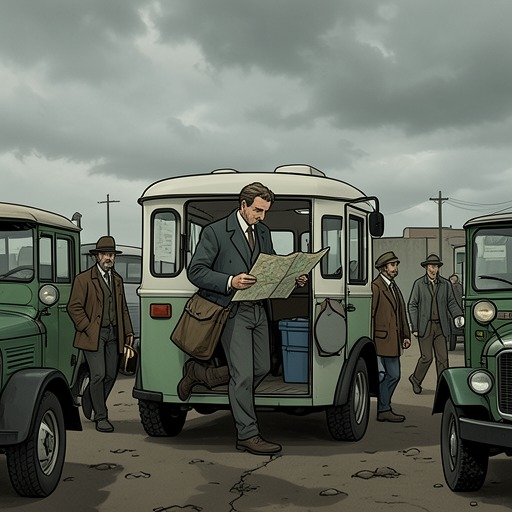
Vincent’s answer was to buy his mother’s 1995 Plymouth Grand Voyager LE and remake it for living. He gutted the interior, then installed linoleum flooring, curtains, shelves, and a sleeping bunk. The conversion was modest but purposeful: a family minivan became both shelter and transportation, allowing him to leave home without taking on rent he could not afford.
He named the van Tillie, after the train in The Little Engine That Could whose refrain is “I think I can, I think I can.” The name gave his new home an expression of resolve without disguising the material difficulty behind it. Vincent described his reason for setting out as learning to stand on his own two feet. His was not simply a journey away from his mother’s house; it was an attempt to build the capacity for independence under conditions that had already interrupted his education and left him carrying substantial debt.
Vincent was bound for Quartzsite, where he planned to meet Charlene Swankie. The two had become acquainted through a Facebook group for nomads, and she had invited him to camp near her, but not with her, at the La Posa Long Term Visitor Area south of Quartzsite. That distinction mattered: her invitation offered a beginning in an unfamiliar setting while preserving the solitude she valued. Vincent arrived on the day before Halloween and parked across an arroyo from her camp.
Learning the Practicalities of Camp Life
Charlene Swankie had already taken Vincent on as a protégé for the season, and her guidance was concrete. She gave him a spare tent for storing food and supplies, and he helped her install a cabinet in her cargo trailer to serve as a pantry. She coached him in setting up a solar panel. When Vincent fixed the panel to Tillie’s roof, he used drilled-out pennies instead of washers, choosing a cheaper substitute suited to his limited means. These exchanges show learning as reciprocal work: he received instruction and equipment, but also contributed labor at her camp.
A rented post office box became another essential piece of that support. Swankie let Vincent use hers, a gesture that carried practical importance because he was a trans man receiving testosterone therapy. His treatment required an injection in the thigh every two weeks, and refills arrived by post. Reliable mail access therefore connected his life on the road to continuing medical care. The box also carried a Christmas package from his mother: homemade snickerdoodles and a tiny red-brick fireplace made from a Saltines box, topped by a dollhouse-sized fir tree. The handmade miniature and the medication arrived through the same channel, joining family affection and an ongoing healthcare need in the material arrangements of nomadic life.
Poverty, Appearance, and Self-Presentation
Vincent’s circumstances also surfaced in the gap in his upper-right teeth. He told the narrator that removing the tooth had cost $250, while a crown would have cost $1,000. The book places the detail within a wider experience among the nomads it describes: some were ashamed of missing teeth, avoided smiling for the camera, or asked that photographs not show empty sockets. Against that background, Vincent’s response was strikingly unashamed. He joked that the gap could hold a straw and made clear that anyone who objected was not someone he wanted to spend time with.
That ease did not erase the economic conditions behind the missing tooth. Rather, his humor refused to let a visible sign of limited resources dictate his social worth. The book notes that more than one in three citizens lacked dental coverage, which was not included in standard medical insurance; Vincent’s choice between a $250 extraction and a $1,000 crown gives that broad lack of coverage an individual scale. His smile becomes a small but memorable assertion of self-definition amid the financial constraints shaping his life.
Work, Generosity, and an Emerging Community
Vincent’s independence developed through work as well as instruction. Around the time of Alex’s tenth birthday, he found a part-time job at Dollar General paying $9 an hour. He also sewed aprons and reusable grocery bags on a machine he had converted to run by treadle rather than electricity. The adaptation let him produce goods without relying on an electric supply, while his sewing offered a second, self-directed source of income.
For Alex’s birthday, Swankie organized an ice-cream party. Vincent gave the boy one of his aprons and a copy of The Lord of the Rings; Alex was ecstatic. The narrator observes that Vincent suddenly seemed less like a kid. The shift is not presented as a single declaration of adulthood, but as a consequence of seeing him act with care: he was earning money, making useful things, and choosing a gift that delighted someone else.
The gathering’s idea of family extended beyond the birthday. Kat later thanked the group for thoughtful gifts and laughter from people she had met only a couple of months earlier, calling that community what family looks like. Swankie had expressed a similar welcome, saying that someone who stayed in her camp for more than twelve hours became family. Vincent’s story gives this claim a practical foundation in the equipment, knowledge, mail access, work, and companionship exchanged around camp. He also joined a group excursion to nearby petroglyphs; when one member’s vehicle became stuck in a ditch, Swankie used her own van and a nylon-webbing strap to pull it free. The episode places Vincent among people whose mutual support extended beyond talk, even as his own central movement remained the effort to become self-reliant.
Vehicle dwellers in the book reject the label homeless in favor of houseless, emphasizing that they possess both shelter and transportation even when they lack conventional housing. Vincent’s account is distinctive because that broad distinction is grounded in specific dependencies and adaptations: an affordable van, improvised hardware, a post office box for prescriptions, hourly work, and help from a camp community. His movement toward independence does not mean that he needs no one. Instead, the narrative shows him learning how to make a life on the road while both contributing to and relying on relationships that make that life possible.