Sameer Ali
NomadlandSameer Ali is a sixty-five-year-old Muslim nomad who lost his halal goat farm as western drought drove hay prices upward and took to van life with his Chihuahua, Mr. Pico. His story brings together the material pressures behind nomadic living, the practical ways he carries his faith on the road, and the struggle to claim an identity beyond the stigma of homelessness. He is also a source of solidarity: having known the anxiety of an almost-empty fuel tank and dwindling supplies, he reaches out to another traveler in financial distress as a brother, not as a distant observer.
Identity and Life on the Road
Sameer’s former livelihood was a halal goat farm, but rising hay prices amid drought deprived him of it. By the time the author encounters him among the nomads, he is living in a van with Mr. Pico. That change places him among people whose mobile lives can look like an adventure from outside while being shaped by economic losses and limited choices. Sameer’s experience gives him firsthand knowledge of the gap between the appealing language of an unconventional lifestyle and the scarcity that may lie behind it.
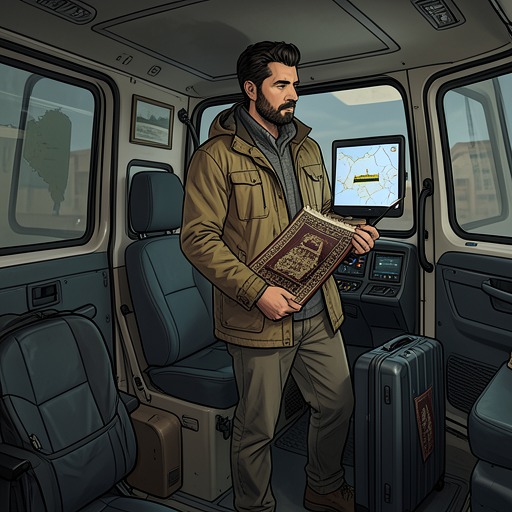
His faith travels with him in an especially concrete form. An iPhone app issues the calls to prayer five times a day and displays a compass pointing toward Mecca. Sameer uses the compass when parking, orienting his van in the proper direction for worship. The van is at once his home and a vehicle he arranges around religious practice: mobility does not require him to leave that practice behind, but makes its daily observance part of the decisions involved in finding a place to stop.
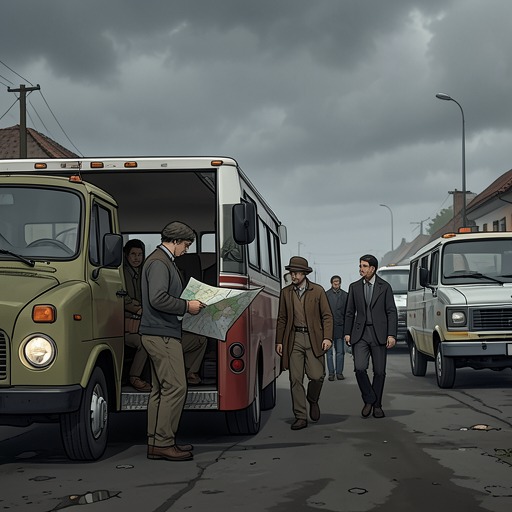
In the Prescott National Forest near Cottonwood, the author finds Sameer among a dispersed group of vandwellers who had moved away from the heat at Ehrenberg. Some camped on an open hillside; others settled in a wooded patch sheltered from the wind. Sameer’s van and his portable prayer routine belong to this larger landscape of improvised homes and shared encampments. When a ranger asked whether the group was a club, Sameer answered, “I guess we are!” The light reply captured a community assembled through travel and mutual recognition rather than a formal organization.
Poverty, Family, and Self-Definition
Sameer’s understanding of nomadic life is neither romantic nor naïve. In an online exchange with LaVonne Ellis, who had confessed that payday loans were keeping her afloat, he described a difficult stretch he had endured with Mr. Pico in a forest near Dolores, Colorado. Eight days before payday, the van’s fuel gauge was nearly empty; they had five days’ worth of food and two days’ worth of water. The details make poverty legible as a chain of immediate calculations—fuel, food, water, and the days remaining before money arrives—not simply as an abstract condition.
Sameer acknowledged to LaVonne that this life could be presented as exciting and innovative, but that many people were living it because of their financial circumstances. He urged her to leave California and the streets of San Diego, where she was treated as homeless, and come to the desert or forest, where she could camp among people who cared for her. His advice drew a distinction between the legal and social stigma attached to homelessness and the sense of belonging available within a nomadic community. It did not deny poverty; it offered a different setting in which to endure it.
The distinction was personal for Sameer. He told the author that, at first, he had worried about being perceived as someone living in a van and did not want to be defined as homeless. During a visit to his sister for Ramadan, she threw him out, judging him a “homeless bum” who would set a bad example for her nieces and nephews. The episode shows the label entering an intimate family relationship: his sister’s judgment did not remain an outside stereotype but became a reason for rejecting him from her home. Sameer said he had expected his family to be kinder.
In explaining what the label meant to him, Sameer emphasized that the words people use to define themselves matter. He drew on Paul Bowles’s distinction between tourists and travelers and identified himself as a traveler. That self-description does not erase the farm he lost, his exposure to scarcity, or the rejection he experienced. Rather, it refuses to let those circumstances become the sole account of who he is. He also recognized the difference between his own effort to claim a mobile identity and the legal category that society might apply to him.
Solidarity and Mutual Aid
Sameer’s response to LaVonne’s confession turns shared hardship into practical and emotional support. He addressed her as his sister, said he wished he could give her a hug, and assured her that she was not alone. His account of being stranded with too little fuel, food, and water gave that reassurance weight: he was not offering a general slogan but speaking from a situation with recognizable material stakes. The details of their exchange preserve both sides of the support—LaVonne’s shame over debt and Sameer’s willingness to meet it with identification rather than judgment.
The community’s care also appears in ordinary acts beyond this exchange. After Kat and Mike Valentino ran out of gas while trying to keep warm in the cold, Vincent Mosemann drove them to town to fill a fuel jug. The return trip brought food-bank supplies, including apples, sausages, and a large bag of spring-mix salad. The episode situates Sameer within a network where practical assistance and shared resources matter, even when the account does not assign him a role in obtaining that food. At another gathering, he joined the group traveling in vans to see petroglyphs; when one member became stuck in a ditch, Charlene Swankie hauled the vehicle free with her van and a nylon strap. Such episodes help explain the appeal of the community Sameer recommended to LaVonne: belonging meant more than adopting a name for the lifestyle; it included people who showed up with help.
Sameer’s own message to LaVonne was careful about the forces that make such a community necessary. He recognized that people might choose how to describe their lives while having far fewer choices about the financial conditions that shaped them. His counsel to find a place where she could camp among people who cared was therefore both a practical suggestion and an affirmation that hardship need not be endured in isolation.
Narrative Significance
Sameer’s story complicates any simple division between adventurous nomads and people experiencing homelessness. His lost farm, near-empty fuel tank, limited food and water, and family rejection make economic vulnerability unmistakable. At the same time, he acts as a friend who can offer another struggling traveler a place within a community, and he asserts a self-understanding shaped by travel rather than by a stigmatizing label. The contrast is not resolved by pretending that poverty is voluntary; it is sustained in the tension between constrained circumstances and the importance of naming oneself.
His use of a compass app for prayer gives that tension an everyday, material form. The same van that signals his uncertain housing also becomes a space he deliberately orients toward religious observance. Likewise, his message to LaVonne turns an experience of isolation into an offer of kinship. Through Sameer, the book shows nomadic identity not as a single condition but as a life made from economic loss, religious practice, fragile self-definition, and mutual care.