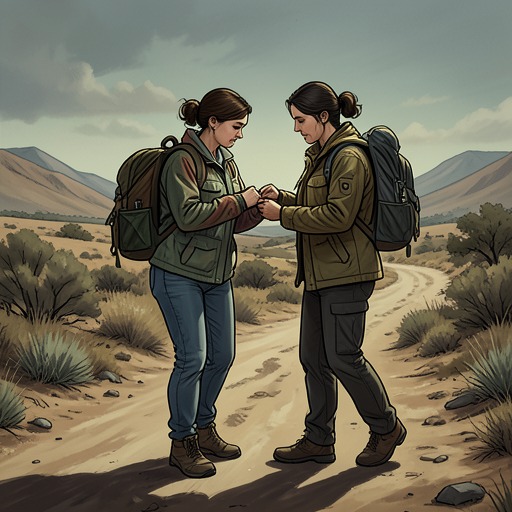
Mike Valentino
NomadlandMike Valentino is one of the family travelers the book encounters at Quartzsite: a forty-seven-year-old husband and father whose move into a van follows the loss of stability in Washington. He and Kat Valentino set out with their son Alex after Kat’s health crisis and Mike’s expiring job contract made their prospects uncertain. Their blue 1991 Ford Econoline, named Katvandu, offers a way out of an untenable motel situation, but life on the road brings its own exposure to cold, fuel shortages, and dependence on other people. Mike’s story is not one of effortless freedom; it shows a family trying to make mobility workable under financial pressure, and finding support in a camp of recent acquaintances.
Background and the Move to the Road
Before the family left Washington, Kat, an Army veteran, was working as a manager at Albertson’s. She was taken from work by ambulance and diagnosed with multiple sclerosis. Her attempt to obtain disability benefits would take three years, leaving a long stretch in which the family could not rely on that support. Mike, meanwhile, earned $9.40 an hour at a frozen vegetable processing plant, but his contract was close to ending. The pair feared what would come next.
Their alternative was not presented as a romantic escape from settled life. The Valentinos spent time in short-stay motels where the surrounding conditions made them feel that the family could not remain. They bought Katvandu and left a couple of weeks before Vincent Mosemann began his own journey. The van, rather than resolving the family’s economic uncertainty, gave them a different way to live through it: shelter and transportation combined in a small space, with the road taking the place of a fixed home.
Family Life in Katvandu
Mike shares the van with Kat and Alex, who is nine when the family sets out, as well as their pet ferret, Ronnie. The household’s crowded, mobile life is also the setting for Alex’s education. Kat explains that he is being roadschooled, the traveling counterpart to homeschooling. Alex is described as bright and inquisitive, with a keen sense of humor; he has also faced social difficulties related to Asperger’s and bullying at public school. On the road, he tells people he wants to found a democratic nation whose capital will be called Vandweller City.
That imagined capital gives the family’s relocation a child’s playful scale, but it sits beside the more immediate facts of their situation: an uncertain income, a parent waiting for disability support, and a van that must serve as home. Mike’s experience is therefore inseparable from Kat’s and Alex’s. His place in the narrative is not that of an isolated traveler pursuing individual independence, but of a parent making a precarious mobile household function.
Winter Hardship and Mutual Aid
At Quartzsite, the family faces a particularly difficult night when the temperature falls into the twenties. Kat and Mike run out of gas while idling Katvandu to keep warm. The van’s fuel gauge is broken, so they cannot tell how quickly the tank is emptying. Nearby, Charlene Swankie and Vincent Mosemann are using the same improvised approach to heating their vehicles; the narrator also idles Halen and sleeps in short intervals. The repeated starting and stopping of the vans gives the encampment a shared, practical rhythm, but it cannot remove the danger of running short of fuel in the cold.
The next morning Vincent drives the Valentinos into town so they can fill a fuel jug. They return not only with fuel but with food from the Quartzsite food bank: apples, sausages, and a large bag of spring-mix salad. The trip turns an immediate problem into an occasion for assistance. The family’s capacity to stay on the road depends not only on its own vehicle and limited resources, but also on nearby travelers willing to help when a plan fails.
A Camp That Becomes a Community
The Valentinos’ connections deepen through ordinary acts of welcome. Two days after Christmas, Alex turns ten, and Charlene Swankie gives him an ice-cream party. Around this period Vincent, who has found part-time work at Dollar General, gives Alex a handmade apron and a copy of The Lord of the Rings. The presents are directed to the child, but they also mark the way other campers have made room for the family in their lives. Kat later writes to thank the group for its thoughtful gifts and laughter, describing the people she had met only months earlier as a family.
That sense of belonging is reinforced by Swankie’s generous treatment of newcomers. She takes the group in vans to see petroglyphs carved into a nearby rock face; when one member of the party gets stuck in a ditch, she pulls the vehicle free with her own van and a strap of nylon webbing. These episodes place Mike and his family within a network built through shared travel and practical help, rather than through long-established ties. The book also shows the limits and conditions of such mobility: public-land camping near Quartzsite is time-limited, and campers must move to another area or pay to stay in the long-term visitor area. The camp’s welcome is real, but it exists within rules and material constraints.
Significance and the Account’s Ending
Mike’s scenes connect the appeal of nomadic life to its costs. Kat had already wondered whether people turning to full-time travel because of financial hardship represented a new kind of freedom or a transformation of the former middle class. The family’s experience makes that tension concrete: leaving the motels opens a different life, but a cold night, an unreliable gauge, and a nearly depleted tank can make basic security uncertain. Mobility is a choice the Valentinos make under pressure, and it requires fuel, shelter, money, and community to remain possible.
The account does not supply a later resolution for Mike. Its final emphasis is instead on the family’s immediate inclusion in the Quartzsite camp: Vincent helps them obtain fuel and food, Swankie celebrates Alex’s birthday, and Kat recognizes the group as a family. Mike’s place in the narrative rests in that contrast between fragility and fellowship. Katvandu is a vulnerable home, but the people gathered around it help the Valentinos endure the conditions that make life on the road precarious.