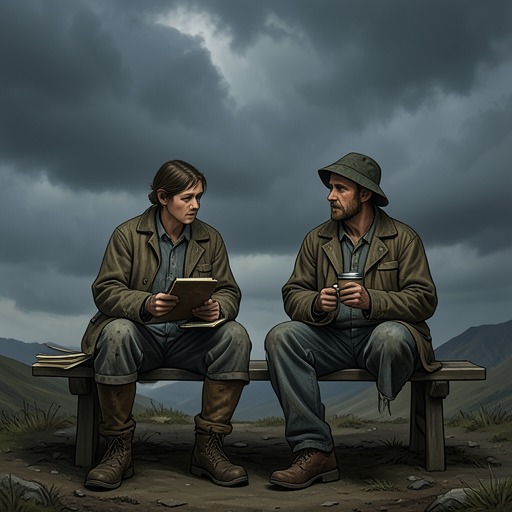
Jen
NomadlandJen’s shift from school-library work to life on the road grows out of a close look at what conventional promises of education and employment could actually deliver. With Ash, she turned that skepticism into a concrete plan: travel, work seasonally, and make a home in a vehicle. Their first cramped car, a later van called the Manatee, and the long route between hiking and warehouse shifts show the effort as well as the possibility involved in choosing that life.
Background and Work
Jen grew up watching her parents work at King Soopers, where her father disliked his job. They urged their children to seek better prospects through college. Jen began working at the grocery store herself in high school, as a bagger and courtesy clerk earning about six dollars an hour. She later earned an associate’s degree on scholarship, but did not see a clear reason to continue her education. Friends with bachelor’s and graduate degrees were struggling to find work, and the prospect of taking on debt for schooling without a reliable payoff frightened her, even though she loved learning.
Her early jobs included work at a craft shop and used bookstores. She eventually became a school-library assistant, a role she found genuinely engaging: she communicated with librarians and helped them use their computers and software. The job brought her into the work of a software administrator for the largest district in Colorado Springs. Jen watched her highly educated boss get pushed toward retirement while Jen took over work at the same level for less pay. She felt guilty about benefiting from her boss’s displacement, whom she regarded as an exceptional person, and doubted that more schooling would lead to a secure career. As the position was reclassified downward, the prospect seemed to be a workforce offering fewer advanced roles, whatever a worker’s qualifications.
Choosing a Mobile Life
Before becoming a nomad, Jen shared a rented house in Colorado Springs with Ash. Both experienced periods of depression and grew increasingly dissatisfied with their job prospects. Jen searched online for alternatives, reading about minimalism and tiny houses before finding CheapRVLiving.com. She gradually came to see vehicle living as a possible way out. Ash was initially uneasy with the idea, associating it with the comic image of a person living in a van by the river, but eventually embraced Jen’s plan.
They intended to alternate work and adventure while living in a Subaru Impreza hatchback handed down by Jen’s mother. The car was a difficult first home: even with the rear seats folded, there was not enough room to lie down unless belongings were packed into the rear footwells to make a headrest. Jen made window coverings from black wool felt, fastening the panels with Velcro for privacy. To reduce what they owned, the pair posted a Craigslist curb alert offering their unwanted possessions for free. The notice invited people to come at nine in the morning; by 8:30, everything on the lawn had been taken, including the trash. The swift emptying of the lawn made downsizing tangible: the transition depended not only on choosing what to keep but on letting the rest go.
Their first major adventure was a fifty-two-day, nonstop hike of the Colorado Trail, more than 480 miles from Denver to Durango. Afterward they headed for seasonal work at the Amazon warehouse in Fernley, initially expecting to live out of the Subaru. Jen later judged that arrangement unworkable, saying they would have quit. They found a van instead, though buying it left them nearly broke. The sequence established the practical rhythm of their plan: travel first, then take temporary work to finance the next stretch of life.
Work on the Road
At Sage Valley RV Park, Jen and Ash tried to save fuel by biking to the warehouse for their first full-length shift. A slow leak in one of Jen’s tires forced them to stop every fifteen minutes to pump it up. The journey took three hours, but they still arrived in time for a ten-hour shift. When work ended at five in the morning, they found the dark and cold biting enough to make their teeth chatter. They stopped at Walmart for extra layers, then biked beside rush-hour traffic into a blinding sunrise. Jen remembered that they became known as the women who rode their bikes to work. The anecdote captures both their resourcefulness and the physical cost of making a low-budget plan function.
After that ride, they changed their routine, staying near the warehouse during the week to save on gas and returning to Sage Valley RV Park on their days off. They parked the Manatee at Walmart or a gas station while near work. The van was not simply a symbol of freedom: it was also their means of getting through the workweek, finding somewhere to park, and managing limited money. Their seasonal employment and vehicle dwelling were intertwined, each making the other possible while imposing its own constraints.
Relationships and Wider Journey
Jen’s choices unfolded alongside Ash’s, whose concerns about debt and employment differed in detail but contributed to their shared decision to leave conventional housing. Their partnership took shape through successive practical tests: adapting the Subaru, giving away possessions, hiking for nearly two months, finding a larger vehicle, and reporting for warehouse work despite an exhausting bicycle commute. The evidence presents them as collaborators who revised their plans when the original arrangement proved unsustainable.
After finishing at Amazon, Jen and Ash visited family in Colorado, hiked the Grand Canyon’s southern rim, and toured Earthships in New Mexico. In mid-January they reached the Rubber Tramp Rendezvous and found Linda, parking the Manatee directly behind Linda’s RV. Linda had already made many new friends for them to meet. Jen’s arrival places the couple within a wider nomadic network, but their own path remains distinctive: the road was not a rejection of work so much as an attempt to combine paid work with adventure on terms that felt more livable than the jobs and housing they had left behind.