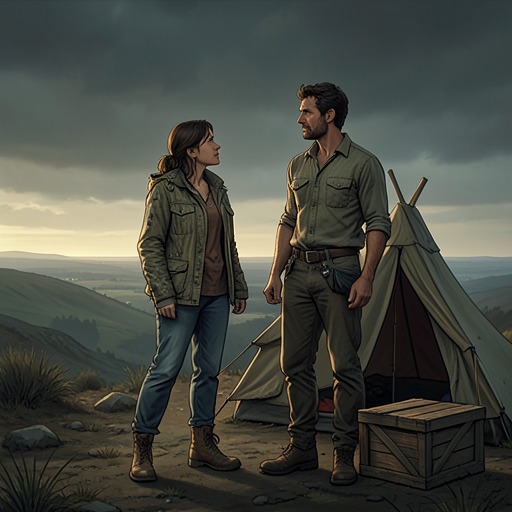
Gary Fallon
NomadlandGary Fallon enters the story as a companion in motion: a fellow camp host, a friend from the Rubber Tramp Rendezvous, and a prospective helper in Linda May’s effort to build a home of her own. His connection with Linda gathers force through shared work and travel, but remains deliberately unsettled as a romance. A minor stroke delays their first planned visit to her land; later, he appears beside her during the writer’s remote exploration of it and agrees to return for the next stage of the project. His part in the narrative is less a completed transformation than a glimpse of how friendship, work, illness, and hope intersect in a life without a fixed home.
Work, Mobility, and Character
Gary was Linda’s fellow camp host and had become a close friend. The two were preparing to work at Amazon, with plans to report to a warehouse in Campbellsville, Kentucky. Their employment plans belonged to the seasonal pattern of nomadic life: camp hosting, travel, and another temporary job followed one another, while Linda’s longer-term ambition was to establish a home on her own land. Gary’s presence connected that immediate need for work to the more uncertain possibility of building something that would last.
Linda described him as someone whose working life, like hers, had crossed many occupations. He had run a radiology department, managed a grocery store, and worked in construction. She also praised his intelligence, memory, handwriting, and ability to do complicated arithmetic in his head. These details come through Linda rather than through an independent account of Gary’s past; in the story, they explain why she can imagine him as a useful and trusted companion in a project involving planning and construction. They do not establish that he had committed to making the land his own or permanently changing his way of life.
Friendship and Romantic Uncertainty
The relationship is close but not defined as a settled partnership. Gary seemed to be sweet on Linda, while she moved back and forth over whether she wanted a romantic relationship with him. Her uncertainty sits alongside the practical intimacy of their lives: they worked as camp-host partners, intended to travel to the same job, and discussed whether he might help build her Earthship. The narrative does not resolve that tension by turning their shared plans into proof of a romance.
Linda’s boundary around the property is especially clear. Although she wondered whether Gary wanted to put down roots and recognized that he believed her plan was feasible, she intended to keep the desert land in her name alone. The distinction preserves the project as her dream, even as she welcomes help. Gary could be a companion and collaborator without becoming a co-owner; the arrangement leaves both the emotional relationship and his future role open.
Illness and the Deferred Journey
The writer had planned to travel with Linda and Gary to see the property near Douglas, Arizona. Just before the mid-July trip, however, Gary suffered a minor stroke. He and Linda took refuge with the Rubber Tramp Rendezvous community in Flagstaff while he recovered, and they postponed the visit. Linda also worried about the extreme heat in the area, the Jeep’s broken air conditioning, and an earlier-than-expected August 1 start date for their Amazon work in Kentucky. The interruption therefore came from both Gary’s health and the practical demands of travel and employment.
Linda and Gary set out on a slow cross-country drive, planning to avoid driving during the hottest part of the day. By the time the writer reached the property, they were already far along the route: they had driven about seventy miles from their previous stop in Tucumcari, New Mexico, and were spending the night in Springfield, Missouri. Linda reported that they had been covering roughly three hundred miles a day and that Gary was very fatigued. The journey put a physical limit on the plan to reach the land immediately, even as their Amazon job offered a route to earn money before returning to it.
Present at the Land, at a Distance
Unable to join the writer in Arizona, Linda followed a live video exploration of the five acres by phone. During the call, she recognized the road and asked whether the boundary markers were visible. Gary was nearby; when Linda called him over, he appeared over her shoulder, wearing black plastic-rimmed glasses and watching the screen with a furrowed brow. His brief observations about the cloudy conditions and the grass, including a dry suggestion that the land might require a riding mower, gave the remote visit a shared, domestic quality. He was not physically on the property, but he was included in the act of looking at it and imagining its demands.
That scene makes his position in Linda’s plan concrete without overstating it. The land was still unfamiliar to both of them, and the call could show only what the camera and connection allowed. Gary’s humor met Linda’s excitement, while the visible grass hinted at work ahead. Their participation in the visit did not settle whether he would relocate or help build the house, but it showed that he was part of the conversation through which Linda tested her dream against the actual terrain.
A Possible Role in the Building Project
Later, Linda said Gary had agreed to return to the land with her after the Rubber Tramp Rendezvous. LaVonne Ellis was also going, and the three planned to start by building a greenhouse for organic farming and shelter from the elements during construction of Linda’s home. Gary’s construction experience made his planned participation relevant, but the evidence describes an intention, not a completed greenhouse or a finished Earthship. The excavator date, land preparations, and other building steps belonged to Linda’s forward-looking plan.
Gary’s narrative significance lies in that distinction between companionship and certainty. He appears in the work-bound migration, the postponed visit, the video call, and the proposed return, but the story leaves his longer-term choice unresolved. The book’s acknowledgements later name him among the many nomads who shared their time, affirming his place in the community around the narrative without supplying a final account of his relationship with Linda or the land. His arc remains open: a friend who may help turn her imagined home into a practical undertaking, while the decision to claim that home remains hers.