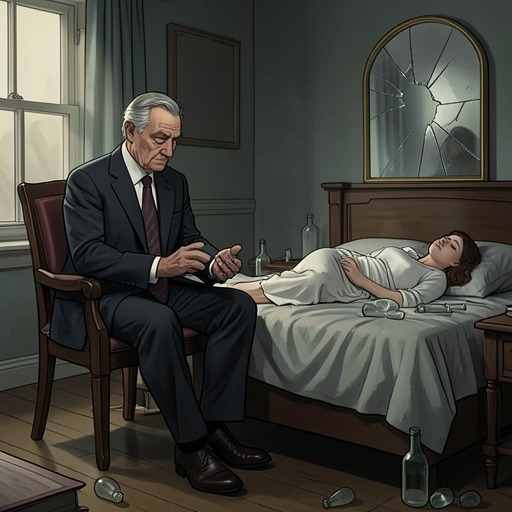
George’s Plan to End Lucille’s Life
SatanGeorges D’Anjou’s plan to end Lucille (Alzheimer’s patient)’s life grows out of her advancing Alzheimer’s disease and her repeated pleas for help, but never reaches a clear act of execution. The episode follows a husband from horror at the idea toward increasingly detailed consideration, then leaves that intention suspended: Lucille dies after wandering from the house, and the narrative does not say that Georges carried out his plan.
Background: Decline and a plea for release
Lucille’s cognitive difficulties first appeared as minor lapses and distractions, but became frequent enough to alarm Georges D’Anjou. He had already seen her experience short-lived absences after drinking; the newer episodes seemed different, arising during the day and growing persistent. The change became unmistakable when, after turning seventy-five, Lucille failed the driving assessment required to retain her licence. Losing the licence restricted her independence and made her condition public, and a medical diagnosis confirmed Alzheimer’s disease.
Her decline continued amid the combined effects of prescribed anxiolytics and alcohol, which Lucille continued to drink secretly. Ordinary movement beyond the house became difficult: even taking a taxi could be a challenge, while walking risked her becoming lost. People in the Haute-Ville began to notice and quietly discuss her condition. The illness thus altered not only Lucille’s memory and mobility but also her place in public life, as private confusion became visible to acquaintances and neighbors.
As confusion alternated with periods of lucidity, Lucille sometimes expressed despair and asked Georges D’Anjou to find a way for her to die. At first he rebuked her and resisted the request. Her pleas returned, however, and the repeated scenes gradually weakened his resistance. In one confrontation, Lucille tried to enter his office because she knew he kept a pistol there. Georges discovered her, became furious, and told her the weapon was locked away and its ammunition stored separately. She wept and appealed to him, and the pleading continued even after he refused.
Lucille also tried to enlist Isabelle D’Anjou, but Isabelle avoided the painful scenes and increasingly wanted to leave the house. Her withdrawal left Georges D’Anjou more directly exposed to Lucille’s distress. The story presents his changing response within this strained household, where affection, exhaustion, fear, and the burden of care coexist without resolving into an easy moral answer.
From temptation to a practical plan
Set in Québec in 2009–2010, Georges D’Anjou’s thinking develops by degrees. What begins as an intrusive, apparently unserious idea returns until he recognizes it as a project. The narration follows the shift from imagining that he might hasten an inevitable death to considering how such an act could be made effective while attracting as little suspicion as possible. His former identity as a senior judge sharpens the contrast between public authority and the secret deliberation occupying his private life.
He initially considers a natural method that would seem gradual. Drawing on an earlier interest in mycology, he recalls a highly toxic mushroom found near the family chalet at Pont-Rouge and consults his books again. The account gives his research a practical direction, but also makes its limits plain: what he hoped might appear discreet could instead cause severe distress, and the delay before death could extend the ordeal. When he considers what Lucille might endure, he hesitates. The prospect of inflicting prolonged suffering challenges the idea that he is acting to spare her pain.
The plan’s supposed rationale is mercy: Georges D’Anjou imagines hastening a death he sees as unavoidable, sparing Lucille and her family a longer period of suffering. He believes her disease to be incurable and reasons that her condition would make an investigation less likely. Yet these are his calculations, not assurances supplied by the narrative. His own deliberation exposes the gap between intention and consequence: a plan meant to look natural might create precisely the suffering and scrutiny he hopes to avoid.
Reconsideration and unresolved alternatives
After learning more about the mushroom’s effects, Georges D’Anjou turns away from that possibility. He cannot reconcile his wish to end Lucille’s ordeal with the prospect that the method itself could subject her to a prolonged crisis. He then considers a fatal combination involving alcohol and sleeping medication. But that alternative carries its own visible risks and could be interpreted as a suicide, or as evidence that those close to Lucille had failed to keep dangerous substances away from her. The account establishes neither that he obtained anything nor that he put any method into action.
During the autumn of 2010, Lucille’s condition becomes especially pitiful, and Georges D’Anjou spends days and weeks turning the dilemma over. He grows gloomy, taciturn, and withdrawn, worrying those around him. This change records a consequence of the plan even before any outcome: the secret deliberation isolates him, while it offers Lucille no described relief or resolution. His reflections move between the idea of compassion and the fear of becoming the cause of further suffering; neither side cancels the other.
Meanwhile, Lucille’s ability to distinguish reality from imagination weakens. Her thoughts and perceptions become increasingly confused, her grasp of words and memories loosens, and moments of clarity are brief. Georges D’Anjou still catches a trace of intelligence in her expression, but it quickly gives way to bewilderment. Her decline provides the immediate pressure behind his plan, while its worsening also makes the prospect of a deliberate decision more fraught: the person whose repeated requests prompted him is becoming less able to remain oriented in the world around her.
The plan’s non-fulfillment and narrative significance
A few days after Isabelle D’Anjou leaves for Cuba again, Lucille slips out of the house during the night. The alarm system has been left disarmed since her illness. Wearing little beyond her nightclothes and a sheet wrapped around her, she walks into the cold and wind. She is found at daybreak on the Plains of Abraham, where she has died from exposure. The narrative presents this as her wandering out of the house, not as the result of Georges D’Anjou’s contemplated poisoning or other proposed means; it never states that he carried out the plan.
The location gives Lucille’s death a historical resonance: Loïc later notes that she was found where Montcalm fell in 1759, and the narration connects the scene to an earlier image of a dead young woman with a baby wrapped in her arms. Those echoes enlarge the meaning of the ending, but do not change the account of what happened to Lucille. Her death arrives outside the course Georges had been trying to devise, leaving his deliberations without a confirmed resolution.
The episode’s force lies in that unresolved distinction between a wish to relieve suffering and an intention to cause death. Georges D’Anjou’s plans become specific enough to expose his growing willingness to act, yet every alternative he considers brings a consequence that unsettles him. Lucille’s own requests matter to the circumstances, but the narrative does not turn them into a simple answer to the ethical conflict. Instead, it sets her dependence and diminishing lucidity beside his fear, responsibility, and limits as a caregiver, then ends with a death neither shown as his chosen method nor described as a deliberate act by him.