Loïc and Laurence’s Car Crash and Near-Death Experience
SatanIn June 2003, a sudden collision on a cliff road in the Lot sends Loïc and Laurence plunging down a ravine. Laurence survives with fractures, but Loïc’s heart stops and he enters a coma. His return to life follows an extended passage through visions of radiant beings, familiar figures, and an idealized double mourning his own death. The accident turns a physical catastrophe into a decisive encounter with the possibility of realities beyond ordinary consciousness.
The collision and its immediate aftermath
The accident occurs on a road winding between an enormous rock face and a sheer cliff, so narrow that two cars can barely pass. Loïc fears meeting another vehicle on the tight turns. When a van suddenly appears around the rock wall, he swerves; within a fraction of a second, the Renault leaves the road. The car tips down the steep slope and comes to rest wedged between two trees, its wheels still spinning over the ravine.
The van’s young driver, horrified by the sight, calls emergency services, and a Peugeot following behind quickly turns back. Police, medical responders, and firefighters arrive. The rescue is precarious: the car must be cut open before the trees holding it in place give way. Laurence is bloodied, shocked, and delirious. Loïc is unconscious, barely breathing, and has a failing pulse; two rescuers perform cardiac massage while they work to free the pair.
The emergency continues on the journey to Cahors. Loïc’s heart stops, and the medical team identifies clinical death. With sirens sounding, the ambulance speeds along the departmental roads and then the highway, while the attendants continue cardiac massage. At the hospital in Cahors, Loïc is taken directly to intensive care. The accident has become a contest over whether his body can be brought back before the loss of life becomes final.
Visions during the coma
As the rescuers fight to sustain him, Loïc’s consciousness passes through a formless state he cannot clearly distinguish as life before life, life after death, or something outside either. He feels himself suspended in an immense gelatinous substance; the environment trembles and intensifies until it becomes disturbing. This indistinct passage gives way to emerging presences, animal-like heads, and a light unlike daylight, which reveals fabulous gardens. Beautiful beings appear and beckon him toward them with an almost irresistible gentleness.
One radiant woman separates from the group. Her face seems strangely familiar, and she communicates through a mingling of thought and feeling rather than spoken words. She conveys that Loïc’s life is unfinished and that he must return. The thought of Laurence rises within him, and his love for her restores his sense of himself. The vision does not end there: a succession of images brings back a mysterious woman whose tragic death he had discovered in the Midwest, the Founder resembling his portrait but appearing less terrible, and Grébiche, transfigured and recognizable by the same smile she had given him as a child. These apparitions bring figures and memories from elsewhere in the story into the crisis of his near-death experience.
Resuscitation and return
At the hospital, the doctors begin to smile as they watch the monitors. Loïc’s heart has restarted, his vital functions are gradually returning, and the line recording his brain waves is slowly rising. Although his condition remains serious, the doctors hope that he will avoid grave aftereffects. The medical signs of recovery proceed alongside the visions, but the account leaves the connection between bodily crisis and his experience open rather than reducing one to the other.
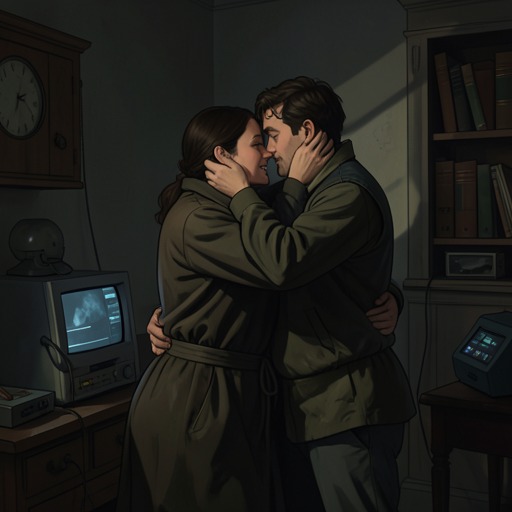
After a blank interval represented as a boundless white desert, shapes emerge: a white-clad, angelic figure seated beside an open coffin. The figure resembles Loïc as a younger, more radiant version of himself and weeps over another Loïc, aged and decrepit, lying dead. The vision draws the living and dead versions of his identity into a single image of mourning. When the angel turns toward him, Loïc feels an intensely loving force drawing him close; he opens his eyes to find Laurence leaning over him at the hospital bedside. Her presence, like the thought of her during the earlier vision, marks the pull that brings him back.
Loïc has been comatose for three days. Even after waking, he remains for a time between two worlds, still carrying traces of what he has seen. The accident therefore ends not simply with resuscitation: his body returns, but his sense of reality has been unsettled and enlarged by the experience.
Consequences and significance
Loïc interprets the episode as confirmation of an intuition he has had since childhood: ordinary waking consciousness occupies only a narrow part of a much larger, layered reality. He considers altered states—including illness, fever, psychosis, and intoxication—possible ways of temporarily leaving the ordinary limits of the brain and becoming accessible to other dimensions. The novel presents this as Loïc’s understanding of his experience, not as a medical conclusion established by the emergency care.
During their recovery in France that summer, Loïc and Laurence spend several weeks at a hotel in Canet-en-Roussillon, near Perpignan. As they regain their strength, they walk on the beach and sit by the shore as the tide comes in, watching the sea advance and withdraw and gathering its shells. The quiet shared days contrast with the violence of the ravine and give their survival a tangible aftermath: recovery is gradual, bodily, and lived together. The encounter also binds Loïc’s return to a renewed awareness of Laurence and leaves him with a lasting conviction that the visible world is only one passage through a wider universe.