1842 Castlemount Ranch Attack
SatanThe 1842 Castlemount Ranch Attack is both a deadly assault on a frontier settlement and the uncertain beginning of a family history. Presented first as a scene in Missouri and later reconstructed from conflicting records by Loïc, the attack leaves two questions entwined: what happened at the ranch, and how did an infant carrying a cameo survive to become the Founder’s ancestor? The novel gives readers a violent event, but also makes its historical record unstable, forcing the family’s origin story to emerge through gaps, corrections, and conjecture.
The attack near Carthage
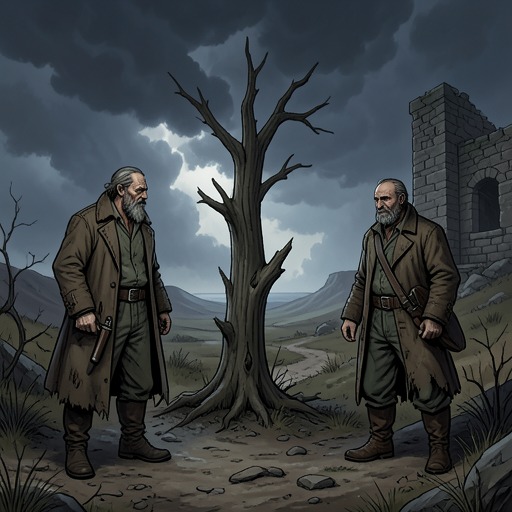
The scene is dated November 2, 1842, and set at a ranch about eight or ten miles south of Carthage, Missouri, in a remote area near Oklahoma. At dawn, around fifteen riders approach through the darkness. The ranch’s owner, an older Frenchman, is already at work with two enslaved Black workers when the alarm reaches the household. He takes up his rifle as the attack begins.
The assailants set fire to the ranch buildings and enter the property. The owner orders the men working there to bring out available firearms and release the horses and livestock, while directing that the women and children take shelter in the house. He then fights the attackers, moving between positions. The account identifies the raiders as Sioux and places their assault within a broader pattern of attacks on settlers’ establishments and traffic along the Santa Fe Trail. It also notes the period’s forced removal of Indigenous peoples west of the Mississippi under the Indian Removal Act. These details situate the attack in a landscape of frontier violence without establishing a specific motive for this particular raid.
The rancher is killed, and the surviving account describes the assault as a catastrophe for the household. The scene’s scale is given more formally in a brief report published days later in a Bowling Green weekly: it says the dwelling and barns had burned, that the owner, his wife and children were presumed dead, and that at least six other men and women—mostly Black—were also believed to have been killed. The report adds that horses and cattle were driven away and that thirty dragoons were sent to pursue the raiders. It does not establish what became of the pursuit.
Reports, corrections, and a damaged record
The early newspaper account is not the last word. About two weeks after the report from Bowling Green, a Saint Louis newspaper stated that no bodies had been found in the completely burned remains and questioned whether anyone had been at the ranch during the attack. In the next edition of the Bowling Green paper, a correction cited a sheriff’s statement: an Indigenous attack had not been proved, the fire might have had natural causes, and the absence of bodies suggested that the ranch could have been unoccupied.
Loïc treats these accounts as a conflict to investigate, not as a settled explanation. He finds neither related court records nor corroboration in several other Missouri newspapers he consults. The later correction and the apparent absence of bodies in the Saint Louis report lead him to suspect that someone intervened between the publications to obscure what had happened. That is Loïc’s inference; the conflicting reports alone do not prove deliberate suppression.
His search eventually uncovers a sheriff’s deposition in regional Library of Congress archives in Washington. Several pages are blackened and nearly illegible, leaving the document’s condition unexplained: it may have been damaged in a fire, or someone may have tried to destroy it. The deposition says that rangers, alerted by neighbors, arrived on November 2, first contained the flames threatening to spread into the surrounding forest, and then found burned bodies. It therefore contradicts the claim that no bodies had been discovered, while preserving uncertainty about the attack’s motive and about the identities of all those who died. The sequence of report, denial, correction, and damaged deposition turns the archive itself into part of the event’s mystery.
The infant in Florissant
The attack’s significance reaches beyond the ranch through a discovery dated November 28. In a separate account Loïc reads, a dog’s persistent barking leads sisters of the Religious of the Sacred Heart of Jesus in Florissant to a young woman lying in the snow. She is dead, but still holds a weakly crying baby, which she has wrapped in the clothing she gave up to protect it from the cold. The account cannot establish whether she was the child’s mother. It records, however, that a finely made cameo was fastened to the infant’s swaddling clothes, inside a torn silk purse secured with a large pin. The religious community plans to baptize the child once adoptive parents have been found.
Loïc connects the discovery to the ranch by comparing the timing and the reported destruction, and by identifying a possible Castlemount connection. He finds records of Louis de Castelmont, a French aristocrat who had settled in the American West, and considers him a likely match for the ranch’s owner. The connection is not proved by the name alone. Nor does the evidence confirm that the young woman found in Florissant had escaped from the ranch, or that she was the baby’s mother. Loïc’s hypothesis is that she may have fled with the child because she feared the local authorities and sought the protection of the Church. The narrative presents this as a reading of the evidence, not as a fact established by the records.
A contested family origin
The cameo gives the infant’s discovery its lasting importance. Loïc considers whether it could have been a family object, a means of identifying the child, or even property taken by a servant and placed with the baby for later security. He also wonders whether the young woman might have been the Founder’s mother and, through that connection, an ancestor of the D’Anjou family. He notes that darker complexions occur in the family, but this observation does not settle the woman’s identity or her relationship to the child.
The attack thus becomes the earliest known point in a chain of questions rather than a complete origin story. The newspapers offer incompatible accounts; the sheriff’s deposition supports the discovery of bodies but does not resolve the identities or motive; and the Florissant account preserves the infant’s survival and the cameo while leaving the woman unnamed. Loïc’s search joins these fragments into a plausible lineage, but keeps its uncertainties visible. The ranch’s destruction matters not only for the deaths it caused, but because the disputed record surrounding it frames the survival of the child—and the passage of the cameo—as a history assembled from evidence that never fully agrees.