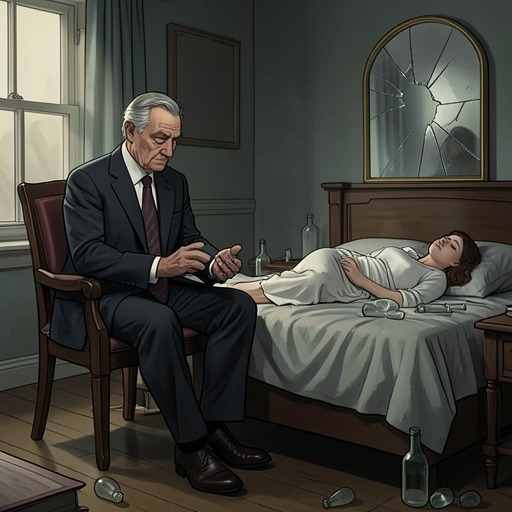
The Death of Georges de Anjou and Public Inquiry into Lucille’s Case
SatanThe death of Georges D’Anjou follows the public investigation into Lucille’s death, a case in which rumor overwhelms evidence and a respected family is tried in the court of public opinion before its patriarch is cleared. The inquiry finds no proof that Georges caused Lucille’s death or helped her die, but its accusations leave lasting damage: his reputation is stained, his health collapses, and he dies in the Grande-Allée house beneath the immense portrait of the Founder.
Lucille’s death becomes a public scandal
In Québec in 2011, Lucille is found dead in the snow, half-dressed, on the Plains of Abraham. The circumstances immediately make her family a target. Gossip radios amplify old grudges and speculation, and the public appetite for scandal turns fragments of rumor into apparent testimony. Georges, a judge, is suspected first; Isabelle D’Anjou and the wider family are drawn in as reports expose Lucille’s alcoholism and Isabelle’s drug addiction.
The accusations escalate from claims of inadequate supervision to the suggestion that Lucille was deliberately abandoned in the freezing night. Some commentators raise the possibility of assisted suicide and insist that Georges should face criminal punishment if he helped his wife die. Others make insinuations about an alleged love affair between Georges and Clémentine, soliciting salacious accounts from supposed witnesses. The case expands beyond its known facts as radio, telephone, and television carry accusation into the national conversation.
The scandal also revives Roger Bolduc’s disappearance in New York during the 2001 World Trade Center attacks. A journalist’s discovery of that history further embarrasses the family and entangles a separate mystery with the inquiry into Lucille’s death. The account notes that the story of the cameo is not uncovered, while Roger’s disappearance is soon relegated to the files of unusual unsolved cases. In this way, the inquiry gathers force not through a single new finding, but through the accumulation of unrelated family secrets, insinuations, and public fascination.
Investigation and exoneration
On the morning of the tragedy, Georges himself calls the police to report that Lucille has disappeared and has been found in the park. Two officers arrive at the family home on Grande-Allée and briefly question Georges and Clémentine, the two people in the house with Lucille that night. At first, doctors, police, and investigators approach the case with restraint toward a family known and respected in Québec City for three generations.
That restraint gives way as public pressure grows. Police return several times to question Georges and Clémentine and record their statements. Medical staff who knew Lucille and had followed her illness are also called to testify. Investigators search the house for fingerprints, examine the door, and retrace Lucille’s route and the approximate time she left. Alain D’Anjou tries to prevent what he considers abusive searches, which he believes presume his father’s guilt, while also using legal threats to challenge what he sees as defamatory claims against the family.
The search uncovers a pistol in the judge’s library, although Georges has no firearms permit. For weeks, the possibility of criminal charges hangs over him. The decisive forensic finding, however, concerns the fingerprints on the door: a fingerprint expert establishes that they are Lucille’s, showing that she opened and then closed the door herself. Some people receive this result with skepticism and hostility, disappointed that a sensational case might end without the condemnation they expected. Georges is ultimately cleared. The exoneration does not restore the family’s standing; suspicion leaves a residue even after the accusations are dismissed.
Decline and death
During the scandal, Georges suffers a heart attack that nearly kills him. He survives, but is left markedly weakened and abruptly aged. He remains in the Grande-Allée house, cared for by Clémentine; later, his grandson Mathieu moves in with his wife and two young children. Georges’s life contracts to a bed and an armchair, while the public disgrace brings his judicial career to an end.
Through the winter and spring, he spends much of his time alone in his rooms, with Clémentine still at her post. Portraits of family members and ancestors surround him: the Founder, his father, his mother, his brother Julien, his elder brother Régis, and Georges himself in his judicial wig. As he drifts toward sleep, he imagines their lips moving and hears murmurs that swell into cries and laments, jolting him awake. The scene gives his isolation a spectral form: the family history that once conferred stature becomes a company of images with which he is left to reckon.
One morning Georges is found folded into his armchair, dead, beneath the Founder’s immense portrait. His death closes the inquiry’s personal aftermath without undoing its consequences. He has been cleared in law, but the family’s reputation remains marked; his career and health have been broken by the scandal. His private reflections also connect the present calamity to the family’s earlier losses and to the possibility that the old curse associated with the cameo has returned. The investigation settles the question of Lucille’s fingerprints, but it does not settle the larger unease the narrative attaches to the D’Anjou family’s history.