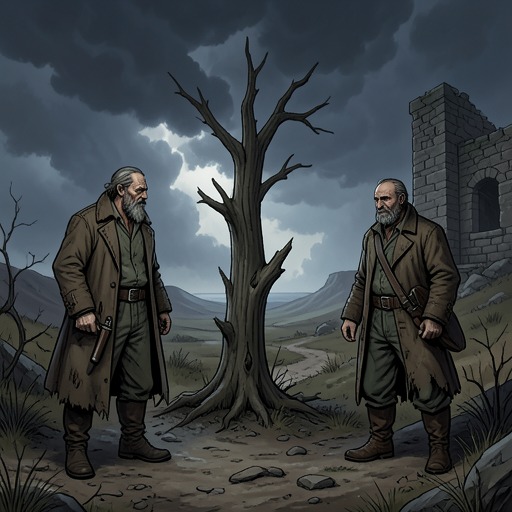
The Castelmont Twins’ Escape and Separation
SatanThe Castelmont twins’ escape and separation begins with a family broken by revolutionary violence and becomes a divergence of continents, fortunes, and claims to inheritance. Entrusted with one cameo each by their mother, Louis de Castelmont and Charles de Castelmont survived the danger that killed their family—but the escape did not reconcile them. It set the brothers on separate routes that would eventually bring them into conflict again.
Arrest, inheritance, and the camées
In 1794, while the twins were in Paris with their mother, their father, sisters, and younger brother were massacred at the Château de Barzac. The brothers were already fiercely hostile to one another; their mother was the one person able to quiet their antagonism. When she faced arrest, she entrusted each son with one of the two camées associated with the family. Louis received one, Charles the other. She had kept the jewels close and had them sewn into the boys’ clothes, binding their flight to a promise that they would never part with the inheritance entrusted to them.
Their mother’s arrest was tied to her close association with Louis XVI. Sensing the danger, she put the camées in her sons’ hands before the authorities could seize them. The boys escaped the agents sent to arrest her and hid separately, a practical arrangement made more stark by their mutual dislike. Their mother was guillotined two months after her arrest. The camées thus became both portable remnants of the family’s past and a charge carried by each twin into exile.
Two routes out of France
The brothers’ escape quickly became a geographical separation. Shortly before the fall of Robespierre in July 1794, Louis slipped away to England in a ship’s hold. Charles, with help from a cousin on his father’s side, made his way to the émigrés in Germany. Neither route brought the twins together: they had fled the same danger, but continued apart, each carrying his own portion of the family inheritance.
Louis soon signed on as a cabin boy aboard a ship bound for America. In Louisiana he survived by petty theft and a succession of makeshift occupations before establishing a small business. Shortly before Louisiana was transferred to the United States in 1802, he used the proceeds to buy land. He later followed westward settlement, lived for a time in Texas, and eventually settled near Carthage, Missouri, where he became a prosperous farmer. His path from fugitive to landowner unfolded far from the European family estates.
Separation becomes a contest over the family name
At the Bourbon Restoration, Charles returned to France and recovered the Castelmont lands. His absent twin was presumed to have left Europe permanently and possibly to have died. That assumption ended when Louis returned to claim his titles and share of the family inheritance. Louis had a claim under the right of primogeniture: the twins’ birth record established that he had been born minutes before Charles.
The years apart had left the brothers unequal in standing. Louis appeared in France as an almost unknown figure from America, while Charles had built political support among the émigrés and around Louis XVIII. Louis therefore had to establish both his identity and his rights. Charles refused to meet him and called him an impostor; the old hostility survived the distance and hardened into a struggle over recognition and property.
From flight to renewed violence
Charles did more than deny his brother’s claim: he repeatedly tried to have Louis killed. Louis survived through his exceptional strength and skill with the sword and pistol. Both brothers had inherited their father’s giant stature and physical strength, though Louis was the larger of the two. Police archives in Paris preserved traces of their confrontations and brawls, allowing Loïc to reconstruct the conflict from scattered records.
The episode’s decisive turn is that escape preserved the twins’ lives without ending their rivalry. Their mother’s camées and promise carried the family past into exile; their separate journeys then produced sharply different positions from which to reclaim that past. When Louis returned, the separation that had once helped the brothers survive had become the ground of their dispute.