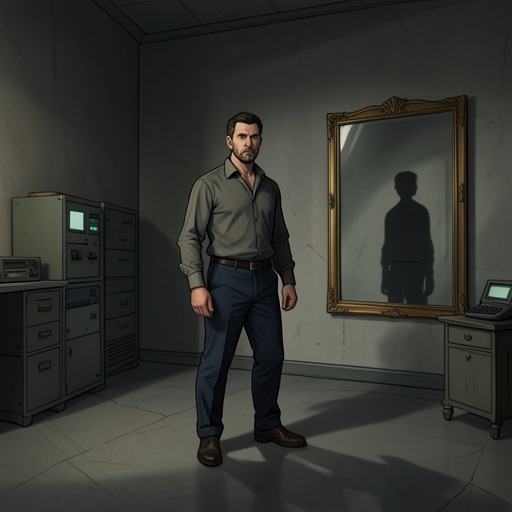
Loïc Learns He Had a Stillborn Twin Sister
SatanLoïc Learns He Had a Stillborn Twin Sister is the revelation that redefines Loïc’s birth and gives a concrete, terrible history to sensations he had never been able to explain. At Guillaume D’Anjou’s last funeral vigil, the doctor who delivered Loïc confesses that Marie-Ange had carried a second fetus, which died before birth. The disclosure is then confirmed by Alexandre D’Anjou, who recalls the discovery of a baby girl’s remains in Marie-Ange’s grave. The scene joins medical secrecy, family grief, and Loïc’s elusive childhood intuitions in a single revelation.
The Doctor’s Confession
During the final evening of the vigil, a well-dressed, distinguished-looking man with a fine moustache and silvering temples arrives. Some mourners recognize him as Pierre Saindon, the doctor who had delivered Loïc from his dying mother. Saindon had left Touladi within a year of the tragic birth to practise in the Québec region. After exchanging greetings with the people present, he draws Loïc aside: he has something important to tell him, a burden he has carried since Loïc’s birth.
Saindon struggles to speak. His face tightens as he tries to contain his tears, and he eventually tells Loïc that another fetus had been in Marie-Ange’s womb. Loïc asks whether the doctor is certain. Saindon says that he recognized the second fetus during the delivery, but knew at once that it was dead. He chose not to tell the family, believing that the death of Marie-Ange was already enough sorrow. The secret was not forgotten, however: Saindon says its concealment weighed on his conscience.
The Grave and the Second Body
When Loïc asks whether the fetus’s sex was known, Saindon cannot answer. Alexandre D’Anjou, who has approached quietly and overheard the exchange, supplies the missing fact: the baby was a girl. He is more than eighty years old, and recalls that the family had opened several graves during the cemetery’s reorganization in 1947, including Marie-Ange’s.
Guillaume had been there with Alexandre. Alcide Bolduc could not remain for long. At first the men noticed an unusual swelling low in Marie-Ange’s abdomen; then they saw a withered infant, nearly a skeleton, between her legs, still attached to her by a dried umbilical cord. Alexandre and Guillaume wept. They could identify the baby as a girl, but could not understand how she had come to be there—or why Saindon had not seen her. Alexandre’s recollection makes the doctor’s confession physically visible: the lost twin was not merely a possibility in a medical account but a body found beside her mother years after the birth.
Loïc turns to Alexandre with a heavy, reproachful look and asks why he had not been told. The disclosure therefore opens more than one silence. Saindon had withheld what he knew at the birth; Alexandre and Guillaume had encountered the remains during the grave’s opening; and Loïc had grown up without either account. Once the doctor explains his reasons and responsibility, Loïc acknowledges that Guillaume can no longer be blamed for keeping the knowledge from him.
Medical Explanation and Remorse
Saindon explains that the second baby had descended as he struggled to stop Marie-Ange’s hemorrhage. By the time he recognized the fetus, it was dead. He says he could feel enough to be certain, but did not disclose what he had discovered, wanting to spare the family another blow. He admits that he could have told them later and calls the silence his fault. He also reproaches himself for failing to save Marie-Ange, and wonders whether he should have avoided putting her to sleep with chloroform.
The doctor identifies what happened in the grave as a rare event known as coffin birth, or, more precisely, post-mortem fetal extrusion. He recalls reading about it in an old medical treatise: gases accumulating in a dead mother’s body can push the fetus out of the uterus. The explanation accounts for how the baby came to lie outside Marie-Ange’s womb, but it does not undo the family’s shock or the delay in discovering her. Saindon says he left Touladi six months after the birth, fleeing his remorse and guilt; in his account, he was also escaping a descent into alcoholism.
Loïc’s Response and the Revelation’s Aftermath
Loïc is outwardly stunned, but inwardly the news sets thoughts and emotions in motion. He says that pieces of a puzzle are falling into place: distant sensations, intuitions, and mysterious experiences that had seemed inexplicable. Before the disclosure, he had often felt a presence around him, even within him. The revelation gives that feeling a new possible connection, though it does not establish that the twin’s presence was supernatural or that every childhood experience can be explained by her existence.
After the vigil ends, Loïc prays briefly with Marie-Louise and her two daughters, then goes to the room still kept for him upstairs. He cannot put aside either the fact of his stillborn sister or the image of her body emerging in the grave. As his awareness fades toward sleep, he imagines himself expelled from the womb like a passenger from a crashed car, while his twin remains trapped inside, a part of himself imprisoned in the fatal shell. The scene brings back an earlier, obsessive image of a child buried alive and turning in its grave. The news thus changes the meaning of Loïc’s birth in his own mind: survival appears not as a clean separation, but as an escape accompanied by an irretrievable remainder.
Narrative Significance
The revelation arrives not in a medical consultation but amid the last vigil for Guillaume, where grief has already gathered the family around the dead. Its timing draws the living back toward another death: Marie-Ange’s, and the unrecognized loss of the daughter who died with her. The doctor’s remorse, Alexandre’s eyewitness memory, and Loïc’s response provide distinct forms of testimony—clinical, familial, and inward—without making them interchangeable.
The episode also leaves an important limit around its explanation. Saindon can name the physical process that carried the fetus out of the womb after death, while Loïc can connect the discovery to his sense of an unseen companion; neither account wholly resolves the other. The twin becomes at once a hidden fact of family history and the image through which Loïc understands a division within himself. What the disclosure settles is the existence and sex of the stillborn child. What it leaves resonant is the life Loïc had felt beside him without knowing why.