Loïc and Rodrigo Discover Their Kinship
SatanLoïc and Rodrigo Lerbier discover that they are cousins when a conversation in Cuba connects Rodrigo’s Canadian great-grandmother, Mathilde, with the estranged daughter of Loïc’s ancestor Élie D’Anjou. The recognition makes a family history of adoption, flight, and silence suddenly personal: what had survived as fragments in two family stories becomes a possible shared lineage, and the two men embrace before they are hurried away on a waiting bus.
The histories behind the meeting
The discovery rests on two incomplete inheritances. Rodrigo knows Mathilde through memories passed down by his mother: his great-grandmother had come from Canada, spoke French, and told stories of houses buried in snow, subzero cold, and winds that seemed to roar like beasts. Rodrigo had never met her, and he could not place her Canadian home more precisely. Her stories, carried into the family’s life in Cárdenas, preserved her origins vividly but not her surname.
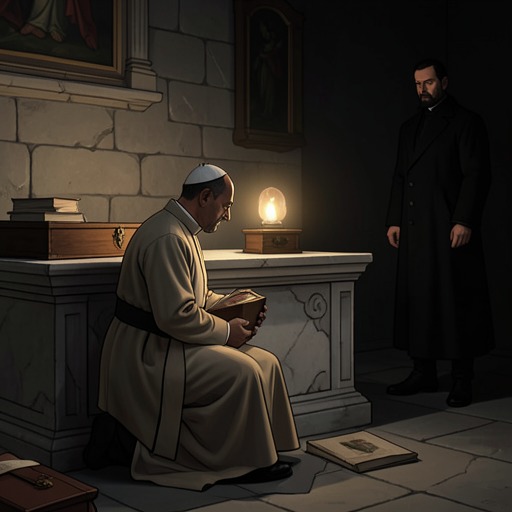
Loïc has a different fragment. During an earlier family gathering, Marthe revealed that Élie D’Anjou had told her he was adopted and knew nothing about his birth family. He had also confided that a valuable stone in his safe troubled him because it came from the United States, his country of origin. He feared the object as malign and had hidden it in his scapular, sewn into his clothing, intending to be buried with it and have the matter forgotten. His reluctance to explain the stone or his origins left his descendants with a secret but no clear account of how the two were connected.
The family gathering also exposed the absence around which another secret had formed. Mathilde had rebelled against her father after her mother died in childbirth in 1889. Élie had refused a caesarean section because the Church prohibited it; Mathilde broke with him, fled the household, and was cursed and disowned. Marthe remembered her sister’s fear and anger as she sought refuge in the older sisters’ bed, then vanished the next morning. Marthe later learned privately that Mathilde had been living in Cuba. That knowledge supplied the missing bridge when Rodrigo spoke of a Canadian ancestor in Cuba.
Recognition in Cuba
The exchange takes place after Loïc has experienced a brief, disorienting vision near a building marked with cabalistic signs. Rodrigo, a babalao, notices the sudden surge of energy passing through him and connects it to the nearby Yoruba altar where the malevolent cameo is displayed. The strange episode does not itself establish their relationship, but it forms the charged setting for Rodrigo’s impulse to share his family memory.
When Rodrigo describes his great-grandmother’s French speech and Canadian winter stories, Loïc identifies the likely region as Quebec and asks her name. Rodrigo recalls it as Matilda. Loïc immediately recognizes the resemblance to Mathilde, the daughter of the Founder who had fled the family home and, according to the story he knows, ended up in Cuba. He asks whether her surname could have been D’Anjou. Rodrigo cannot be certain: his mother had once given him the family name, but he did not retain it. The evidence is suggestive rather than documentary, yet the match between the unusual migration story and the name remembered by Loïc is enough to make the possibility compelling to both men.
From possibility to kinship
Loïc sees the implication at once: if Rodrigo’s ancestor was Mathilde D’Anjou, then the two men share family. Rodrigo is equally shaken. Loïc tells him what he knows of Mathilde’s escape to the United States and her meeting with a man who brought her to Cuba, probably before 1900. The account supplies context for the journey Rodrigo’s family had remembered only as a Canadian origin and a life in Cuba; it does not fill in the unknown man’s identity or establish every link in the descent.
Rodrigo embraces Loïc and addresses him as a friend and cousin. Their recognition is emotional and provisional at the same time: they accept one another as kin on the strength of converging family memories, although Rodrigo cannot recall the surname and the conversation produces no newly located record. The bus for Varadero is waiting, and Loïc must break off the encounter. They part with promises to keep in contact and meet again, turning a sudden genealogical possibility into a relationship they intend to continue.
A family secret made relational
The scene gives Mathilde’s disappearance a consequence beyond the D’Anjou household. Her flight had been remembered within Loïc’s family as rupture and disgrace; Rodrigo’s inherited recollections make it also a route by which that family history crossed into Cuba. The contrast is striking: Élie concealed his adoption and the stone associated with his unknown origins, while Mathilde’s descendants preserved enough of her Canadian past for Loïc to recognize it generations later.
The discovery also echoes the novel’s broader distinction between biological descent and the records or social decisions that shape family identity. Élie himself was adopted after being found as a baby in 1842, and Loïc was adopted by Guillaume and Marie-Louise after his mother, Marie-Ange, died following his birth. In both histories, care and family belonging are established through adoption, while questions of origin remain open. Loïc and Rodrigo’s encounter does not resolve every uncertainty, but it changes the meaning of those absences: a name lost in one branch may still be approached through the memories of another. The cousins’ brief embrace is the first shared confirmation of a connection that generations of silence had left unrecognized.