Lucille Freezes to Death on the Plains of Abraham
SatanLucille’s death on the Plains of Abraham follows the collapse of her memory, her desperate appeals to Georges D’Anjou, and his increasingly concrete thoughts of ending her suffering. But the narrative distinguishes his unexecuted plan from what happens: Lucille leaves the house alone in the night and dies in the cold, her death bound by its location to both a family memory and the history of Quebec.
The illness and its exposure
Lucille’s decline first appears in small lapses: misplaced keys and a lost wallet, moments that Georges could initially attribute to age or to the brief absences that followed her drinking. The pattern changes. Her forgetfulness becomes frequent, and a driving test she must take after passing the age of seventy-five brings the problem into public view. Anxiety and confusion contribute to her failure; she loses her licence, and a medical diagnosis confirms Alzheimer’s disease. The loss is practical as well as personal: she is suddenly less able to move about independently, and the illness she had tried to keep private is exposed.
Her condition worsens amid the combination of prescribed anxiolytics and alcohol she continues to drink secretly. Going for a drink at the Château Frontenac becomes harder; even taking a taxi is difficult, while walking risks getting lost and asking strangers for directions. In the Haute-Ville, where she is well known, people notice her disorientation and begin to whisper. The narrative thus places her deterioration not only inside the home but in the visible routines of a city where her changing condition becomes a subject of discreet public knowledge.
Pleas, care, and Georges’s plan
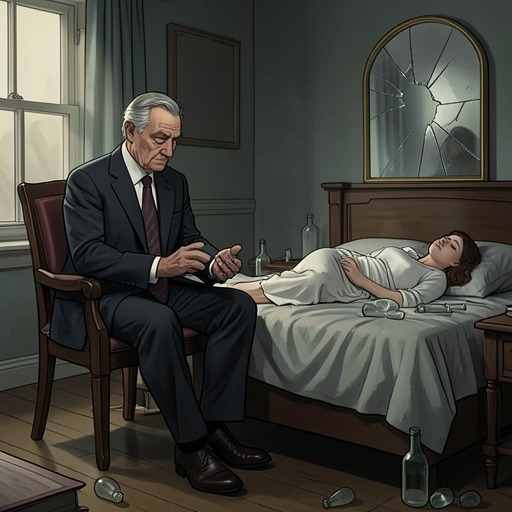
In lucid intervals amid increasingly frequent confusion and paranoia, Lucille tells Georges that she wants to die and asks him to find a way to end her life. He initially rebukes her. Her pleas continue, however, and his resistance gradually weakens under the strain of watching her decline. She knows that he keeps a pistol in his office and once tries to get to it without his knowledge. Georges catches her and refuses to hand it over, explaining that the weapon is locked away and the ammunition kept separately. Lucille weeps, falls to the floor, clings to his legs, and begs him to spare her what she understands as the approaching horror of losing herself.
The request unsettles the household in different ways. Georges is confronted with both his wife’s explicit wish and the limits of what he can bear to do; Isabelle, unable to face her mother’s transformation, avoids these scenes and considers leaving the house. The story does not reduce Lucille’s dependence to a single appeal or Georges’s care to a simple decision. It shows repeated pleading, his initial refusal and faltering resolve, and a family increasingly unable to live together with the illness.
By 2009–2010, Georges’s temptation has become a plan he considers in detail. He reasons that death is inevitable and imagines bringing it forward as an act of mercy. Drawing on his youthful interest in mycology, he considers poisonous mushrooms, but consulting his books reminds him that the poisoning would begin with severe, visible suffering and could lead to organ destruction over a prolonged period. The prospect of making Lucille endure that ordeal stops him short. The passage records the plan and its moral pressure, not its execution: the subsequent account of Lucille’s death presents her leaving the house alone, not Georges administering poison.
The night and the discovery
After another of Isabelle’s trips to Cuba, Lucille rises during the night while the large house is asleep. The alarm has been left disarmed since her illness began. She opens the front door and goes outside wearing little more than her nightgown and a sheet twisted around her like a toga. Two cats patrol the corridors, but no person is awake to stop her or notice her departure.
It is late December, bitterly cold, and wind comes off the river. The streets are empty. The sheet lifts and billows in the storm, alternately resembling a sail and a white flag; it also takes on the shape of a shroud. The narration renders Lucille as a ghostly figure carried through the snow by the blizzard, an image that makes her disappearance from the house seem at once deliberate in its direction and helpless in its course. At daybreak she is discovered, partly covered by snow, her mouth sealed by the cold. Her death is the culmination of a night in which illness has left her wandering beyond the protection of the home, with no witness present until morning.
Place, echo, and consequence
Lucille is found on the Plains of Abraham at the very place where Montcalm fell in 1759. Loïc later recognizes the coincidence, and the narration connects the site of an individual death with the fate of a people. It raises, without settling, the possibility that Lucille’s ending figures a nation worn down by amnesia. The location therefore does more than mark where she died: it gives her personal loss a historical and political resonance.
Her snow-covered body also echoes an earlier image from the story: a young woman found dead in the Midwest with a baby wrapped in her arms. The parallel links Lucille’s final appearance to a prior death without making the two circumstances identical. Together with the sheet that becomes both flag and shroud, these echoes gather around the novel’s recurring concerns with memory, loss, and the boundary between private suffering and collective history.