Execution of Delphine de Castelmont
SatanDelphine de Castelmont’s execution on May 21, 1794, turns a public act of revolutionary punishment into the hinge of a family history: before dying, she had entrusted her twin sons with a pair of royal cameos, binding their separate escapes to a legacy they could not understand. The episode is presented as a scene reconstructed by Loïc from scattered historical records, where the guillotine’s spectacle gives way to questions about what Delphine carried into her final moments and what her children carried away.
Background and Arrest
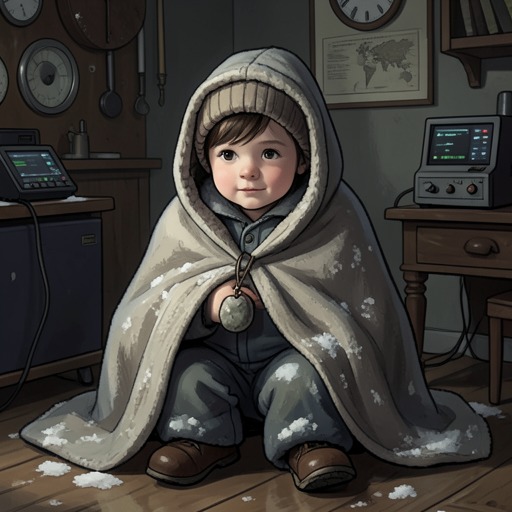
By the time Delphine faced execution, violence had already broken apart her family. Two months earlier, revolutionaries had massacred her husband, her mother, and their household at Château de Barzac. Her twin sons, Louis and Charles de Castelmont, then about twelve years old, escaped with her to Paris. The boys’ hatred of one another was so intense that their mother alone could calm them; even their father’s blows had failed to end their quarrels. Their flight offered temporary safety, not a way out of the Revolution’s reach.
Delphine was arrested in March and placed on the Committee of Public Safety’s list of people destined for the guillotine. The stated grounds were her special connection to Louis XVI, known after his fall as Citizen Capet: she had been his childhood friend, and he had remained devoted to her. The connection was more than a private bond in the political climate of the time. A pair of cameos associated with the king could serve as a passport or as grounds for arrest, depending on who held power and how the objects were read.
The Execution in Paris
Loïc’s archival reconstruction opens at Place des Victoires beneath a leaden sky. The guillotine stands at the center of the square, while a noisy, drunken crowd gathers for what the narration presents as a familiar revolutionary spectacle. Delphine remains dignified on the scaffold as the crowd jeers at her. The scene narrows to the executioner Sanson raising his hand; the blade falls, and her head drops into the basket. Sanson lifts it by the hair for the crowd to see, and the onlookers answer with shouting, whistling, applause, and a revolutionary refrain.
The crowd’s response makes Delphine’s death a public performance as well as a killing. Her aristocratic identity is reduced to a target for collective derision, while the executioner’s display turns her body into part of the spectacle. A sudden cry against Robespierre interrupts that apparent unanimity. Guards turn toward the voice, but the boy who shouted slips through the crowd and escapes their grasp. The brief disruption does not stop the execution or undo its consequences; it exposes a gathering in which dissent is dangerous and the crowd’s apparent unity can fracture in an instant.
The Cameos and Her Final Choice
The narrative pauses over the uncertainty of Delphine’s last thoughts. It raises the possibility that she remembered the relatives and servants killed at Château de Barzac, her two sons, or the cameos entrusted to them. These are questions, not reported answers: the account cannot establish what she thought as she died. It does, however, trace the objects’ history. Louis XVI had given Delphine the pair in 1782 to mark the birth of her twin sons, and later sent her the second cameo, Castor, through a secret mission entrusted to the Duke of La Rochefoucauld-Liancourt.
Delphine kept both cameos with her. Sensing that arrest was imminent, she gave one to each son and made them promise never to part with them for any amount of money. She sewed the jewels into their clothes to keep them safe: Louis received Castor, and Charles received Pollux. The gesture was protection under immediate threat, but the account also casts it as the beginning of an inheritance shadowed by danger. The objects could help a bearer pass through one political world and expose him in another.
Escape and Aftermath
The twins narrowly evaded the men who came to arrest their mother. They hid separately, in keeping with their inability to tolerate one another. After Delphine’s execution, their paths divided: just before Thermidor in July 1794, Louis escaped to England in a ship’s hold, while Charles reached the émigrés in Germany with help from a cousin on his father’s side. The account gives no reunion; instead, the cameos leave the brothers linked across their separation.
Louis later sailed to America as a cabin boy. In Louisiana he survived through petty theft and a succession of makeshift occupations, eventually building a small trade that enabled him to buy land shortly before the Louisiana Purchase in 1802. He moved west with the expansion of settlement, lived for a time in Texas, and ultimately became a prosperous farmer near Carthage, Missouri. Delphine’s execution thus marks both the close of one family life and the beginning of two separate trajectories. Her last act preserved the paired objects for her sons, while the story’s language of a cursed gift foreshadows the harmful consequences that would extend to their descendants.