Einor
ShrineEinor is the central figure in a disputed sixteenth-century history that reaches into the present through a manuscript attributed to Thomas Woolgar. In Woolgar’s account, she is at once a nun who heals the sick, a secretive student of unusual powers, and a victim of a village’s violent accusations. Her execution, the curse said to accompany it, and her possible connection to Alice Pagett make her the story’s hinge between historical persecution and contemporary supernatural crisis. Yet the account is filtered through a priest who admits his guilt and whose sanity is questioned, leaving Einor’s identity inseparable from the uncertainty of the record.
Identity and Historical Setting
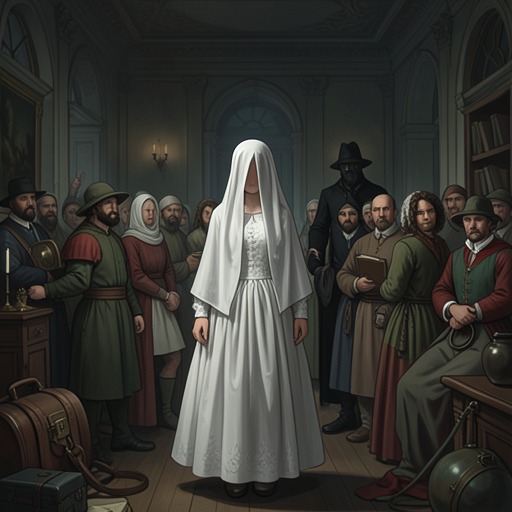
The manuscript presents Einor as a nun sent by her prioress to assist Woolgar, then serving at St. Joseph’s Church in Banfield. At first he describes her as fair and gentle, apparently suited to church duties. Her learning unsettles his expectations: she knows more than he does about medicine and alchemy, and he finds her understanding difficult to reconcile with her religious position. He also describes her as devoted to the Virgin Mary. In public, she prays and serves the community; in his retrospective account, the same religious setting becomes the place where private conduct and public devotion conflict.
Einor’s story is situated amid the religious and political upheavals of Mary Tudor’s reign. Woolgar says she was brought into his parish by the prioress, who did not know what he believed Einor to be. The manuscript’s language of sorcery and heresy belongs to a world in which religious authority could shape accusations and punishment. It also records a local community willing to interpret misfortune and unexplained events through the categories available to it. The text therefore documents not only claims about Einor, but the making of those claims by people with religious, familial, and local power.
Healing, Knowledge, and Woolgar’s Account
Before the accusations, Einor acquires a reputation as a healer. Woolgar says villagers brought her gifts because they believed she had cured illnesses; she kept the more valuable offerings secretly in the church crypt and passed lesser gifts to the priory. The children, in particular, admired her and sought her blessing. Her cures strengthened the appearance of holiness that later made the accusation against her so explosive: the same people who had treated her as a saint came to regard her as a threat.
Woolgar’s account also makes him a compromised witness. He confesses to a sexual relationship with Einor and portrays himself as captivated by her, claiming that she controlled his will and used potions. At the same time, he acknowledges that his own desires and choices were involved. His effort to shift responsibility onto Einor sits uneasily beside his admissions of complicity. He describes her as teaching that human will was a power greater than supernatural magic, and says she intended to gain the position and authority of prioress. These claims come from Woolgar’s retrospective manuscript, not from an independent account of Einor’s intentions.
The manuscript connects the relationship to a wider pattern of harm. Woolgar admits that three children disappeared and were killed, and describes himself as having helped suppress their cries. He also recounts Einor’s influence over two novices; one later took her own life after confessing to the prioress. The account thus places Woolgar not merely as a recorder of Einor’s alleged crimes, but as a participant who concealed them and later had reason to present himself as both culpable and controlled. That tension is essential to any reading of his portrait of her.
Accusation, Execution, and Curse
When the prioress learns of Einor’s conduct, Woolgar says he confesses some of his own wrongdoing but not everything. He joins the decision to denounce Einor as a witch and heretic, and returns to Banfield to warn members of his congregation. His testimony helps mobilize a crowd. At St. Joseph’s Church, Einor is discovered with Rosemund, a novice whom Woolgar says had also succumbed to her influence. The villagers drag Einor away; Woolgar’s account says that he denies her accusation that he was her partner and directs the crowd toward the supposed mark on her body, which they interpret as proof of witchcraft.
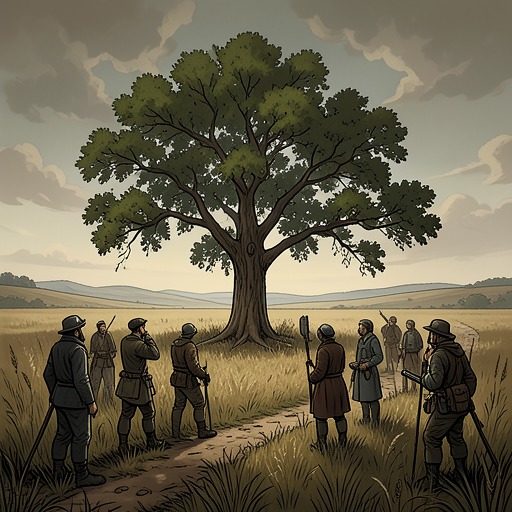
The crowd subjects Einor to escalating violence and demands a confession. According to the manuscript, she eventually confesses under torture, after which the villagers hang and burn her at a nearby oak. Woolgar says she curses him and those present, extending the curse to their descendants, and also curses the name of Mary. He describes darkness, trembling ground, and an opening into an infernal world after her death. Those supernatural details are his account, not independently verified events. Others later tell him that a thunderstorm and low clouds accompanied the day, while rejecting his claims about demons and an opening to Hell. The contrast preserves two explanations: an extraordinary supernatural rupture in Woolgar’s testimony, and a public account that reduces it to a storm and a witch’s confession.
The Manuscript and the Later Mystery
Woolgar says that after the execution he was treated as mentally unwell and removed from Banfield to St. Peter’s at Barham. His father arranged for church records and other materials to be transferred, but Woolgar claims that he hid this manuscript so it would survive. Near its end, he writes that Einor’s presence continued to pursue him and that his own desire remained a bond between them. The document closes as a warning, but its author’s admissions, self-exculpation, and apparent distress complicate its authority. The later reader, Gerry Fenn, is left weighing whether its claims are the ravings of a guilty man or an account of a real supernatural legacy.
That legacy becomes relevant when Father Delgard considers the events surrounding Alice Pagett. Delgard speculates that Einor was more than a witch and that a force connected to her death could persist beyond her lifetime. He links Alice’s conception in the same field where Einor was killed to the possibility of a soul’s transmigration, while treating the connection as a disturbing hypothesis rather than a settled fact. The story’s modern events likewise make Einor’s history newly consequential without resolving whether Alice is a reincarnation, a possession, or something else.
Narrative Significance
Einor’s character is built from opposing roles that the manuscript cannot reconcile: healer and alleged killer, religious devotee and profaner, accused witch and possible supernatural being. Her cures produce trust; that trust helps conceal the crimes Woolgar later confesses; then the crowd converts suspicion into collective violence under religious authority. Woolgar’s participation further unsettles the distinction between accuser and accused: he helps condemn Einor while admitting that he shared in wrongdoing and concealed the truth.
The uncertain authorship is not the issue—the manuscript is identified as Woolgar’s—but its reliability and the meanings of its claims remain open. His account gives Einor little independent voice beyond the words and accusations he attributes to her. The curse and continued presence may be literal within the novel’s supernatural pattern, or shaped by his guilt and fear; later events keep both readings in play. Through Einor, the narrative joins religious fervor, personal culpability, communal violence, and the persistence of an unresolved past. Her decisive significance lies less in a confirmed explanation of what she was than in the way her contested history continues to reorganize the present.