Mother Marie-Claire
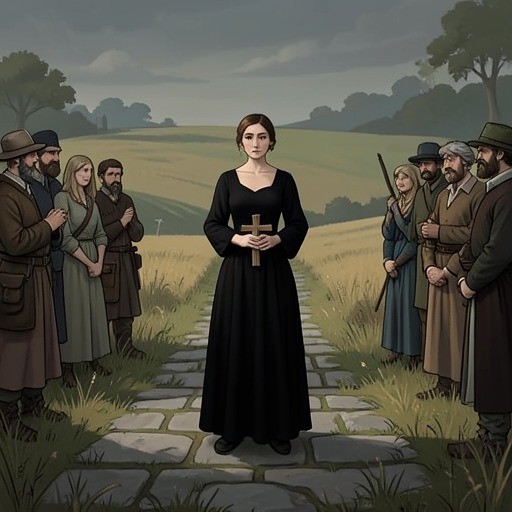
ShrineMother Marie-Claire, the Reverend Mother of the convent, becomes an important witness to the disturbances surrounding Alice Pagett. She enters Alice’s room cautiously, holding the crucifix at her chest, after Alice has fallen quiet and returned to stillness. The narrative gives her little dialogue or independent history, but her observations carry the episode beyond rumor: she later reports finding a cat on Alice while the girl slept, and insists that she was certain of what she had seen.
Position in the Convent
As Reverend Mother, Mother Marie-Claire occupies a position of responsibility within the convent. The evidence presents her principally through her dealings with Alice and Father Andrew Hagan rather than through a broader account of her life. Her authority matters because she is not merely repeating a story heard from someone else: she went to Alice’s room and subsequently brought what she had discovered to the priest.
That limited role also sets a boundary around what can be said about her. The account does not establish her personal interpretation of the events, her prior relationship with Alice, or what further action she takes. Her importance rests instead on the precise observations and warnings she contributes to the unfolding investigation.
Witness to Alice’s Disturbances
Mother Marie-Claire listens outside Alice’s door after Alice has begun speaking in her sleep again. She cannot make out much of what Alice says, but she recognizes the speech as resembling a form heard before and recalls a few phrases. The episode therefore gives her an attentive but incomplete position: she detects a recurrence without claiming to understand its meaning.
On another night, she finds a cat in Alice’s room, resting on the sleeping girl. The preceding scene shows Mother Marie-Claire opening the door after Alice has become quiet; she holds the crucifix against her chest and advances slowly. Her later report supplies the practical identification of the creature as a cat, while the scene itself emphasizes her cautious entry and the disturbing circumstances in which she encounters it.
Report to Father Andrew Hagan
The following morning, Mother Marie-Claire comes to Father Andrew Hagan in an agitated state. She tells him about Alice’s renewed sleep-talking and the cat she found in the room. The sequence makes her report a trigger for discussion: details that might otherwise remain separate—the repeated nocturnal speech and the animal’s presence—are brought together for the priest to consider.
Her certainty about the animal is particularly consequential. When Father Andrew Hagan revisits the account, he says that her assurance caused him to recall something he had previously forgotten. The resulting explanation comes from the folklore he discusses, not from a stated theory of Mother Marie-Claire’s own. He describes spirit-beasts associated with witches and errands of a malicious kind, linking that tradition to a bodily mark. The narrative thus distinguishes her role as witness from the interpretive framework another character places around her evidence.
Narrative Role and Limits
Mother Marie-Claire’s appearances establish a chain of observation and transmission: she listens at Alice’s door, enters the room, finds the cat, and reports what happened to Father Andrew Hagan. Each step adds information while preserving uncertainty. She hears only fragments of Alice’s sleep-speech, and the cat’s presence does not by itself prove the folklore explanation later raised by the priest.
Her account nevertheless changes the weight of the disturbance. The incident is no longer only a strange pattern of speech or an uncertain impression; it has a witness who returns to the priest with a definite report. The crucifix she holds as she enters the room reinforces the religious setting of the encounter, while the explanation of the creature remains someone else’s. Mother Marie-Claire therefore serves as a credible observer at the threshold between the convent’s ordinary routines and the supernatural interpretation developing around Alice, without the text supplying enough evidence to resolve what she herself believes.