Rodney Tucker
ShrineRodney Tucker is Banfield’s supermarket owner and one of the village’s most forceful advocates for exploiting its sudden fame. A newcomer who never wins full local acceptance, he sees the reported miracles at St. Joseph’s Church as both a commercial opening and a route into local influence. His ambitions help translate religious attention into plans for tourism and expansion, but the catastrophe at the pilgrimage site ends with Tucker dead and his schemes reduced to ruins.
Identity and Background
Tucker owns the only supermarket on Banfield’s High Street, a modest store suited to a small town. He moved there from Croydon eleven years before the events around the reported miracle. His earlier grocery business had been forced out by large chain stores; selling its premises gave him the capital to enter the competition in Banfield. He had learned from being displaced by larger retailers, and his move was a calculated attempt to establish himself where the national chains had not yet taken hold.
The village’s social boundaries remain harder to cross than its commercial ones. Tucker knows important local men, has dined and played golf with them, and has cultivated contacts, but he is still regarded as an outsider. In Banfield, acceptance depends on family roots extending back generations, not merely on years of residence. This exclusion matters to him because he wants a seat on the parish council: local office would give him access to land and to the building-trade contacts he hopes to put to use. His economic success has not brought the local standing he wants.
The Miracle as a Business Opportunity
The reported healing at St. Joseph’s Church reaches Tucker in his shop, where a customer brings him the newspaper and tells him about Alice Pagett, a child he has seen shopping with her mother. In a later meeting arranged by George Southworth, Tucker is introduced to Gerry Fenn as a Banfield resident of eleven years. His guarded manner contrasts with Southworth’s effort to present a community-wide vision: the village has little to offer visitors, and the hotel’s summer guests mostly use it as a base for trips elsewhere. Southworth says he and Tucker would invest if the returns justified it; Tucker adds that other local businessmen are also looking for an investment.
Tucker makes the commercial principle explicit: opportunities have to be seized. When Gerry Fenn observes that Southworth’s proposal sounds cynical, Tucker answers that this is the real world. The attitude is not merely opportunistic banter. He and Southworth see the reported miracle as a means to draw visitors, stimulate building, and generate income in a village with spare land. Tucker’s own interest in parish-council membership and building contacts gives the tourist proposal a local political dimension: development could bring him influence as well as profit.
After the second reported manifestation, the scale of the opportunity changes. Five people have been cured of genuine conditions, though two still have incomplete recoveries; the story spreads internationally and Banfield fills with media workers and visitors. Southworth sees the village’s sudden attention as a chance to reverse its long decline, and reports that council members have become receptive to expansion plans. Tucker, in turn, sees the possibility of rapid development. A proposed new shop is discussed with Paula, his employee and lover, and he tells her that matters are nearly settled. She considers whether she will have to run the shop alone while he organizes the larger venture. Their exchange makes clear that the boom is already being imagined as an operating business, not only as a distant prospect.
Ambition, Relationships, and the Tourist Boom
Tucker’s relationship with Paula is entangled with his plans. He is her employer and lover; she knows that he is married to Marcia Tucker and resents being treated as disposable. At times she threatens to let Marcia discover the affair. Tucker regards Paula’s changing moods with unease, but when she appears supportive during the village’s sudden excitement, he wonders whether she wants a place in his schemes. Paula does: she expects tourism to bring money and intends to benefit alongside him, regardless of his wife. Their arrangement reflects the same transactional logic as Tucker’s public ambitions, though Paula is not simply a passive accessory to them; she is calculating how to secure a share for herself.
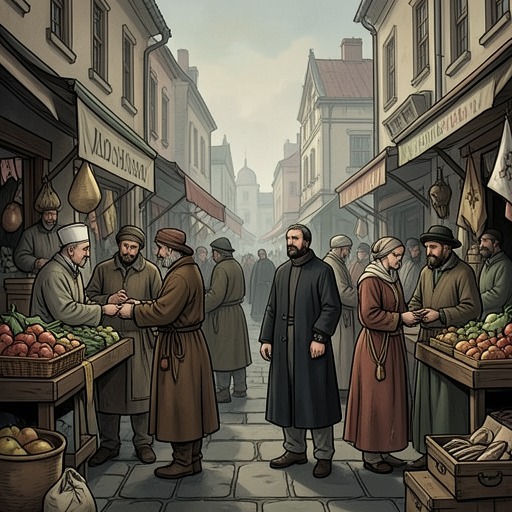
The boom acquires a visible commercial face in the pilgrimage crowds. Makeshift stalls offer small religious statues, trinkets, and posters; one display includes a plastic shrine with a newspaper image of Alice Pagett in place of another holy picture. Other vendors sell supposed holy soil and novelty objects bearing Alice’s likeness. These details do not establish Tucker as a seller or organizer of the merchandise, but they show the kind of trade that grows around the attraction he and George Southworth hoped to develop. The sacred site becomes at once a focus of belief, a destination for the curious, and a marketplace.
Fall and Aftermath
During the final disaster, Paula finds her mother dead as the ground briefly stills, then sees Tucker collapsed nearby. When the earth opens, Marcia Tucker is caught at the edge of the chasm and clings to her husband. Tucker pulls her hands away and struggles to get clear, unwilling to risk being dragged in with her. She falls into the opening; Paula then charges Tucker, driven by hatred of his betrayal and mistreatment, and the two fall together into the chasm. The scene reverses the promise of their earlier partnership: the wealth and shared future Paula hoped to claim give way to a violent reckoning amid the collapse of the pilgrimage site.
The later account says Tucker was found in the mud, his face discolored, and attributes his death to a heart attack. His chief assistant was found collapsed on top of him and remained in shock; her mother had also died nearby, likewise from heart failure. Marcia was found nearby and could remember only fainting while trying to escape the field. The aftermath offers no success story for Tucker’s development plans. The visitor economy that had seemed capable of reviving Banfield is overtaken by death and destruction.
Narrative Significance
Tucker’s arc ties the village’s economic decline to the rapid commercialization of its supposed miracle. He is not the sole architect of the boom: George Southworth advances the council-facing proposal, local businesses anticipate investment, and pilgrims and thrill-seekers arrive in response to the coverage. Tucker’s contribution is to make the profit motive plain. For him, the miracle creates an opportunity to expand, secure investment, and gain standing in a community that continues to treat him as an outsider.
That contrast sharpens the disaster’s irony. The village’s old social order had kept Tucker at its margins, while the pilgrimage boom seemed to offer a route into its future. Yet the commercial project cannot master the spiritual and supernatural forces surrounding the shrine. Tucker’s death amid the collapse of the site turns his prospective success into an image of ambition caught in the very upheaval it hoped to exploit.