Thomas Woolgar
ShrineThomas Woolgar is the sixteenth-century priest whose hidden chronicle connects the modern crisis at St. Joseph’s Church in Banfield with the persecution and death of Einor. In his account, he admits to helping conceal the killing of three children and to denouncing Einor as a witch, even as he repeatedly tries to recast himself as her helpless victim. The manuscript becomes evidence about the past, but its confessions and contradictions leave its author’s reliability—and the supernatural explanation he proposes—unsettled.
Identity and Discovery
Woolgar served as a priest at St. Joseph’s Church in Banfield and later at a small church on his father’s estate in Barham. A clerical plaque at St. Peter’s identifies a Reverend Thomas Woolgar, whom Gerry Fenn recognizes as the priest from Banfield; Fenn estimates from the dates that Woolgar died in 1560, aged about thirty-five. The identification is confirmed in the manuscript’s closing editorial note, which names him as the son of a wealthy landowner and records his service at both churches.
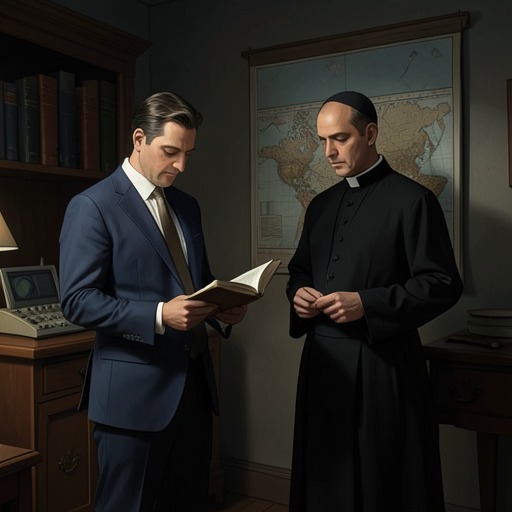
The chronicle reaches Fenn through Monsignor Delgard’s investigation. During a storm, Fenn enters the church where the old church chest has been kept and recognizes Woolgar’s name on the plaque before preparing to open the chest. Delgard later translates and annotates the papers. His notes describe difficult, erratic writing and uncertain passages, distinguishing his own interpretation from the manuscript’s claims. Fenn reads the document and struggles to decide whether it records a real history or the ravings of a disturbed man. That uncertainty is part of Woolgar’s significance: the manuscript offers an explanation for events in Banfield without making that explanation independently certain.
Priesthood, Einor, and the Account of Their Past
Woolgar presents himself as a once-respected parish priest. He says villagers trusted his counsel and treated his word as religious authority, while he took pride in serving the parish during the religious upheavals of the period. His account also describes Einor as a nun brought to the church by the prioress. She tended the sick, prepared remedies, and gained a reputation for healing; some people attributed her success to divine guidance. Woolgar recalls her use of small images associated with healing, a practice that interested him even when he considered it sacrilegious.
He says that a serious illness left him in Einor’s care and that their relationship became a sexual and religious transgression. In the chronicle, he describes being drawn into her influence, but his narrative simultaneously admits his own desire and participation. He attributes to Einor ideas about human will and hidden psychical forces, and claims that she understood powers he could not explain. These passages make his account a confession shaped by guilt as much as an explanation of her alleged abilities: he offers supernatural influence as a cause of his conduct while acknowledging that his own will was implicated.
As the relationship continued, Woolgar says that three children disappeared and were killed. He admits helping to silence them and says their bodies were concealed. He also recounts the prioress’s decline and death, which he connects to Einor’s actions, and describes the exploitation of two young novices. One novice later died by suicide after confessing her experience to the prioress. Woolgar’s narrative thus moves beyond private misconduct to a chain of concealed crimes, endangered young people, and institutional knowledge. Its account of these events is his own retrospective testimony, not an impartial record.
Betrayal, Execution, and Exile
When the prioress confronted him, Woolgar confessed to his sexual relationship with Einor but withheld information that might expose the full extent of his involvement. He then accepted the explanation that Einor was a witch who had overcome his reason. Under the authority of Mary Tudor’s persecution of heretics and witches, he denounced Einor and helped set the accusation in motion. He says he returned to Banfield and spread the charge among parishioners whose children had disappeared.
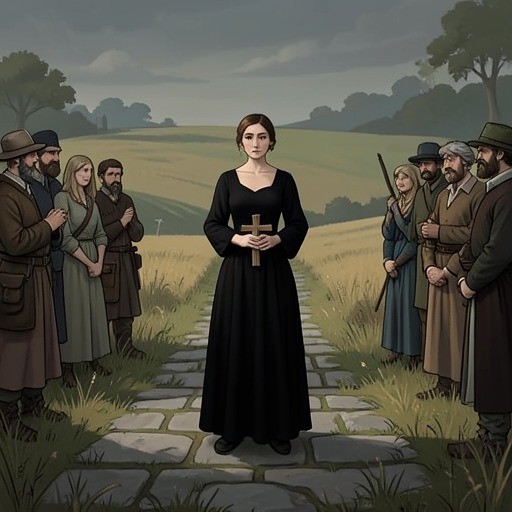
Woolgar’s chronicle depicts the villagers seizing Einor at the church and subjecting her to a brutal public ordeal before carrying out her execution. In that account, she curses him and the people present as she dies. Woolgar writes that he did not stop the crowd and eventually wanted the accusation against her to be true. The confession therefore records both his role in bringing about her death and his effort to distinguish himself from the violence that followed. He casts himself as deceived and fearful, yet his own account shows that he helped direct suspicion toward Einor, denied the extent of his complicity, and failed to intervene decisively.
Afterward, Woolgar says, his father and bishop judged him mentally unwell and removed him from Banfield. He was assigned to serve at the church on his father’s estate, where he describes himself as isolated and troubled by visions of Einor. His father arranged for the church chest and parish records to be transferred there. Woolgar suspects that his father wanted to protect the family’s reputation by examining the records, but says that he had not written down the evidence of his own misconduct in the parish documents. He hides the chronicle separately, intending it to be found in the future.
The Manuscript and Its Connection to Banfield
The chronicle is framed as a warning written while Woolgar believes Einor’s presence still pursues him. Its final pages claim that her spirit has not found rest and urge future readers to protect their souls. Delgard’s annotations identify the surviving document as Woolgar’s work, while noting illegibility and the difficulty of interpreting portions of it. The manuscript’s form—an agitated first-person confession preserved in a church chest—makes the reader encounter both the alleged history and the fear, guilt, and self-justification through which Woolgar recounts it.
Delgard sees a possible link between Woolgar’s history and Alice Pagett: Einor’s death in the field near St. Joseph’s, Alice’s conception there, and the modern cluster of reported cures may, in his theory, have brought old psychical forces into contact with new circumstances. Woolgar’s text supplies details that inform that hypothesis, including Einor’s supposed powers, her execution, and her curse. It does not settle whether Einor’s spirit survived, whether Alice is connected to her, or whether the manuscript’s supernatural claims are true. Fenn remains divided between the document and his own reluctance to accept the paranormal, even after his experiences in a church at Barham.
Woolgar’s lasting narrative role is therefore double. He is the source of the historical account that lets Delgard and Fenn connect the present crisis to a buried past, but he is also a compromised witness whose account repeatedly redistributes responsibility. His chronicle makes the transfer of blame visible: a priest who helped enable harm presents himself as entranced, while the woman he accused becomes the focus of the community’s violence. The manuscript’s most consequential revelation is not simply its proposed supernatural link to Banfield, but the human chain of desire, concealment, accusation, and collective punishment that Woolgar confesses while trying to excuse himself.