Gerry Fenn
ShrineGerry Fenn is a journalist whose pursuit of a story about Alice Pagett draws him from opportunistic reporting into a dangerous investigation of the events at St. Joseph’s Church. He is at once a witness, a skeptic, and a participant: the same professional instinct that first turns Alice into sensational copy later drives him to search archives and confront the history behind the apparent miracles. His struggle to distinguish evidence from belief leaves him isolated, but at the shrine’s final collapse he manages to resist Either-Nor and is rescued by Sue and Ben.
Identity and Introduction
Fenn first appears after a local public meeting that has consumed nearly two hours debating whether remote houses should connect to the main drainage system. Tired, angry, and somewhat drunk, he has fallen asleep at the back of the hall and is roused only by the meeting’s noisy conclusion. His exhaustion and impatience establish a reporter accustomed to treating local affairs as tedious until something more compelling interrupts them.
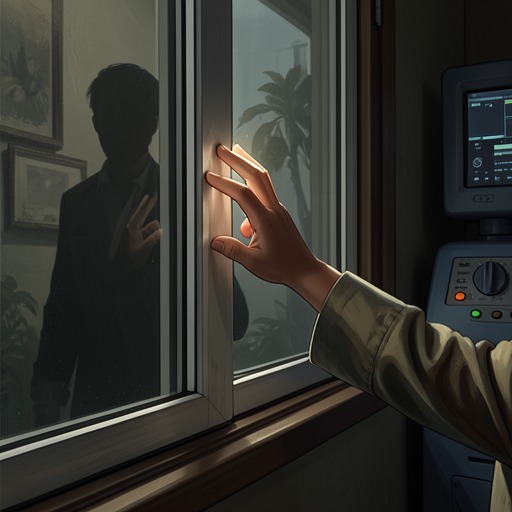
Driving away in a van, he hears a sound that makes him brake and swerve sharply, bringing the vehicle to rest on the grass verge. After a brief pause, he leans out into the cold night air. He has encountered what seems to be a small figure near an isolated tree in the field. Watching from the road, he initially misreads the child’s posture as sinking into the earth; when he approaches, he sees a girl kneeling and looking at the tree. The encounter becomes the opening point of his involvement with Alice and the field’s emerging reputation.
Fenn’s first response is not reverence but professional calculation. In his written version of the incident, he arranges the details into a dramatic progression: a white apparition in the night, a pursuit through a graveyard, and a little girl in a white nightgown kneeling alone before the tree. He also recognizes that Alice had been deaf and mute. His imagined story emphasizes atmosphere and a striking reveal, exposing how readily he turns an uncertain experience into a publishable spectacle. The episode does not make him a simple fabricator: he has witnessed something unusual, but he selects and shapes its details for effect.
Reporting, Skepticism, and the Miracle
The public response to Alice’s recovery places Fenn among competing explanations rather than outside the debate. Father Andrew Hagan has returned from Sussex Hospital in Brighton, where Alice is undergoing tests. Specialists had found no physical malformation in her ears or throat and had understood her deafness and muteness as psychosomatic. Her sudden ability to hear and speak is therefore medically striking, but the account distinguishes a change in her condition from proof of a supernatural cause. Fenn’s later work unfolds in the same unsettled space: visible outcomes provoke claims of miracles, while the grounds for interpreting them remain disputed.
At a crowded church gathering, Fenn’s excitement gives way to impatience as the congregation presses close and blocks his view of the front bench. Sue, beside him, reacts with sudden hostility to the contempt she perceives in his manner. The moment exposes a divide between them: Fenn’s skepticism can function as professional detachment, but it can also look like reflexive disbelief shaped by self-interest. Sue’s response leaves him confused, and he does not understand why she has turned away.
His reporting later intersects with formal Church and medical procedures. Bishop Caines announces that six extraordinary cures, described cautiously as alleged cures, will be examined by a specially formed medical bureau. The bureau will consult the patients’ doctors and hospitals, conduct examinations, and keep dossiers before passing its findings to an international committee. Monsignor Delgard clarifies the boundary of that process: the investigators can assess whether a cure is medically inexplicable, but they cannot establish whether it is a miracle. Fenn presses for an account of the medical team’s findings, showing his interest in what can be established through evidence even as the story acquires religious meaning.
The distinction between investigation and interpretation is central to Fenn’s role. Medical bodies can examine the recoveries, and Church authorities can define what their process does and does not decide, but neither procedure settles the larger question that attracts the public. Fenn reports within that tension. His work brings him close to the institutional machinery surrounding the cures, while his own experiences increasingly resist the clean separation between observable fact and supernatural explanation.
Investigation and Mounting Conflict
Fenn’s relationship with Sue remains strained by the contrast between his skepticism and her response to the events. In one exchange, she teases him for looking pleased with himself; elsewhere, the pressure of the crowded church gives way to her sharp, unspoken judgment of his contemptuous outlook. The evidence shows emotional distance and misunderstanding rather than a settled reconciliation at this stage. Their connection later becomes consequential in a different way: Sue is one of the people who physically gets him away from the shrine.
A local offer invites Fenn to help steer publicity from inside, on the argument that publicity is already gathering momentum and needs guidance. The invitation treats him as a journalist whose influence might be useful to the people promoting Banfield. Separately, Monsignor Delgard tells him that he has looked into Fenn’s circumstances and asks for his help, citing both Fenn’s association with the Church under Bishop Caines’ direction and his possible usefulness in other ways. These approaches place Fenn between institutional inquiry and publicity management, without making his role identical to either one.
The danger becomes immediate during the crash involving Len Pagett. Fenn identifies Len as the driver of an erratically moving car, while Nancy screams and the vehicle’s direction appears beyond the driver’s control. The car skids into the path of a bus turning into a garage forecourt where a tanker is unloading its contents. Fenn is present as a witness to the collision and the resulting fire. He then runs toward the burning vehicles, angry and frightened, trying to reach Len, who is trapped inside the car. Heat and smoke impede his approach, and he sees Len trying to get out through the rear of the vehicle. The evidence establishes Fenn’s attempt to help, not a successful rescue.
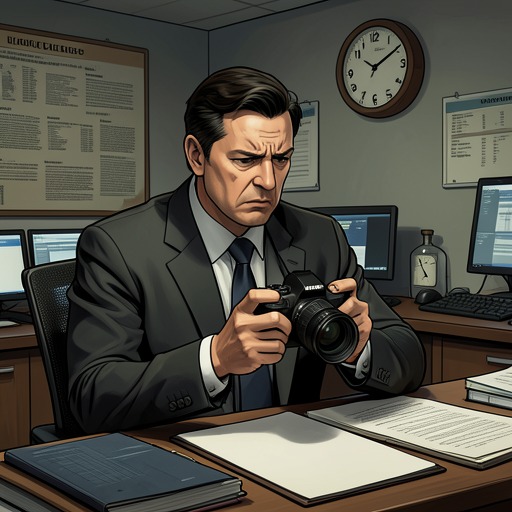
The episode also marks a break in his professional life. In a later telephone conversation, Frank Aitken says Fenn reported being slightly burned in the Banfield fire, but did not file the story despite having witnessed the whole event. Fenn said he had leave available and chose to take it. Aitken has been unable to reach him at home or find him through a visitor, and reports that he has disappeared from contact. The contrast is pointed: the reporter who had once converted a strange night encounter into dramatic copy now declines to deliver a major story he witnessed firsthand. The available account does not establish why he withdraws from work, but it makes his absence a conspicuous consequence of the fire.
Historical Search and the Failure of Proof
Fenn’s later investigation takes him from contemporary events into church history. In a crypt, he studies damaged statues and recognizes a figure of Mary as resembling the statue upstairs in the church. The contrast between its apparently ruined appearance at a distance and its serene, intact face at close range unsettles his first impression. When a lamp is brought nearer, he continues examining the statues. The scene places his attention on physical objects that may be clues, while also showing how poor light and shifting appearances complicate what he thinks he sees.
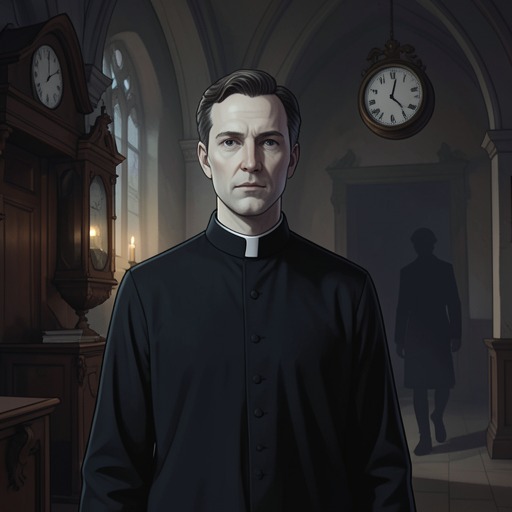
Monsignor Delgard insists that locating the church chest is vital and reminds Fenn of an earlier experience: Fenn had believed that a white, unblemished statue of the Virgin Mary moved toward him, with its lips and eyes seeming alive. Delgard uses the discrepancy between that conviction and Fenn’s present doubt to challenge him. Fenn’s own testimony thus becomes evidence in a dispute about his reliability, even as he continues investigating phenomena that cannot easily be dismissed as ordinary observation.
Following Delgard’s advice, Fenn visits the cathedral at Arundel to seek further documents concerning St. Joseph’s Church. There he learns of St. Peter’s Church at Stapley and Stapley Manor, making a connection he recognizes from his archival notes. The Church had owned the estate associated with the history he is tracing. He concludes that the chest in the small church may be the one he has been looking for, then opens it using a short metal rod and a sequence of keys as instructed by a priest. The padlock comes apart, and the heavy lid opens. This is a concrete step in his archival search, although the evidence does not show that the chest provides the decisive proof he needs.
By the time Fenn tries to persuade Bishop Caines, he is exhausted by disturbed sleep and aware that his intensity sounds nearly deranged. Caines does not accept his warnings; the bishop requires proof. Fenn’s account of a manuscript and Delgard’s translation cannot supply it, and he finds no usable confirmation in the priest’s house, where only dust remains. He also fails to persuade Southworth, the businessman whose interests are tied to Banfield’s development. Fenn recognizes that his urgency and emotional force have weakened his credibility, but he cannot make the danger legible to people who demand evidence he cannot produce.
The Shrine and the Ending
At the public service, Fenn sees Alice walk to the center of the platform as the hymn falters and stops. Her apparent serenity gives way, in his perception, to a smile that seems threatening and directed at him; the crowd, by contrast, is absorbed by her. He feels his strength ebb as the people watch. The scene reverses the logic of his first encounter with Alice: once she was a striking subject for a story, but now she is the focus of a mass response that Fenn experiences as dangerous and personally involving.
During the disaster, Fenn is left on the platform amid a foul atmosphere and the confusion of people trying to escape as the ground trembles. Though his body feels weak and his attention is held by the figure before him, he understands the danger as an attempt to destroy everything around it. He recalls the voices that have appeared in his dreams and thinks of Either-Nor as dependent on the living, drawing power from their accumulated evil. The thought offers him a principle of resistance: Either-Nor cannot govern those who oppose it. Fenn tries to resist, though the account leaves uncertainty about whether he trusts the voices or fears that he is deceiving himself.
His resistance is not presented as a sudden mastery of the threat. He is drawn toward Either-Nor and nearly loses himself in the encounter. Sue and Ben reach him and pull him from the platform, leading him away as the tree begins to fall. From outside the shrine, Fenn sees Alice’s body engulfed beneath the descending tree and the creature’s form destroyed. The shrine’s centerpiece collapses around the people who have fallen there. The scene makes Fenn’s survival dependent not only on his refusal to yield but on Sue and Ben’s intervention.
Afterward, Fenn looks toward Sue at the open car door and gently shakes his head. The small gesture closes an arc that began with him alone in a van, turning a strange sight into a story. At the end, he has witnessed the collapse of the shrine and survived an encounter he could neither prove to Bishop Caines nor fully master himself. His importance lies in that unresolved passage: skepticism does not protect him from the uncanny, while belief alone does not give him control. He remains a reporter shaped by the demand for evidence, but the final crisis leaves him alive through resistance, help, and events that exceed what his reporting can settle.