Monsignor Peter Delgard
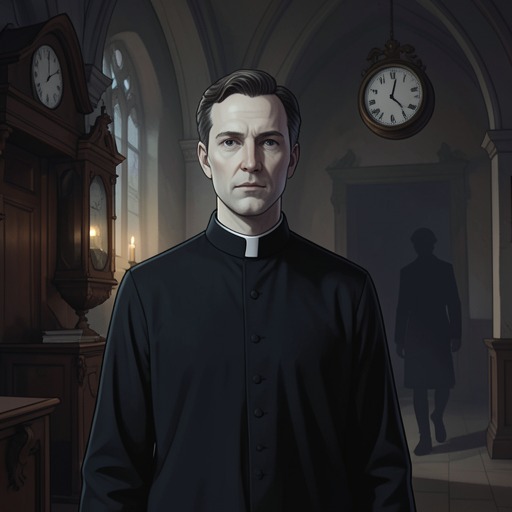
ShrineMonsignor Peter Delgard is the senior cleric who helps manage the Roman Catholic Church’s response to the reported cures at St. Joseph’s Church in Banfield. His significance lies in the boundary he maintains between medical findings and religious judgment: extraordinary recoveries may warrant investigation, but neither public excitement nor a medical committee can by itself establish a miracle. His work also leads Gerry Fenn toward the church’s past, where the emerging historical record unsettles any simple division between religious authority and moral responsibility.
Identity and First Appearance
Fenn first notices Delgard during a crowded service at St. Joseph’s Church. Tall and painfully thin, with a pronounced stoop and a forceful stride, he walks up the aisle to settle a disturbance at the doors. The congregation parts to let him through, and the murmuring pauses while he moves among them. The scene gives him an immediate presence in the church: he can impose order without raising the public gathering’s excitement into spectacle.
When Fenn is challenged as a reporter, Delgard steps between him and the priest confronting him, identifies himself, and asks whether he can help. This introduction establishes him as both an intermediary and an authority within the parish. He does not simply exclude Fenn; he opens a channel through which the reporter can become involved in the inquiry.
Caution and the Investigation of the Cures
Delgard argues that the developing situation must be examined thoroughly before the Church makes a judgment. The crowds have already gathered in substantial numbers, including on a working day before the news has appeared in the press, but he cautions against encouraging them. His position recognizes that events may gather momentum independently of official approval, making restraint and investigation more urgent rather than less.
He proposes interviewing each of the six people reported cured, including Alice Pagett, and seeking permission to consult their doctors and medical records. He recommends an independent medical commission to investigate their histories. At a later press conference, he explains the commission’s remit: it is to determine whether a cure is medically inexplicable, not whether it has a religious or mystical cause. That distinction reserves the spiritual interpretation for the bishop and his advisers rather than allowing a clinical finding to settle a theological question.
Delgard outlines the medical tests that the commission must consider. A cure must be sudden, complete, lasting, and without convalescence; the original illness must be serious and objectively established; and prior treatment must not account for the recovery. The committee also needs time to determine whether improvement lasts, with three or four years given as an example of the necessary interval. A condition attributed to a mental disorder would not satisfy the stated standard for a miraculous cure. These requirements make delay part of the process: a public claim can arise quickly, but the Church’s medical assessment cannot responsibly do so.
The investigation is presented as institutionally divided. A medical bureau is to examine the cases and pass its findings to the International Medical Committee, which can recommend whether a cure is inexplicable. Delgard explains that the bishop, rather than the committee, makes the final decision about whether the cures are declared miraculous. He also describes the Church’s historical caution: strict guidelines dating to the eighteenth century were intended to guard against proclaiming events that scientific evidence might later explain. The procedure protects the Church from premature certainty while preserving a distinct role for spiritual judgment.
Banfield, Fenn, and the Church’s Interests
Delgard’s caution is not a withdrawal from the crisis. He acknowledges the crowds and the likely scrutiny, while declining to encourage expectations before the evidence is gathered. The distinction matters in a town where religious hope, press attention, and the possibility of commercial revival can converge. George Southworth speaks of a possible rebirth for Banfield and renewed belief among its people, while also admitting that the town’s revitalization could benefit him. Delgard’s method offers a counterweight to such competing interests: the cures must be examined case by case, not made certain by the hopes attached to them.
He eventually gives Fenn a direct assignment: to find out about the church. This request extends the inquiry beyond the medical status of the reported cures. Delgard’s role thus links institutional scrutiny of present events to a reporter’s investigation of St. Joseph’s history. The request also places Fenn in a working relationship with him, though the evidence presents their cooperation as investigative rather than as an unrestricted sharing of authority.
The Historical Record and Its Limits
Fenn later reads a large notebook associated with Delgard while the monsignor is away. The material includes a chronicle attributed to Thomas Woolgar, whose account describes a sixteenth-century priest’s involvement with Einor, the deaths of three children, the priest’s denunciation of Einor, and her execution by villagers. The chronicle portrays Woolgar as confessing both participation and guilt while also attempting to shift responsibility onto Einor. It records that his father and bishop later treated his account of supernatural events as madness, and that the church chest containing parish records was moved from St. Joseph’s to another church.
The chronicle is not presented as a neutral, independently verified history. Its author depicts himself as both culpable and tormented, and the account itself preserves the tension between his confession, his self-exculpation, and the supernatural explanations he insists upon. Delgard’s connection to the notebook places him near this contested record, but does not make him its author or establish every claim in it as fact. Its importance to his investigation is that the church’s present-day claims cannot be considered wholly apart from the disturbing history attached to the site.
Narrative Role
Delgard embodies procedural restraint at a moment when cures are already attracting crowds and competing interpretations. He separates medical expertise from ecclesiastical authority without dismissing either, and he treats investigation as a prerequisite to judgment rather than as a device for validating a conclusion already reached. His physical command of a crowded church contrasts with the careful limits he places on what the Church can yet claim.
His assignment to Fenn broadens that scrutiny from the patients’ medical histories to the church itself. The notebook and Woolgar chronicle give this inquiry a longer temporal reach, while their uncertain and self-accusing testimony prevents the past from serving as uncomplicated proof. Delgard’s significance is therefore not that he resolves the tension between miracle, medicine, and history, but that he insists those questions be investigated separately even as the story brings them into contact.