George Southworth
ShrineGeorge Southworth, the hotel owner and parish council member, helps turn the alleged cures at St. Joseph’s Church into a public and commercial opportunity for Banfield. He presents the events as a possible divine gift and a chance for the village to recover, but his own plans reveal a less generous ambition: he wants the pilgrimage to revive his hotel, increase the value of property he secretly owns, and restore the Southworth name. His flight during the shrine’s final catastrophe exposes the moral cost of that double vision.## Identity and Introduction Southworth first enters the story as a local businessman who believes Banfield has little to offer visitors. In summer, his hotel receives travelers using the village as a base for excursions around Sussex, Brighton, and other south-coast resorts, but he considers the benefit to Banfield itself minimal. He is nevertheless willing to invest more if he expects a reasonable return, and he knows Rodney Tucker shares that combination of interest and caution. Their concern is not simply whether the village might attract attention, but whether attention can be converted into lasting economic benefit.
Southworth’s response changes after Tucker telephones him about the occurrence at St. Joseph’s Church. He admits that he had previously dismissed reports of it as exaggerated or misinformed. Reading Gerry Fenn’s account and then meeting Tucker persuade him that the event might grow into something consequential. He is therefore among the first local figures to understand that the reported cures could alter Banfield’s prospects, although his interest in that possibility is never solely pastoral.
From Reported Cures to Public Opportunity
Southworth argues that the events may be divine and that the village might have been given an opportunity for renewal. In his account, Banfield could be reborn from decline while its people regain belief. He asks Fenn to write more about what is becoming known as the Banfield Miracle, joining religious language to an appeal for continuing publicity. The two purposes coexist from the outset: the miracle may matter as a sign of divine action, and reporting it may bring Banfield the attention it lacks.
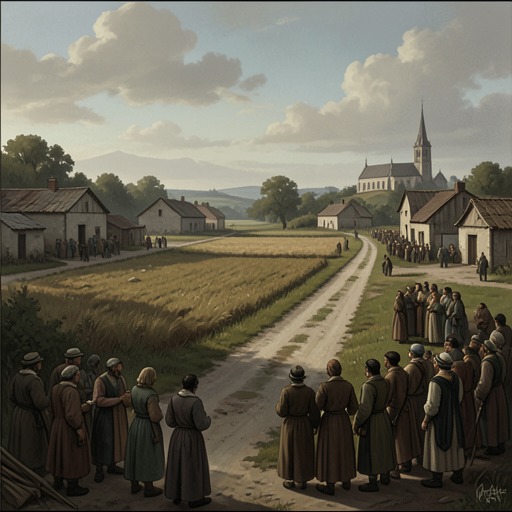
The gathering at the church soon gives that possibility a visible form. On a cold, wet Sunday, unusual traffic and activity fill the village streets as people make their way toward the grounds. Fenn sees Southworth seated near the front of the church, among those attending the service. The crowds include people already familiar to Fenn from the day Alice Pagett was cured, as well as visitors whose interest may have come from further afield. Southworth’s presence places him at the meeting point between local organization and public expectation: the event is still religious in form, but the number and variety of those arriving promise a wider consequence.
After further reported cures, that consequence becomes difficult to contain. Bishop Caines recognizes that people will come in large numbers whether or not the church is formally declared a shrine, and stresses that the Roman Catholic Church must manage the situation. Southworth, meanwhile, sees a possible alliance between the parish council and the Church. He has spoken with Bishop Caines and expects cooperation over the coming months, while saying that he opposes cheap exploitation or activity that would compromise the dignity of the Church. The Church’s official response includes a medical examination of the six alleged cures and an agreement to purchase the adjoining field. Southworth’s hopes thus develop alongside attempts by religious and civic authorities to organize the site, not outside them.
Publicity, Investment, and Contradiction
As the story spreads, Southworth sees Banfield transformed by press, television, and magazine attention. The village, previously obscure, is suddenly crowded with media representatives; its residents are bewildered by the attention but begin to thrive on it. The early limitations of individual cures do not end the publicity: one patient’s sight is still improving, and a boy continues to have difficulty walking without assistance while his weakened leg muscles recover. For Southworth, the broader change is already unmistakable. Banfield has become a place the world knows about, and the crowds offer a prospect of continuing business.
His public caution about exploitation contrasts with his private property dealings. Southworth secretly owns several Banfield shops, bought cheaply over the years through a company and negotiated by his solicitor so that even fellow parish council members do not know he is the owner. With business expected to boom, he plans to double, and perhaps treble, the tenants’ rents. He assumes that tenants who cannot pay can be replaced by others eager to take their places at still higher rates. He also anticipates beginning work on a more modern hotel designed for rapid turnover. These are not merely hopes for general village prosperity: his concealment, anticipated rent increases, and plans for his own hotel show how specifically he intends to benefit.
Southworth does not describe himself as the sole beneficiary. He considers the tourist trade good for Banfield and the Church as well as for those who have invested. But Fenn privately recognizes the self-interest beneath his appeal, and the gap between Southworth’s public language and hidden holdings makes that judgment consequential. Southworth supports steering the publicity from within even after it has begun to spread on its own. He tells Fenn that the publicity machine needs little impetus from him or the parish council, but might need guidance, and suggests that Fenn could help provide it. He wants to shape the opportunity while preserving the appearance that events are moving naturally.
The Miracle as a Private Revival
The large open-air gathering confirms the scale of the transformation Southworth anticipated. Hours before Mass, people are already pressing through a newly constructed entrance and filling the field, seeking places near the altar. Some want to see Alice, whom others regard as the Miracle Girl; some hope to be close enough to feel the effects of her holiness. The crowd has become both congregation and audience, and the site’s growing arrangements accommodate religious dignitaries, associations, and ordinary visitors.
The devotional setting is accompanied by an expanding trade in religious souvenirs. Makeshift stalls display small statues, holy trinkets, and images of the Virgin; one poster shows the Pope in a cowboy hat, and a plastic shrine has a newspaper photograph of Alice where another holy image had been. Visitors can also buy a container advertised as holding holy soil from the field. These details make tangible the conversion of the reported events into objects for consumption. Southworth is not shown setting up these particular stalls, but the trade belongs to the tourism boom he has welcomed and privately prepared to exploit.
During the service, Southworth witnesses a patient’s severe facial pits being covered by rapidly growing skin as the child takes her place again among the congregation. The change occurs before thousands, and even Monsignor Delgard cannot dismiss what has physically happened. Southworth takes this as confirmation that the phenomenon is genuine, but its meaning for him remains distinctive. While religious figures confront the implications for faith and ecclesiastical authority, Southworth returns to his desk with brandy and imagines the village, his wealth, and the Southworth name rising together. The miracle has renewed his expectations of personal and local advancement; that expectation is, in effect, his own private miracle.
Exposure and Flight
When Alice rises after being shot and transformed, Southworth understands the danger in terms that implicate him. He believes the creature has recognized the greed in his heart and welcomed it as part of the evil sustaining her existence. The insight does not lead him to remain with the crowd or assist those in danger. He runs toward the church wall as panic spreads, and when a wasted, skeletal man asks him to carry him away, Southworth knocks the man’s hand aside and continues fleeing.
The shaking ground drives Southworth and other escapees over the low wall into the graveyard. There, the tremors disturb the graves: a stone slab falls, a tomb covering slides off and breaks, and Southworth sees shapes moving in the earth. He struggles toward St. Joseph’s Church, reaching its old wooden door and forcing his way inside. He shuts it against the disturbance outside, then remains in the dark, listening as something scratches at the wood. Seeking the church as sanctuary, he finds it enclosed by the consequences of the very pilgrimage economy he had expected to secure his future.
The disturbance continues inside. Southworth moves through the church touching the pews as he passes, reaches the altar rail, and finds the building vibrating as its statues shift. The available account does not establish what happens to him during the church’s upheaval. Afterward, he is found hiding in St. Joseph’s, shivering and in such a state that others have to drag him out; he refuses to walk down the aisle to the broken doorway. The church has a cracked door and a shattered stained-glass window, damage thought to have been caused by lightning, but no other damage is found. Southworth nevertheless insists that the building lay in ruins around him.
Narrative Role
Southworth links the alleged miracle to the material structures that grow around it: publicity, parish planning, accommodation, property ownership, and the trade in pilgrimage goods. His changing response is not a simple passage from disbelief to faith. He begins by dismissing the story, comes to see it as a divine and economic opportunity, and ultimately recognizes his own acquisitiveness as part of the evil revealed at the shrine. Yet recognition arrives in the form of terror rather than reform. His flight, including his refusal to help the disabled man, shows that the moral knowledge he gains does not make him courageous or selfless.
The contrast between his publicly stated concern for Banfield and his concealed ownership of its shops gives the village’s revival a sharp double edge. Southworth’s plans might help turn a declining place into a destination, but they also make residents and visitors resources from which he expects to extract profit. When the shrine collapses into catastrophe, the commercial optimism that once made him imagine Banfield flourishing becomes part of the story’s judgment on collective greed. His final image is not that of the successful promoter but of a man hiding in the church, unable to make his remembered catastrophe agree with the limited damage others find.