Father Andrew Hagan
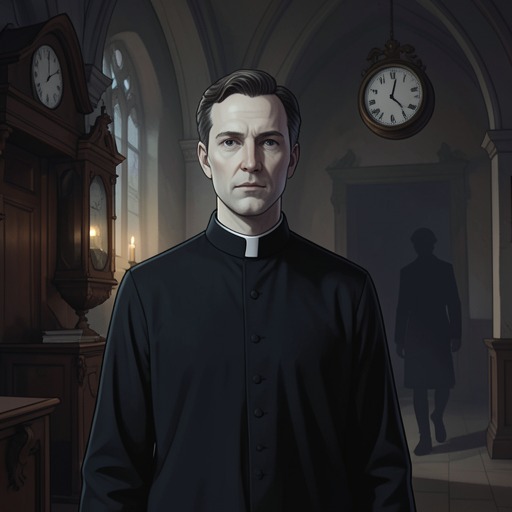
ShrineFather Andrew Hagan is the parish priest of St. Joseph’s Church and one of the first adults to take responsibility for Alice Pagett when her strange experiences draw attention to the village. His history gives that role a particular weight: a mild heart attack once forced him to confront the erosion of his faith, but years later he is again physically declining and uncertain about the spiritual life of the church he serves. He tries to protect Alice even as others insist she must remain close to the place she loves; he dies before the danger he senses can be settled.
Identity and Background
Hagan is forty-six and has been part of the Church for nearly nineteen years. Before becoming a priest, he taught for four years at a Catholic grammar school in London, teaching history and divinity. He then spent three years at a comprehensive school in the suburbs, where religion had become almost defunct. He continued to teach history and sometimes English, but no longer had the daily opportunity to discuss belief with young people. His faith, once sustained through that work, became increasingly private and difficult to express.
Two days after his twenty-seventh birthday, a mild heart attack interrupted what he understood as a gradual loss of faith. He had felt material concerns narrowing his spiritual life, and the closeness of death made that decline impossible to ignore. Within a year, he was in Rome studying for the priesthood. The decision was not simply a career change: he wanted to live among people who believed, trusting that their faith could strengthen his own. Yet he later wonders whether the earlier corrosion had left a residue. His vocation therefore begins in renewed commitment, but not in untroubled certainty.
As parish priest, he lives in an isolated presbytery beside a graveyard, with fields and woods surrounding it on three sides and the main road connecting him to his parishioners. The setting places him between the daily life of the village and the more secluded responsibilities of the church. When someone pounds on his door after midnight, he is reluctant to open it, though he is not described as timid. He switches on the porch light and admits a frightened man carrying a child.
Alice Pagett and Pastoral Responsibility
Hagan recognizes the frail child in the nightdress as Alice before seeing her face clearly. He brings her inside, turns on the sitting-room light and heater, and identifies her by name when asked who she is. He does not answer the questions about why she has come or where she is from. His immediate response is practical care rather than speculation: the child is brought into warmth and safety before her presence is explained.
That concern continues when Alice kneels near the oak during the episode in which other children begin to collapse or weep. Gerry Fenn sees the children’s behavior as possibly connected to Alice’s mental state, but Hagan moves through the anxious families and kneels beside her. Knowing she cannot hear, he puts an arm around her and speaks in the hope that she will sense his kindness. The scene establishes a form of care that does not depend on Alice being able to answer him or confirm what she understands. While the adults around her are trying to interpret the event, Hagan attends to the child herself.
His concern eventually puts him at odds with those who want Alice to remain at St. Joseph’s Church. He argues that she should be kept away from the church permanently. Bishop Caines rejects the proposal as impractical: Alice has known the church all her life, misses it when separated from it, and has been found weeping in her room. The disagreement reveals competing versions of protection. Hagan sees continued access to the church as something that may need to be stopped; the bishop emphasizes Alice’s attachment and the impossibility of keeping her away indefinitely. The account gives no full explanation of Hagan’s reasoning, but his warning makes clear that he does not regard her presence there as harmless.
Hagan also takes an interest in Alice’s pictures. With her mother’s permission, he removes some from the house, and the pictures are later described as repeatedly depicting a figure believed to be the Blessed Virgin. Alice’s focus is understood as unusually concentrated, even obsessive. Hagan’s knowledge of the drawings places him among those who have seen evidence of her private preoccupation before it becomes a public matter.
Doubt and Declining Health
Hagan’s concern about Alice develops alongside a renewed crisis of confidence. In a conversation with Bishop Caines, the bishop admits grave misgivings about the matter, and Hagan responds that he is worried and confused as well. He is not presented as offering an easy religious explanation. His earlier struggle with faith has left him alert to the possibility that apparent spiritual events may not be what they seem, while his pastoral responsibilities prevent him from treating the situation as an abstract puzzle.
By the time of a crowded Mass, his appearance has changed markedly. Fenn sees him as bowed and sallow, with a nervous manner and an evident unease before the size of the congregation. The priest’s vestments no longer seem to conceal his frailty. As the service continues, however, Fenn becomes less certain that Hagan’s deterioration is as severe as it first appeared; perhaps the priest seems to regain some stature, or perhaps the earlier impression was intensified by the time since they last met. The uncertainty belongs to Fenn’s observation, not to a confirmed recovery. At a later meeting, Bishop Caines is again shocked by how much Hagan’s physical condition has worsened over only a few weeks. He takes Hagan’s hand and offers him brandy, but Hagan protests that he is fine.
A later account of St. Joseph’s Church’s spiritual condition links Hagan to the judgment that the church is empty. The statement is reported by someone else rather than delivered directly by Hagan, but it presents his sense of spiritual depletion as preceding his death. This perception sits uneasily beside the crowds gathered around Alice: public attention and religious excitement increase, while the priest associated with the church experiences its interior life as diminished.
Death and Narrative Significance
Hagan dies during a dinner attended by Monsignor Delgard and Fenn. The death begins as a sudden choking episode: Delgard rises to help, and Fenn recognizes that Hagan is in distress. Fenn later recalls being present and trying to save him. The postmortem identifies a heart attack, while Fenn remains certain that Hagan was choking. The distinction between the medical finding and Fenn’s firsthand impression is left unresolved, so the death carries both an official explanation and the unsettling circumstances of the witnessed event.
His death is a personal loss for Alice as well as a turning point in the handling of her story. A later report describes her as close to Hagan and records that his death came only days before the death of her father, Leonard Pagett. She is shown standing silently at her father’s grave, apparently shocked by the two losses in quick succession. Hagan’s role in her life has therefore extended beyond initial shelter: he was a trusted priest whose absence compounds her bereavement.
As a character, Hagan joins pastoral tenderness to unresolved doubt. He accepts Alice into his home, comforts her when she cannot hear him, and takes seriously the possibility that she should be kept away from the church. At the same time, he does not claim certainty about what is happening, and his own earlier crisis makes faith something he has had to recover rather than simply inherit. His decline and death leave his warning without resolution. The contrast between the growing crowds around Alice and Hagan’s reported sense of emptiness at St. Joseph’s Church sharpens the story’s distinction between religious spectacle and spiritual conviction: the priest who once sought a community of believers ends his life troubled by the condition of the place he serves.