Molly Pagett
ShrineMolly Pagett is Alice Pagett’s mother and the emotional center of the family’s response to the alleged miracles at Banfield. A devoted Catholic whose life has been organized around caring for her only child, she moves from frightened skepticism to intense religious certainty as Alice’s condition changes. Her maternal hope and faith make the apparent cure a source of profound joy; the same attachment leaves her unable to turn away when the miracle becomes a catastrophe.
Identity and Home
Molly lives with her husband, Leonard Pagett, and Alice in a small red-brick house in Banfield’s public housing. Alice’s childhood illness at four, after which the effects of mumps left her deaf and unable to speak, had made her daughter a continuing source of worry. Molly worked part-time as a home-help, while caring for Alice and managing a strained household. Her anxieties show in small, practical details: she limits her cigarettes according to what the family can afford, but sometimes smokes more when life at home becomes difficult.
Her marriage to Leonard is troubled by their sharply different attitudes toward religion. He is an atheist who avoids churches; Molly’s faith, by contrast, is central to her sense of purpose. She recalls that before they married he would wait outside the church rather than go in. Her later account of their relationship suggests that this difference was not a minor disagreement but a division she had not fully understood when she chose him. Even so, her attention remains focused on Alice, whose needs and safety shape Molly’s ordinary routines as well as her deepest hopes.
The Disappearances and the First Sign of Change
Before Alice’s apparent recovery, Molly is already frightened by her daughter’s unexplained journeys to the oak in the field. On an earlier occasion, Alice’s absence sent Molly searching the church and grounds and checking the road. Father Andrew Hagan helped with the search and found Alice kneeling before the tree. The girl had been smiling, then appeared confused and disoriented when her mother and the priest approached. Molly asked why she had gone there in sign language, but Alice did not seem to understand. Although Alice afterward seemed mostly herself, Molly could not forget the episode.
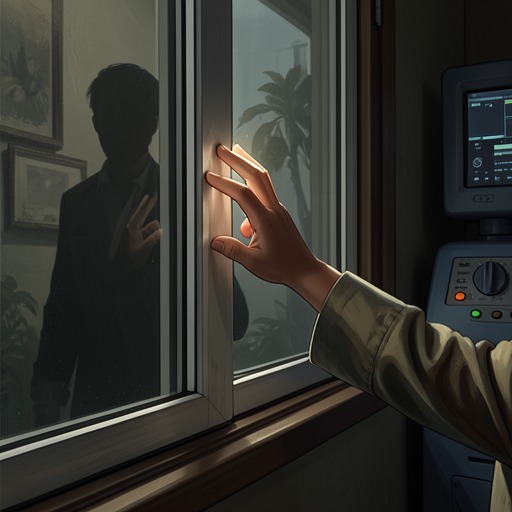
The fear returns when Father Andrew Hagan arrives at the house during the night to say that Alice is at the presbytery with a doctor. Molly initially insists that her daughter is asleep in bed. She rushes to check and finds the bed empty, with the covers thrown back and Alice’s doll hanging over the edge. Leonard and Father Andrew Hagan accompany her to the church. The doctor finds nothing apparently wrong and considers sleepwalking a possible explanation, but Molly remains alarmed that Alice has gone to the tree again. The night’s events leave her caught between dread and the faint hope that something extraordinary has happened.
That hope becomes harder to deny when Alice speaks of what she says the woman at the tree told her: that she was the Immaculate Conception. Molly responds by rushing forward, kneeling and embracing her daughter as tears fall. The gesture marks a change in her understanding. Until then, she has tried to make room for an ordinary explanation and has been afraid to hope; now the possibility of a divine intervention takes hold with unusual force.
Faith, Care, and Confinement
Molly’s belief deepens as Alice’s hearing and speech return. She interprets the change as the Blessed Virgin Mary’s intervention, consistent with the devotion she has maintained through years of caring for Alice. She had encouraged her daughter’s worship of Mary, and understands Alice’s recovery not as an isolated medical event but as an answer to their shared religious life. The joy is accompanied by vigilance: when the hospital wants to keep Alice overnight for more examination, Molly refuses, fearing that the tests and probing will undo what has happened.
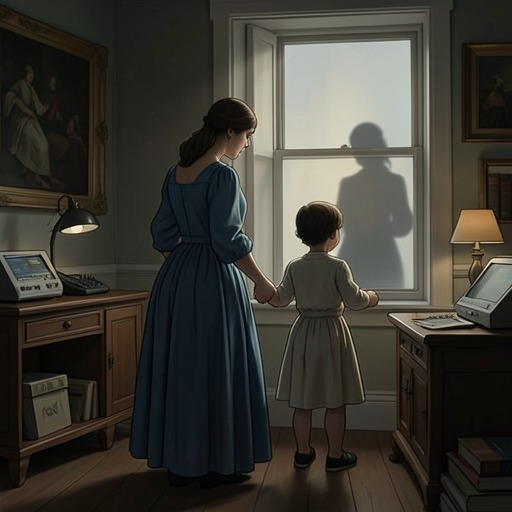
The family’s circumstances change when Alice and Molly are moved into a convent to shield the girl from the press. Molly agrees to follow the Church’s guidance, but the protection also places mother and daughter in an increasingly restricted environment. Molly sleeps in the room next to Alice’s and spends nights awake, murmuring prayers and listening for any disturbance. Her red-rimmed eyes and exhausted appearance reflect how completely the events have absorbed her. The convent becomes an extension of her religious devotion, but it is not a refuge Alice welcomes: the girl dislikes its sparse room and the attention of doctors, clergy, nuns, and reporters. Molly’s faith steadies her even as the surrounding scrutiny and her daughter’s unhappiness intensify her burden.
At night, a familiar electronic game sound from Alice’s room brings Molly out of bed. She remembers the first years of motherhood, when she would hurry to a baby’s cry, and reflects on how much Alice had filled an otherwise barren life. She sees the recovery as a second intervention by the Virgin after the earlier suffering of her child. This recollection reveals the personal history beneath Molly’s public religious certainty: the miracle matters not only because it seems to confirm her faith, but because motherhood has been her most cherished answer to years of prayer.
Leonard Pagett and the Secret of the Field
After Leonard’s death, Monsignor Delgard visits Molly in the convent. Though she is grieving, she speaks of her husband with marked distaste, saying that he could not understand what was happening to Alice because he did not believe in God. She also tells Delgard that Leonard thought he could make money from the events. Her reaction exposes both the old bitterness in their marriage and the way the pilgrimage fever has brought their opposed values into sharper relief.
Molly explains that she wanted to see Delgard because of her own connection to the field beside St Joseph’s Church, which she now regards as sacred ground. Before their marriage, Leonard had waited for her outside the church; she says that Alice was conceived in the field during a single encounter. Molly remembers feeling ashamed afterward and knowing soon that she was pregnant, yet she was happy to have the child. She had feared remaining unmarried and childless, and had devoted much of her life to the church. In her understanding, Alice was a gift from God despite the circumstances that had caused her shame. That belief also leaves her troubled: she cannot reconcile the idea that a gift could follow what she considered a sin with her understanding of divine reward.
The disclosure connects Molly’s most intimate history to the public transformation of the field into a shrine. The place is sacred to her both because of the apparitions and because it is where her own motherhood began. Monsignor Delgard, looking at preparations for a service in the field, recognizes the irony of the conception there. Molly’s confession therefore complicates the language of immaculate origin surrounding Alice: her faith remains sincere, but the family story she reveals is marked by desire, embarrassment, hope, and a life-changing consequence.
The Shrine Disaster and Molly’s Death
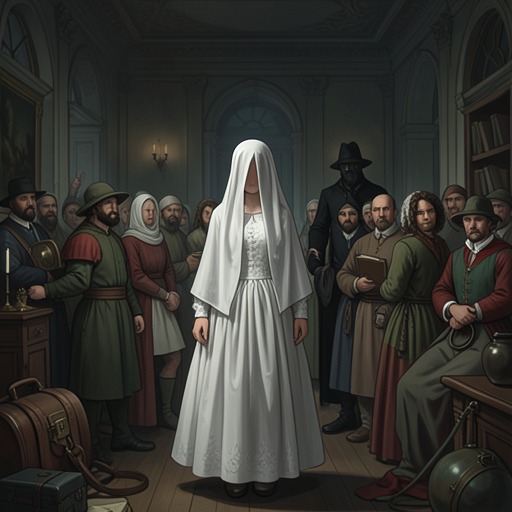
During the great service at the shrine, Molly is among those closest to Alice and the altar. After Wilkes shoots Alice, Molly is left in extreme shock, supported by a priest as the people around her struggle to understand what has happened. Gerry Fenn sees her standing transfixed, reaching toward the small, bloodied figure as Alice begins to rise. The child who had brought Molly renewed faith is no longer recognizable as an ordinary child; the transformation exposes the terror beneath the apparent miracle.
When the figure speaks the name Rosemund, Molly moves toward Alice, then collapses in denial. As the disturbance at the shrine intensifies, she remains standing and reaches toward her daughter even as others falter. Alice’s voice identifies her as a presence associated with death and the underworld, but Molly continues to respond as a mother trying to reach Alice. She cries out to her daughter and advances toward the figure despite the danger.
Molly then reaches toward the charred body of Einor, who has appeared in connection with Alice. The contact sets her alight. Fenn attempts to go to her, but she is beyond his help; she moves once more toward the dark figure before falling from the platform. Her death follows the collapse of the religious spectacle into violence and supernatural terror. In the aftermath, Fenn remembers her as a woman who had endured the sight of Alice being shot, rising again, and becoming something unrecognizable before dying in agony.
Narrative Role and Significance
Molly’s story is shaped by a repeated tension between care and belief. She initially resists certainty, searches for ordinary explanations, and fears allowing herself to hope. Once Alice recovers, however, faith gives Molly a language for the change and a way to interpret the hardships that preceded it. The same conviction helps sustain her through public attention and private grief, but cannot protect her from the danger attached to the shrine.
Her confession also places the spectacle of the pilgrimage beside the intimate circumstances of family life. The field is simultaneously a contested holy site, the setting of Alice’s visions, and the place where Molly says her daughter was conceived. That overlap makes Molly more than a witness to the Banfield events: her history is woven into the place that the Church and the crowds are trying to define. At the end, her actions remain maternal rather than abstractly devotional. Even when Alice’s transformation makes her seem lost, Molly keeps reaching toward her daughter, and that persistence becomes the last expression of the love that has governed her life.