Rosemund
ShrineRosemund is a novice associated with Sister Einor in Thomas Woolgar’s account of the events surrounding Einor’s downfall. The chronicle records her as Einor’s companion and says she was later cast out of the priory; centuries afterward, Alice Pagett names herself Rosemund during her transformation, making the novice’s uncertain fate part of the book’s unresolved link between past and present.
Identity and Historical Record
Rosemund appears only through Thomas Woolgar’s chronicle and the later scene in which Alice Pagett speaks her name. The manuscript places her among two young novices who came to St. Joseph’s Church regularly and became involved with Einor. It does not provide a clear account of Rosemund’s background, family, or life before she entered the priory.
Woolgar describes the novices differently: one accepted Einor’s influence, while the other submitted and later took her own life after confessing to the Prioress. The text does not clearly identify which novice had which experience. It therefore does not establish that Rosemund was the novice who died by suicide, even though Woolgar later connects her directly to Einor.
Rosemund and Einor in the Chronicle
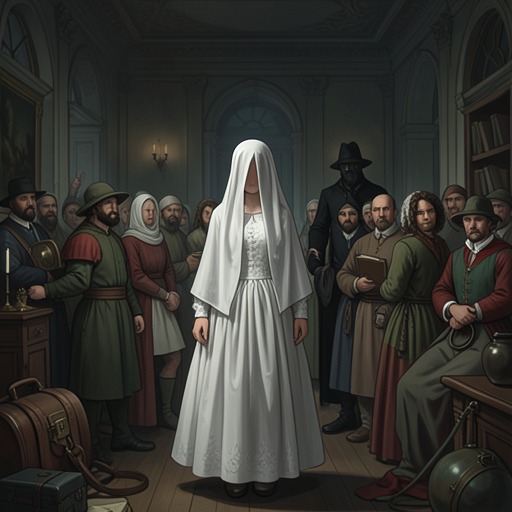
When villagers descended on St. Joseph’s Church, Woolgar says they found Einor beneath the statue of the Virgin Mary with Rosemund. In his account, the crowd seized Einor and cast her companion aside. This episode places Rosemund at the center of the accusations against Einor, but it is reported through Woolgar, whose narrative is shaped by his own acknowledged guilt and attempts to explain his participation in the events.
Woolgar presents Einor as the force behind his conduct and describes himself as having been overcome by her influence. At the same time, he admits that his own will and choices were involved. His account thus gives Rosemund little independent voice: she is identified through her connection to Einor, while the priest’s testimony focuses chiefly on his own culpability, his fear of exposure, and the community’s response. The manuscript is evidence of what Woolgar claimed, not an independent confirmation of every claim it contains.
Expulsion and Uncertain Fate
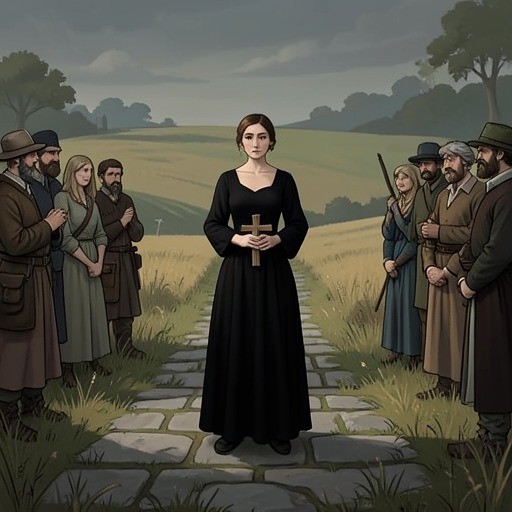
After Einor’s death, Woolgar records that Rosemund was expelled from the priory and went to live in the forests near the village. The chronicle supplies no further reliable account of her life, and it does not say what became of her afterward. Her disappearance from the record leaves her story unfinished: she is neither given a known later identity nor explicitly connected to any person in the intervening centuries.
The Name Reappears
During the final events at the shrine, Gerry Fenn sees Alice Pagett’s features change and hears her identify herself as Rosemund. Molly Pagett, who has moved toward her daughter, stops in shock. The name makes the sixteenth-century chronicle newly relevant to the present-day crisis, but the scene does not explain how Alice’s utterance relates to the historical novice.
After the disaster, Fenn recalls that Rosemund was one of the novices in Woolgar’s account and considers two possibilities: Molly might have descended from Rosemund, or the entity speaking through Alice might be confusing Rosemund with its own history and hatred. Fenn cannot resolve the question. Rosemund consequently remains both a person with a sparse, mediated historical record and a name through which the novel signals a possible, but unconfirmed, continuity between Einor’s past and Alice’s transformation.