Bishop Caines
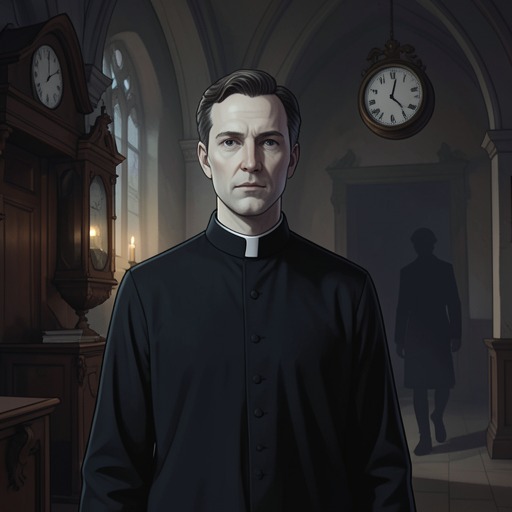
ShrineBishop Caines is the church authority responsible for guiding the official response to Alice Pagett’s reported cures and the crowds that gather at St. Joseph’s Church. His course moves from insistence on evidence and careful procedure to public support for ceremonies built around the disputed claims. The shift leaves him caught between his duties as an investigator and the religious spectacle taking shape around Alice; in the final disaster, he collapses on the altar platform and dies with other members of the clergy.
Office and Initial Caution
Bishop Caines first appears in a pastoral and investigative role, listening to Father Hagan’s concerns about Alice and the claims surrounding her. He challenges the priest’s assumptions by insisting that there is no evidence for the conclusion under discussion. He also stresses that the matter must be investigated thoroughly before any judgment can be made, invoking strict guidelines for assessing such cases. His caution is not presented as simple indifference: he recognizes the seriousness of Hagan’s anxiety and asks whether another concern is troubling him. When Hagan asks what he should do about Alice, the bishop is being asked not merely to pronounce on an event but to guide a parish priest facing an increasingly consequential case.
The distinction between a reported cure and a recognized miracle becomes central to Bishop Caines’s approach. He is wary of allowing the church to appear foolish by making a premature public declaration. After consulting with the cardinal archbishop, he conveys that a full report is required before anything is announced to the media, and that official statements must come from the appropriate offices. His preference is for a controlled, institutional process rather than an immediate public endorsement.
Investigation and Control of Claims
Bishop Caines proposes taking the evidence to the Conference of Bishops and inviting the apostolic delegate, so that the matter can be brought promptly to the Pope and potentially considered at a Synod in Rome. This plan places Alice’s case within formal church channels, where individual testimony can be reviewed before an authoritative position is announced. The bishop’s response thus addresses both the substance of the alleged cures and the risk that uncontrolled publicity will force the church into a premature judgment.
At a press conference, he acknowledges a series of extraordinary cures associated with the church grounds, while qualifying them as alleged cures. He clarifies that the incidents occurred in the field beside St. Joseph’s Church, not literally within the church building, but notes that the church has reached an agreement to purchase the land. This change in the site’s status has practical and symbolic weight: the church is preparing to take responsibility for the place even as the claims remain under examination.
Bishop Caines outlines a medical process for reviewing the six reported cures. A specially formed medical bureau will consult each person’s general practitioner and hospital, conduct examinations, and maintain a dossier. The findings will then go to an international committee for a final recommendation. He relies on Monsignor Delgard to clarify the limits of that inquiry: the medical bodies are to determine whether a cure is inexplicable in light of current science, not whether it constitutes a miracle. The separation preserves a distinction between medical assessment and religious judgment, even as the public increasingly treats the former as a route to the latter.
The Pilgrimage and a Change in Public Role
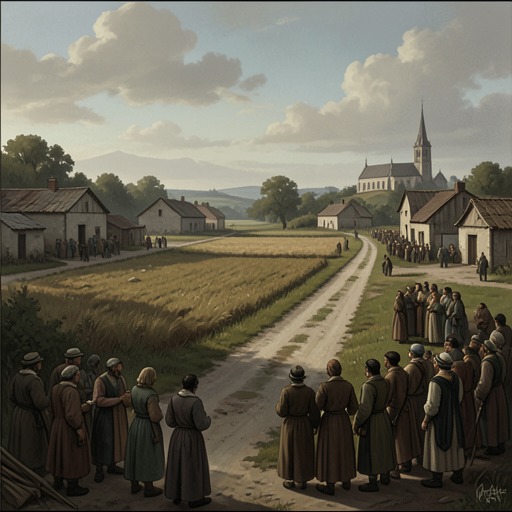
As reports of Alice spread, the response at St. Joseph’s Church grows beyond the scale of an ordinary parish gathering. The first surge of visitors brings pilgrims, believers, and curious onlookers through the church gate. Later, thousands gather for the open-air service, with benches and reserved areas dividing the field among ordinary visitors, clergy, religious associations, and dignitaries. Bishop Caines appears alongside Southworth, talking and laughing before the ceremony. His presence gives institutional standing to an event whose appeal is partly the prospect of seeing Alice and partly the hope of sharing in her holiness.
Father Hagan’s reaction throws the bishop’s public composure into relief. Facing the large congregation, Hagan fears that the church is lending its authority to a delusion and hopes that the gathering will not deepen the sick visitors’ disappointment. Bishop Caines, by contrast, smiles encouragingly from below the altar platform. The contrast does not establish that he privately shares every claim made about Alice; it shows that, at this stage, his conduct publicly sustains a ceremony that Hagan regards with grave doubt.
The bishop’s support remains carefully qualified in his public statements. After a service, he rejects claims that the crowd was badly behaved, while acknowledging that many visitors may have been disappointed because they did not see Alice. He urges the public not to travel to St. Joseph’s, saying there will be nothing to see, yet also confirms that construction is under way and that preparations are being made for a large influx of visitors. His simultaneous discouragement and preparation captures the institutional bind: the church warns against spectacle while organizing for the crowds that spectacle has already produced.
Ambition, Memorial, and Institutional Pressure
Southworth interprets Bishop Caines as more susceptible to persuasion than Father Hagan and believes that the bishop has private ambitions. This is Southworth’s assessment, not an independently confirmed account of the bishop’s motives. The distinction matters: the narrative presents the bishop’s conduct through competing perspectives, including the suspicion that institutional advancement may blunt his judgment. What is observable is that Bishop Caines increasingly manages the public meaning of events rather than simply withholding judgment until the investigation is complete.
After the deaths of Father Hagan and Monsignor Delgard, Bishop Caines announces a procession in their memory and frames it as a tribute to two priests, rather than compliance with Alice’s wishes or confirmation of her vision. He presents himself as a reluctant advocate and continues to qualify the claim that Alice has seen the Virgin. Yet he also denounces Gerry Fenn when the reporter argues that the events at Banfield may represent evil rather than holiness. His response illustrates how public authority can become defensive: the bishop protects the ceremony’s religious framing even while the church has not formally recognized the cures as miracles.
The procession brings that framing to its fullest public expression. Bishop Caines leads the march from Arundel, followed by priests, nuns, and Alice, as thousands travel from Banfield and farther afield. The event is presented as a tribute to the dead clergy and as an occasion of religious expectation, while the bishop’s leadership gives it the appearance of an official church act. His earlier procedural caution has not disappeared from the institution’s language, but it now coexists with a large-scale ceremony that gathers authority, devotion, curiosity, and public attention around Alice.
Collapse and Death
During the final disaster, the ceremonial setting becomes a scene of collapse. Bishop Caines is found among the clergy and altar servers on the platform, struggling to remain upright. He falls to his knees, braces one hand against the floor, and makes a weak, uncoordinated attempt at the sign of the cross. He continues praying, invoking God against the destructive force before him. Molly Pagett is the only person nearby still standing for a time, and she too begins to sink while reaching toward Alice.
Bishop Caines dies in the destruction at the field. The aftermath accounts for his death among those of the clergy and altar servers, who are caught in the fire and the falling tree. His ending reverses the order he had tried to maintain: the bishop who had managed statements, investigations, crowds, and ceremonies is reduced to prayer amid a calamity beyond institutional control. His character arc rests on that tension. He neither simply confirms the miracle nor remains outside its public machinery; he helps give the disputed events an official setting, then dies when that setting is overwhelmed.