Wilkes
ShrineWilkes is the gunman who shoots Alice Pagett at the crowded shrine service, turning a public display of supposed holiness into a catastrophe. He arrives intending to make his act spectacular and to secure a place in the world’s attention. The attack kills Alice, provokes a panicked and furious crowd, and is followed by the return of conditions that her reported healings had relieved. Wilkes’s death is confirmed afterward, but the story never settles whether fame, hostility toward what he regarded as goodness, or some other motive drove him.
Identity and Preparation
Wilkes travels to Banfield the night before the service and spends the night in a bus shelter near the village, cold and poorly rested. His anticipation of what he plans to do sustains him through the discomfort. At the church the following morning, he is disappointed to find a large crowd already gathered and that the shrine is not yet open; preparations for the expected attendance delay entry until early evening. He joins the queue and makes a performance of sociability and devotion, joking with other pilgrims and pretending to be interested in their stories and in the Church. Privately, he regards them as insignificant and believes they do not know who is standing among them.
Security staff glance inside bags and containers, but no body searches take place. Wilkes has concealed a German Luger, identified in the scene also as a Pistole 38, beneath his clothes and taped it against his groin. The concealment allows him to enter without attracting suspicion. His practical planning is closely bound to his desire for an audience: he does not intend merely to reach Alice, but to act where the assembled crowd can witness him.
At the Shrine
Wilkes chooses a bench on the center aisle, close to the altar. When Alice arrives with the procession, she passes within a few feet of him. He considers acting immediately but decides that waiting will make the act more spectacular and ensure that everyone sees it. During the service he follows the congregation’s movements—standing, kneeling, and sitting—without appearing engaged in the Mass. His attention remains fixed on the moment he has planned.
As the third hymn nears its end, Alice rises, walks to the center of the platform, and looks upward. The singing fades as the congregation notices her. With the altar and illuminated oak behind her, she spreads her arms and begins to rise above the platform. The crowd is transfixed. Wilkes leaves his bench, removes the concealed weapon, and walks down the aisle while attention is concentrated on Alice. He fires at her from close range and continues until the fifth bullet jams in the pistol. The scene sets his calculated pursuit of public notice against the congregation’s absorption in what it takes to be a sacred manifestation: the very spectacle he has waited for becomes inseparable from the violence he brings into it.
Attack and Immediate Consequences
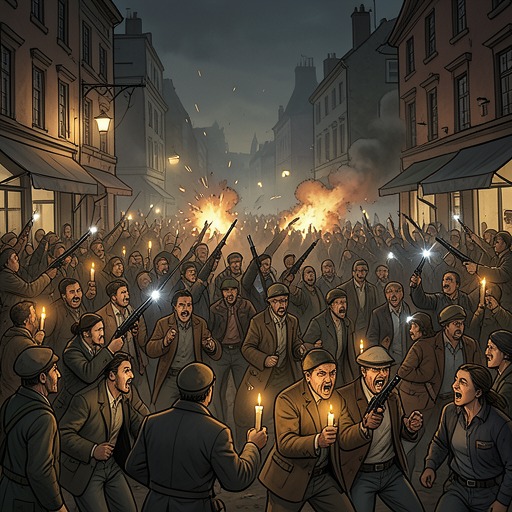
Alice falls onto the platform, and blood spreads across her white dress and over its edge. For a brief moment, the crowd is silent with shock; then thunder and the uproar of the gathering break that stillness. Some people cry or stand numb, while others call for revenge. Those who did not see the shooting try to learn what has happened. The response is collective and uncontrolled: people rush Wilkes, and he is knocked down and beaten. The crowd takes the gun from him, and he dies in the crush.
The attack also marks a reversal in the shrine’s reported effects. People who had come because Alice had restored their sight, movement, or speech begin to lose those benefits; others experience the return of the conditions from which they had been relieved. The narrative places these reversals immediately after Alice is shot, making the public violence coincide with the apparent failure of the healings. Wilkes does not survive to explain himself or to see the consequences of his act. The story later confirms that his body was found among the dead and that the German pistol was recovered nearby with its barrel jammed.
Motive and Narrative Significance
After the disaster, Gerry Fenn considers what might have led Wilkes to shoot Alice. Newspaper clippings found in Wilkes’s bedsit show a fascination with the assassin of John Lennon and with people who attempted to assassinate Pope Paul and Ronald Reagan. Fenn sees this collection as evidence of Wilkes’s interest in high-profile attackers, but it does not establish a complete motive. The novel offers possibilities rather than a settled explanation: Wilkes may have sought fame through the trigger, or he may have acted out of rejection of what he perceived as total goodness. Fenn cannot determine which account, if either, is true.
That uncertainty limits any simple reading of Wilkes as an instrument of the larger supernatural conflict. Fenn wonders whether evil has defeated evil, and whether Alice’s unforeseen death has interrupted the revenge associated with Einor; these are troubled interpretations formed amid the aftermath, not a disclosed explanation for Wilkes’s conduct. Wilkes’s role is therefore both decisive and opaque. His deliberate staging of the shooting destroys the fragile order of the service, while the absence of a conclusive motive leaves the reader with an act whose consequences are unmistakable but whose inward cause remains unresolved.