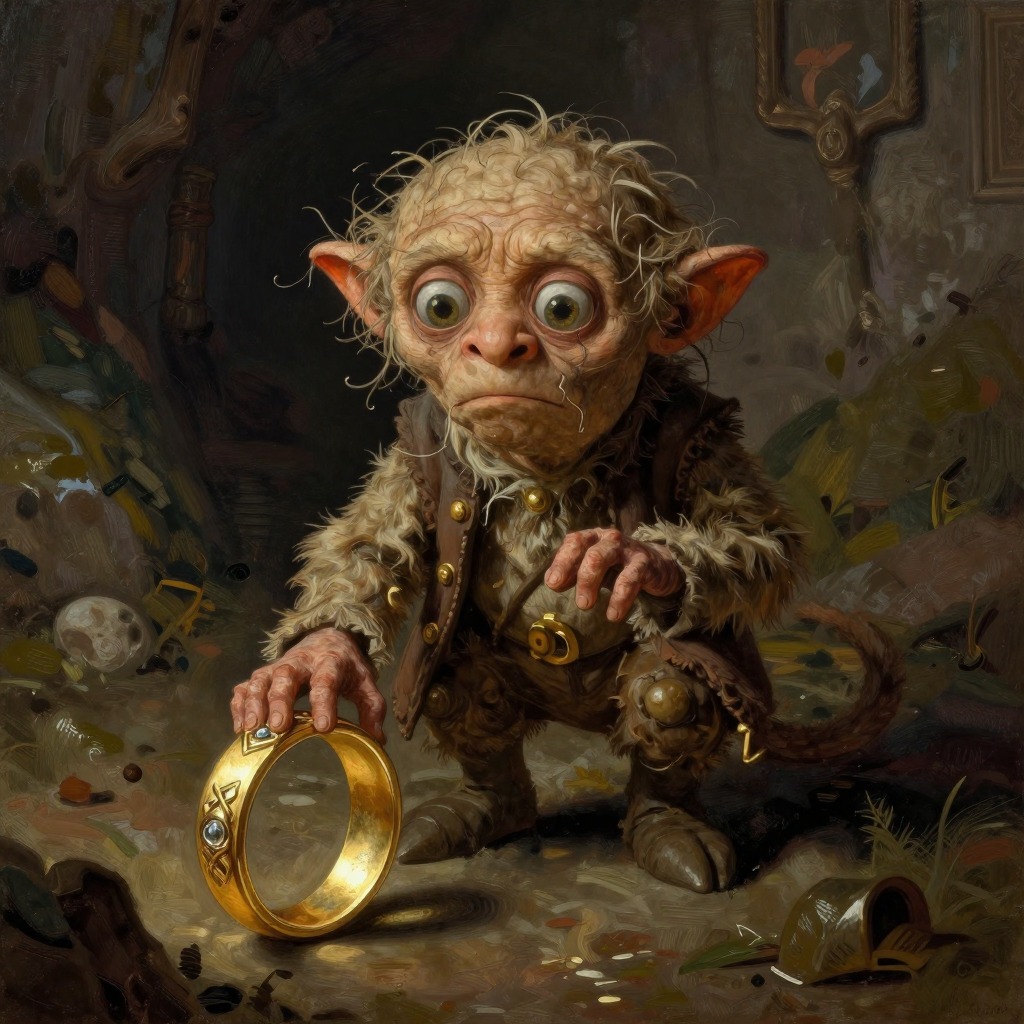
Thief, thief, thief! Baggins! We hates it, we hates it, we hates it for ever!
Gollum's curse, 'Thief, thief, thief! Baggins! We hates it, we hates it, we hates it for ever!', is the defining verbal expression of his hatred and despair after losing the One Ring to Bilbo Baggins, marking the irreversible rupture between the two characters and the birth of a relentless enmity that echoes through the rest of the story. The utterance crystallizes Gollum's identity as a creature consumed by possessive rage, and it transforms Bilbo from a chance encounter into a permanent object of loathing. The curse is not merely an outburst but a performative act that seals a new, antagonistic relationship, one that will have consequences far beyond the dark tunnels of the Misty Mountains.
Origin and Context
The curse erupts at the climax of the riddle-game in the goblin tunnels deep under the Misty Mountains. Bilbo, having won the contest by asking 'What have I got in my pocket?'—a question that Gollum could not answer—has fled down a new passage after leaping over Gollum's head. Gollum, defeated and realizing that the hobbit has taken his 'birthday-present,' the magic ring that makes its wearer invisible, is consumed by a rage of loss and suspicion. He dares go no further, and from behind Bilbo comes a blood-curdling shriek 'filled with hatred and despair.' The curse is the final, desperate articulation of that defeat: 'Thief, thief, thief! Baggins! We hates it, we hates it, we hates it for ever!' . The words are a direct response to the loss of the ring, which Gollum had possessed for ages and which he called 'my precious.'
Thematic Significance
The curse encapsulates several of the book's central themes. It is the most concentrated expression of the possessive, corrosive desire that the ring inspires—a desire that Gollum calls 'dragon-sickness' in others but embodies himself. The repetition of 'we hates it' reflects Gollum's fractured identity, his habit of speaking to himself as 'we' and 'my precious,' a linguistic symptom of his long isolation and his complete subordination to the ring's will. The curse also marks the moment when Bilbo, who had been a reluctant and accidental adventurer, becomes a named enemy, a 'thief' in Gollum's eyes. This accusation, however unjust from an objective standpoint (Bilbo found the ring by accident), will haunt the narrative. It is a verbal scar that Bilbo carries, and it foreshadows the moral complexities of possession and ownership that arise later with the Arkenstone.
Echoes and Aftermath
The curse does not fade with the scene. It reverberates through Bilbo's subsequent adventures and his life after his return. The Tookish side of Bilbo, which had awakened during the dwarves' song in his hobbit-hole , is now permanently shadowed by this encounter. The ring itself, which Bilbo keeps a great secret, is a constant, silent reminder of Gollum's curse. Even in the peaceful years after his return to Bag-End, when Bilbo takes to writing poetry and visiting elves, the memory of that shriek and those words remains part of his private history . The curse is a thread connecting the dark, primal world of Gollum to the comfortable, respectable world of the Shire, a reminder that the adventure has changed Bilbo irrevocably and that some enmities are never forgotten. The phrase 'Thief, thief, thief! Baggins!' becomes, in effect, Gollum's own defining statement, a verbal brand that identifies him as much as it condemns Bilbo.