Bradley
TrespassesBradley is the headmaster of Cushla Lavery’s school, a figure whose formal authority shapes the treatment of vulnerable pupils and the boundaries of Cushla’s work. He presents himself as responsible for child welfare and school discipline, but his actions reveal how procedure can also become a means of pressure: he records Cushla’s words, reports her concern about the McGeown family, and later makes clear that she herself is under scrutiny.
Position and Treatment of Davy
Bradley’s authority first comes into view in the corridor after Cushla has brought Davy McGeown in from the rain and dried his face and hair with paper towels. He looms over the boy and asks where his coat is. When Davy says he forgot it, Bradley pauses as if considering an appropriate punishment. The exchange makes a small lapse into a test of discipline, even though Cushla has already intervened to call it a mistake and steer Davy away.
Davy is not simply an anonymous pupil to Bradley. His name sometimes comes up at staff meetings, and Bradley knows details of his family: his father is a roofer who rarely seems to have work, while his mother is Protestant and has not converted, although the children are being raised Catholic. The narration describes Bradley’s view of the family as so suspicious that they might as well be members of the Manson Family. That comparison conveys the force of his prejudice without establishing that the family has done anything to deserve it. Davy’s vulnerability is also visible in the classroom: he sits in the front row beneath Cushla’s eye, not because he is naughty, but because other children torment him.
Public Authority and Private Warning
After Seamie McGeown is found badly injured and initially reported as dead, Bradley summons the teachers to bring their pupils to the hall. The children move through the school in silence because news of the attack has spread. Onstage with Father Slattery, Bradley adjusts the lapels of his brown suit and addresses the pupils. He warns them against idle gossip and presents prayer as the appropriate response. The assembly thus places him at the centre of the school’s official response to violence: he calls for restraint, but the event is already being felt by children whose classmate’s father is in hospital.
Bradley’s concern about Cushla becomes more explicit when he catches her after she has given Davy a lift. The formal address, Miss Lavery, briefly makes her mistake him for Gerry Devlin pretending to be the headmaster. Bradley tells her that he hopes she knows what she is getting into. Cushla says she is only giving the child a lift; Bradley objects not only to that journey but to a pattern of attention, listing her sitting with Davy at break, the lifts, and the lunches. His warning recasts ordinary acts of care as a potentially troubling relationship. The contrast with Davy’s need for protection is sharp: Bradley notices Cushla’s assistance and treats it as a problem, while Davy’s exposure to other children’s torment is part of the reason she keeps him close.
The McGeown Report and Institutional Power
When Cushla goes to Bradley after visiting the McGeown home, she asks whether he sent a social worker. Bradley retrieves his diary and finds the entry quickly, smoothing the page before pointing to the words he recorded in neat Quink. He says Cushla had described Betty McGeown as struggling, and explains that, as principal, he is obliged to pass concerns about pupils’ welfare to the relevant authorities. The diary turns a conversation into a durable institutional record: Cushla’s attempt to secure free school dinners for Davy by making Bradley feel sympathy has become the basis for an official intervention.
Cushla clarifies that Betty is indeed struggling but is a good mother, and that she meant only to get her some help. Bradley answers that the matter is not a game and invokes pupils from the school who have been taken into care. He also claims to have reported a British Army captain’s wife for burning her child with a cigarette. The narration immediately complicates that account: it was the nurse who checked children for nits and rickets who reported the woman, not Bradley. The distinction matters because Bradley invokes a precedent to defend his judgement while the account corrects his claim to have acted in that case.
The earlier example of a child who arrived at school with blood on the seat of his short trousers further complicates Bradley’s language of safeguarding. Before Cushla’s time, Bradley sent Father Slattery to speak quietly with the child’s father and made the man swear on a Bible that he would not go near the boy again. The narration judges that Slattery himself should not have been allowed near children. In this light, Bradley’s appeal to responsible procedure sits beside a response that relied on a private confrontation and a religious oath. After Cushla leaves his office, she recalls these discrepancies and recognizes that Bradley’s attention is not directed solely at the welfare of the McGeown children: he is marking her card.
Conflict and Narrative Significance
Bradley’s power over Cushla is sustained through ordinary school mechanisms rather than a dramatic confrontation. He summons her, records her words, cites his obligations, and instructs her to act with rationality and integrity. His calm, formal manner does not make the encounter neutral; Cushla finds herself obeying his instruction to sit despite her anger, and afterward waits in her car until her hands are steady enough to start it. The scene gives procedure a personal consequence: a teacher who tried to help a family is made to feel watched and professionally exposed.
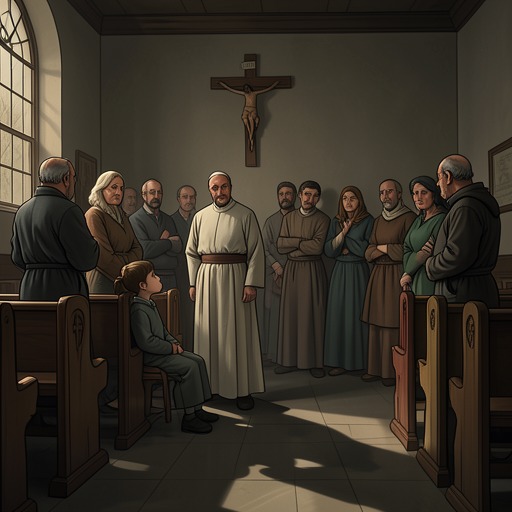
That pressure is present again at the First Confession. Davy receives an interminable penance from Father Slattery, while Bradley stands near the entrance to the crying chapel. Cushla considers approaching him but says nothing, remembering the revenge he had taken on the McGeown family for her insolence. Tommy McGeown eventually pulls Davy from his knees and challenges Bradley and Slattery, telling them that what is happening is not right. Bradley is present when the dispute becomes open, but the evidence does not specify the precise form of the earlier retaliation. The uncertainty itself preserves the unequal footing between him and Cushla: she anticipates consequences from his power even when she does not confront him.
Bradley therefore functions as more than a strict school administrator. His conduct joins discipline, record-keeping, child-welfare authority, and social suspicion in a single institutional role. He can describe intervention as obligation, yet the narrative repeatedly places that claim against selective memory, earlier private handling of abuse, and his scrutiny of Cushla’s care for Davy. The result is a portrait of authority that speaks in the language of protection while also deciding whose actions, families, and loyalties will be treated as suspect.