Fidel
TrespassesFidel is a local loyalist whose life moves between his mother’s sweet shop, the pub, and the clandestine world of paramilitary activity. By day he measures mint imperials and clove rock; by night he is brigadier of the local branch of the Ulster Defence Association. The contrast gives his character its defining tension: he can appear as a familiar shopkeeper and jovial regular, yet also operate among armed men behind a masked face. The novel makes those roles coexist without resolving them into a reassuring distinction between private kindness and public menace.
Identity and Public Persona
Fidel is established through sharply particular details of appearance and routine. He wears a khaki cap and tinted glasses, and keeps a beard that he shapes into a long, tapered point by looping it around his thumb. In the pub he belongs to the company of familiar regulars, but his position is not merely social: the sweet-shop counter by day and his leadership in the Ulster Defence Association by night place him at the junction of neighborhood commerce and loyalist power.
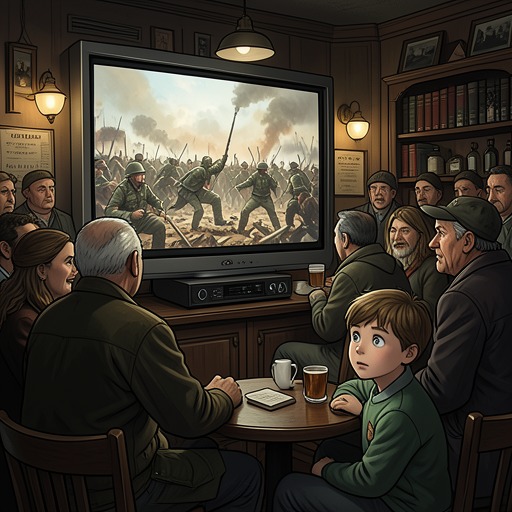
His taste in music also reveals how he fashions a public identity. When Eamonn Lavery considers booking a band for the pub’s unused upstairs lounge, Fidel’s preference is Lynyrd Skynyrd. He feels an affinity with the Confederate Army, a revealing identification that sits alongside his local political role. During the strike, he swaggers around the pub joking that it is an essential service while other businesses close. His humor makes the pub’s persistence sound ordinary, but the political setting surrounding it is anything but: the power-sharing government is collapsing, paramilitaries are openly parading, and violence is present on the television and in the streets.
Gifts, Community, and Uneasy Generosity
Fidel’s interactions with the McGeown family show a less threatening, though not uncomplicated, side of his presence. At Easter, he comes loping up the Lavery driveway with a plastic carrier bag and offers chocolate for the children. The previous day, Gina Lavery had told him whom the eggs were for and demanded a ten per cent discount, treating the prominent loyalist as someone who ought to make amends through confectionery. The exchange makes the gift part of a neighborhood relationship shaped by expectation as much as goodwill: Fidel supplies the chocolate, while Gina dictates what his role should mean.
Later, as Cushla Lavery leads children across High Street toward the park, Fidel steps out of his shop to watch them pass. The children wear their own clothes for protection, yet remain identifiable as Catholics because other schools in town require uniforms. Fidel speaks to Cushla, then crouches in front of Davy McGeown and strokes his beard. Davy keeps his head down and rearranges the contents of Cushla’s basket rather than responding. Fidel straightens, seeming put out; Cushla wonders whether he expected the boy to thank him for the Creme Eggs. The moment does not settle whether Fidel regards the earlier gift as kindness, obligation, or a claim to recognition. Instead, it places an ordinary act of giving inside a community divided by identity and exposed to danger.
Masked Authority and Political Violence
Fidel’s most unsettling appearance comes when Cushla and Gina Lavery are on their way to visit Cushla’s father’s grave. Near the cemetery, a tractor blocks the road. Two men with tartan scarves over their faces stop the car, one holding a shotgun; a third, wearing a balaclava, steps forward and signals for Cushla to lower the window. Gina recognizes him as Fidel and challenges him for pretending not to be himself. He glances back toward the other two men, who are leaning against the tractor and smoking. The scene reveals that the shopkeeper and pub regular can also be encountered as an armed man at a roadblock, his familiar identity concealed but still legible to people who know him.
The episode turns recognition into a form of power. Fidel is masked, yet Gina identifies him; the two companions remain at ease with their weapons and with the road they have closed. The scene offers no account of what the men intend beyond stopping the car, so it does not establish a specific plan or outcome. Its force lies in making the threat immediate: a family journey to a grave passes through territory where armed loyalists can decide who moves onward.
His other paramilitary connections appear more obliquely. Years later, Fidel still comes into the pub occasionally, accompanied by the hoods he used to meet in private above the shop. After they leave, Eamonn Lavery finds cigarettes ground into the carpet and black, melted holes in the upholstery. Their presence is registered less through explanation than through damage left behind. Catholics have also drifted away from the pub, unwilling to be seen as condoning the Laverys’ sheltering of the McGeowns. Fidel’s private meetings and the group’s physical traces thus form part of a wider pattern in which political alignments alter who feels able to enter a public place.
Ambiguity, Protection, and the Ending
Fidel’s relationship to the Lavery family remains most ambiguous after a bomb is left in an empty beer keg beside their building. An anonymous caller gives the police fifteen minutes’ warning, and the bar is evacuated before the explosion. Eamonn stands in the tunnel between two RUC officers and watches the blast. Fidel has not been seen for more than a week; the Laverys are inclined to think he was responsible for the warning, which they understand as an act of leniency. The narrative does not confirm that he made the call or arranged the evacuation. It preserves the family’s suspicion as suspicion, shaped by what they know of Fidel’s influence and by the fact that nobody is killed.
That possible protection is not a conversion or a clean moral reversal. The same Fidel who appears in a balaclava with armed companions may, in the Laverys’ understanding, have helped spare them from a lethal attack. His apparent capacity to offer protection does not undo the intimidation associated with his position; it makes the boundary between threat and favor harder to hold. In a place where survival can feel like a gift, even an unconfirmed intervention carries weight.
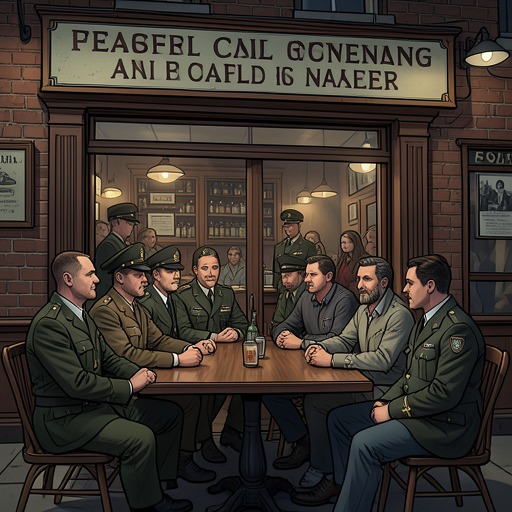
The later photographs gather these contradictions into ordinary images. Eamonn’s pictures show Fidel drinking vodka and bitter lemon, still flush with the money Cushla had paid for ice creams, and posing with Leslie, Minty, and Jimmy O’Kane. In one, the familiar regulars give thumbs up; in another, Jimmy’s single egg is visible in his pocket. Fidel appears not as an abstract emblem of loyalism but as a participant in the pub’s everyday company, complete with its small rituals and jokes. Yet the images cannot erase the men who meet above his shop, the cigarette burns they leave, or the roadblock where Gina recognized him beneath a mask. Fidel’s narrative role depends on that unresolved coexistence: he embodies how community familiarity, political allegiance, coercion, generosity, and possible protection can occupy the same person without cancelling one another.