Davy McGeown
TrespassesDavy McGeown is one of Cushla Lavery’s pupils, but the life he brings into her classroom is never confined to school. He arrives without a coat, is tormented by other children, and belongs to a family exposed to sectarian intimidation, serious injury, and forced displacement. His story moves from everyday vulnerability to the destruction of his home and separation from his sister, then across decades to an adult reunion with Cushla. The boy who runs with his eyes shut and carries his satchel out of a burning house remains vivid in the adult whose return answers, without undoing, years of absence.
Identity and Background
Davy lives with his family in a grid of beige houses at the edge of a field of gorse. Their home’s front garden is marked by the words “TAIGS OUT,” a sectarian threat written on the wall. Coal bags stand by the door and net curtains cover the windows. When Cushla brings him home after accidentally splashing him with her car, Davy’s mother, Betty McGeown, answers the door in a blue and orange nylon tabard and kisses his forehead. Her first concern is that he has gone out without a coat. Davy says that he forgot it and explains that Cushla gave him a lift, revealing both the ordinary care between mother and child and the precarious circumstances in which that care has to operate.
At school, Davy is a regular target of his classmates’ torment, so Cushla seats him in the front row beside her. He is also notably willing to speak: during the daily news exercise, he volunteers first and reports that there has been a bomb in Belfast. Another pupil points out that Davy says this every day. The exchange makes his familiarity with violence part of the children’s routine, not a distant adult account of events. Cushla dislikes the exercise precisely because she thinks the children already know too much about the world around them.
School and Cushla’s Care
Davy’s relationship with Cushla develops through practical gestures rather than grand promises. On a rainy school morning, she tries to avoid a puddle but splashes him as another car approaches. He arrives at school dripping and red with cold. Cushla apologizes and guides him away with her hands on his shoulders. The mistake is small, but it establishes how closely she watches over a child who is already exposed to discomfort and ridicule.
That attentiveness extends beyond the classroom. Later, when Betty explains that Davy is eighteen and no longer reliably at home, Cushla remembers that he can receive school dinners for the rest of the term. Betty asks who will pay; Cushla says the school, though she has not prepared an answer and speaks a beat late. The exchange shows her trying to help without making the assistance a spectacle, while Betty’s question registers the family’s need to know what support will cost them.
At the First Communion, Davy appears in a sky-blue suit and initially hovers by the holy-water font instead of going to Cushla. He has received a missal and rosary beads from her, but now produces them from his pocket while looking between Cushla and Betty. The gifts, bought out of love, have become entangled with the family’s fear of losing the children. The previous day, after Davy’s first confession, Slattery kept him kneeling through an extended penance. Tommy McGeown eventually pulled him up and challenged Slattery and Bradley; Cushla followed them out but had remained silent inside, remembering Bradley’s retaliation against the family. Davy’s religious milestone is thus bound to adult authority, family danger, and the limits of the protection Cushla can offer.
Courage, Play, and Family
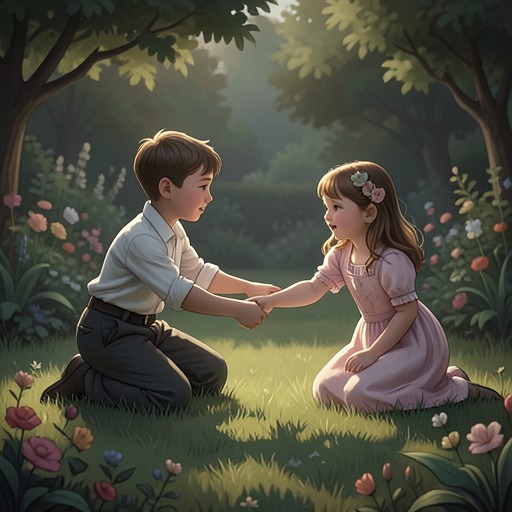
Davy’s awkwardness does not prevent him from becoming the center of a moment of collective encouragement. At a school sports day, Cushla puts him in a relay team. When Jonathan’s team debates who should run the final leg, Cushla insists that Davy should finish. Once the baton reaches him, he runs hard around the bends without looking back. His classmates begin chanting his name; at the finish they lift him and thump him on the back. Cushla photographs him among the boys, holding his medal and smiling. He also wins the egg-and-spoon race. In the sack race he falls near the finish and injures his ankle, but tells Cushla that he is happy enough. The sequence makes his achievement neither a miraculous transformation nor a denial of his clumsiness: he is celebrated, falls, hurts himself, and still finds the day good.
His family’s hardship becomes more acute in the aftermath of violence against their home. When the house is burning, Davy disappears into it while Cushla pushes through the crowd to find him. Smoke fills the sitting room, the settee is ablaze, and he emerges down the stairs with his eyes squeezed shut. Cushla catches his hand and drags him outside. Even then he is clutching his satchel, which she gently unfolds from his hands after they have been pulled away from the house. She calls the act brave and stupid while crying. The satchel is a school object, but in this moment it is also what the frightened child has carried through the fire.
Once they are out of the estate, Davy produces a paper bag of his father Seamie McGeown’s tablets. He tells him that he got them and that Seamie will be able to sleep that night. The detail brings Davy’s attention back to his injured father even in the immediate aftermath of the blaze. At Cushla’s home, Betty describes a bottle smashing on the hearth and flames spreading across the carpet and up the settee; she also says police came for Tommy that evening. The fire destroys the family’s home, and the violence does not end with escape from the flames.
Separation and Return
After the family is displaced, Davy and his sister Mandy are placed with different foster families. In a letter to Cushla, Davy uses the format she taught the children in school, beginning with the conventional greeting she recognizes. Her pleasure at hearing from him gives way when she learns they have not found a new house and that Mandy is somewhere else. The letter is a surviving thread between them, but its news also sets out the lasting consequence of their removal: the siblings are separated, and Davy’s home is no longer the place he shared with his family.
Cushla keeps looking for him. She searches streets and classrooms, asks Gerry Devlin to check successive telephone directories, and replays footage of Tommy’s funeral in the hope of spotting Davy among the mourners. She once drives toward Short Strand but turns away when the flags and walls overwhelm her and she fears she is being followed. Her search records the distance that violence has imposed: she can remember the child closely, yet cannot safely or reliably find the place where he has gone.
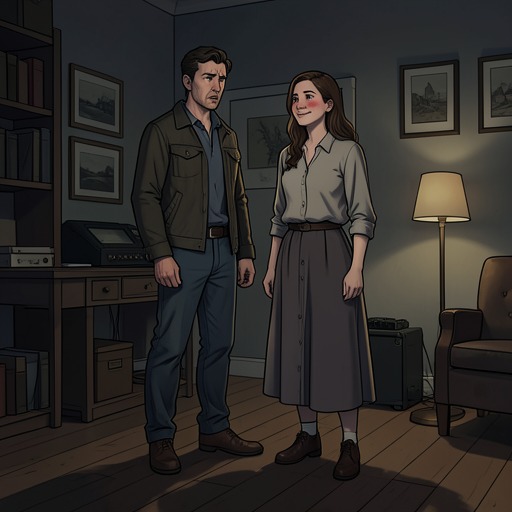
In 2015, Davy stands before her as a middle-aged man, carefully dressed in a navy pea coat, denim shirt, and maroon sweater. Cushla recognizes the sweater’s color from the day she soaked him, while his blue eyes recall his mother’s. The skittishness she associates with the boy seems to have gone, though he takes her hand and swings it. Cushla tells him that she looked for him; the admission gathers together her unsuccessful searches without pretending they could have prevented the separation. His return does not restore the family or erase the years apart. It does, however, give their bond a present tense again: the former pupil and teacher can meet, and the adult Davy can answer the place he occupied in Cushla’s memory.
Narrative Significance
Davy’s trajectory joins the intimate scale of a child’s school life to the wider pressures of Belfast. Bomb reports enter the classroom as routine news; sectarian writing marks the family home; an attack destroys that home; and the resulting displacement separates Davy from Mandy and from Cushla. The novel also gives him moments not reducible to victimhood: he volunteers to speak, runs for his team, savors his medal, and thinks of his father’s medicine while escaping a fire. His adult appearance in 2015 makes the long interval visible in a single contrast between the coatless pupil and the carefully dressed man. What survives that interval is not an uncomplicated rescue story, but the evidence that care was offered, remembered, and eventually met again.