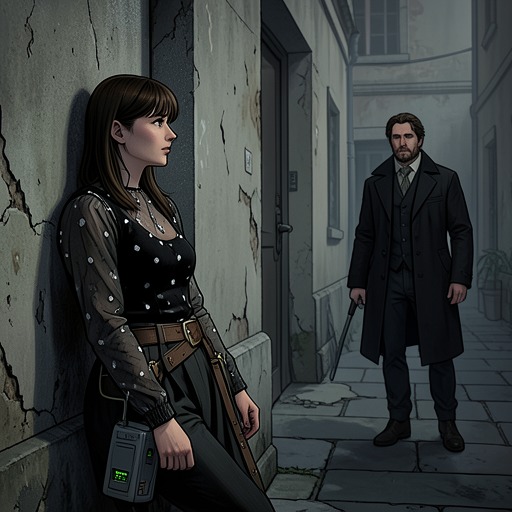
Cushla Lavery
TrespassesCushla Lavery’s life is divided between a family bar, a Catholic school, and private attachments that cannot be kept separate from the violence around her. She teaches Davy McGeown, helps his family after his father is attacked, and has an affair with Michael Agnew. When Michael is shot dead, the Royal Ulster Constabulary connects her to the case and subjects her to questioning. The later return to her story, beside a monument to Michael, shows a woman whose life has continued beyond the loss without making that loss disappear.
Identity and Background
Cushla works both in her family’s bar and as a teacher. At the bar, her brother Eamonn is occupied with the stock list while she tries to remove the ashes Father Slattery has marked on her forehead. The cross is conspicuous enough to draw Eamonn’s attention through the long mirror behind the counter. On Ash Wednesday, she knows that the men who drink there generally do not observe the religious practices she does. Her mark makes the difference visible: the bar may be Catholic-owned, but a woman serving drinks with a religious sign on her face unsettles its customers. She rubs the cross away before it can define her in the room.
The scene establishes a recurring pressure in Cushla’s life: private conviction has public consequences in a divided society. Her religious observance is not presented as a declaration or a political act, yet it can be read by others as one. At school, too, ordinary routines are shaped by the surrounding conflict. Her pupils recite the Hail Mary in preparation for First Holy Communion, then turn to the news. Cushla dislikes the exercise because she believes the children already know too much about events beyond the classroom. Davy, the first to volunteer, reports a bombing in Belfast. The contrast between prayer and news makes clear how little protection the school can offer from the violence outside it.
Teaching and Care for the McGeown Family
Cushla pays particular attention to Davy, who sits in the front row not because he is troublesome but because the other children torment him. Her concern extends beyond the classroom. When she visits the McGeown home with Gina, Davy explains that his father has been attacked as if delivering a school news report. Cushla kneels and takes his hands. She knows what has happened, but his disappointed response suggests that knowing the fact is not the same as being able to give him the reassurance he needs.
The home’s cramped, carefully maintained interior offers a concrete setting for the family’s vulnerability: a spotless kitchen is crowded with stacked containers, a small table and stools, and laundry partly obstructing the back door. These details do not reduce the McGeowns to their circumstances; they make visible the close domestic world Cushla enters as she tries to help. Davy’s parents also occupy a religious divide. His father is Catholic, while his Protestant mother has not converted, although the children are being raised Catholic. At school, the headmaster treats this difference as a reason for suspicion. Cushla instead keeps Davy close and steers him away from trouble, resisting the assumption that his family’s mixed background makes him an outsider.
When she later meets Davy’s injured father, Seamie, Cushla instinctively offers her hand. Seamie turns up his palms rather than taking it. She sees enough to understand that even a simple gesture of greeting may be difficult for him, and she has to steady herself. Betty, Seamie’s wife, notices Cushla’s reaction and gives her a moment before directing her toward the kitchen. Cushla’s response is not a grand intervention: it is the effort to remain present without making Seamie’s condition a spectacle. Her continued involvement with the family is part of the same practical care she offers Davy, though the scale of the family’s need exceeds what she can control.
Michael Agnew and the Affair
Michael enters Cushla’s private life through a phone call from a public phone box. Their exchange has a playful ease: he describes the untidy contents around him and says he can pick her up as he passes her door. That lightness contrasts with the strain of the world around them, but it also marks the relationship as a private space Cushla is willing to enter. The later account of their affair reveals that Michael guides its progression, showing her where he lives, giving her his number, and eventually giving her a key. He leaves her waiting and then returns, drawing her back with time together in Dublin or at his flat.
Cushla has known that Michael has had other affairs. What changes is her understanding of what that pattern means for her. She recalls how his friends accepted her without the scandal she had expected, and how little she had allowed herself to think about his wife, Joanna Agnew. Cushla had found it easier to imagine Joanna as an obstacle in an unhappy marriage than to consider her as a person in Michael’s life. The recognition that she is neither Michael’s first affair nor likely to be his last becomes a painful reversal. Her attachment has made the marriage seem remote; the accumulating signs of his wider pattern bring it sharply back into view.
The account also complicates any idea that Cushla is simply deceived or simply in control. She understands some of the arrangement and resents its implications, yet she remains emotionally bound to Michael. At one point she prepares to go with him despite feeling utterly defeated, explaining to herself that each meeting carries the fear that it may be the last. Kindness alone does not account for her decision. The relationship is sustained by desire and apprehension together, and neither cancels the other.
Murder, Investigation, and Loss
The news that Michael has been shot dead reaches Cushla at the bar. Gina is nearby, and Cushla’s first response is bodily and automatic: she pats her mother’s back while her thoughts scatter. She then returns to washing glasses, filling the glasswasher tray as people around her speak. Eamonn touches her arm, but she walks away. At the doorway, her body seems to turn back toward the place where she imagines Michael beside her; she finally leaves the bar and crosses the car park. The routine of washing glasses briefly gives her movements a structure, but it cannot absorb the shock. Her grief breaks through in the involuntary turn of her body and her departure.
The Royal Ulster Constabulary’s investigation makes her private relationship part of the public case. An officer asks about her connection to Michael and insists that she is the link between the victim and his killer. Cushla rejects the implication that the connection proves involvement, and her anger breaks into an exclamation before she forces herself to sit and steady her shaking hands. Later, she tells Gina that the Royal Ulster Constabulary had followed them and taken photographs of her with Michael in his car and at his flat. She also recounts that an officer who had worked as a disc jockey at her school threatened to detain her for seven days unless she submitted to his demand. The threat turns an inquiry into an experience of coercive pressure, while the photographs expose how thoroughly the relationship had been observed.
Cushla says she had hoped the situation would resolve itself and admits that Gerry Devlin’s kindness had not made her fall for him. After Michael’s death and the questioning, however, her concern turns toward Davy and what will happen to him. That question brings her back to the responsibilities that had long connected her to the McGeown family. Her own exposure to surveillance and pressure does not erase her care for the boy; instead, the two strands of her life meet in a moment when she has to consider what she can still do for someone else.
Later Life and Narrative Significance
Years later, Cushla stands near Penny’s monument to Michael. She understands that her presence beside it is a matter of chance, as was the earlier coincidence that brought Tommy McGeown into Michael’s kitchen. The pairing does not give either event a hidden design; it shows how chance can place lives together without explaining what follows. Cushla’s return to the monument brings the private history of her relationship into contact with the public memorial to Michael, while keeping the distinction between coincidence and meaning intact.
She is no longer Miss Lavery. She says she has been Mrs McTiernan for a long time and asks to be called Cushla. The name marks the passage of years and a changed social identity, but the insistence on her given name also makes the encounter personal rather than ceremonial. She expects that Gerry Devlin might have been her husband; she corrects that assumption, explaining that Gerry is in a civil partnership with Mr Mulgrew and remains her best friend. The exchange gives no account of how Cushla came to marry or of her life with Mr McTiernan, so the later scene preserves those limits rather than filling them in.
Cushla’s story is shaped by acts of attention: she notices Davy’s isolation, responds to Seamie’s difficulty with a handshake, and recognizes the implications of Michael’s pattern of affairs only as her attachment deepens. Such care does not make her immune to social division, bereavement, or state scrutiny. Her experience instead joins the intimate and the political without making them interchangeable. The ashes on her forehead, the school’s daily news, the photographs of her with Michael, and the later monument each show private life becoming visible to others in a different way. The final exchange gives her a present name and a surviving friendship, but leaves the past, and the loss at its center, unresolved.