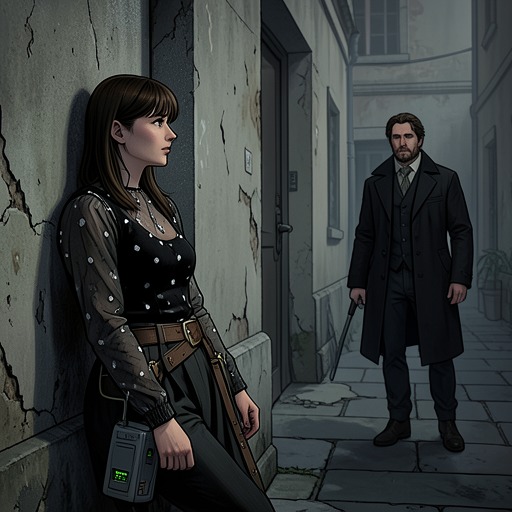
Michael Agnew
TrespassesMichael Agnew is a Belfast barrister whose defense of civil-rights figures and criticism of emergency courts make justice a public commitment as well as a professional practice. His relationship with Cushla Lavery brings that commitment into private life, while his work on police-abuse cases exposes the violence obscured by official accounts. His murder, followed by the conviction of a teenager, leaves his life caught between legal principle and the conflict it could not contain.
Identity and Public Work
Michael is a barrister who has also made a documentary about the 1798 rebellion, a work that caused controversy. He has spoken out against internment and represented civil-rights activists when other lawyers would not. To one observer, saying that Michael is all right means, more narrowly, that he is not a bigot; the qualification hints at how unusual even that limited judgment can seem in a divided society.
His opposition to the legal arrangements used in the conflict is expressed in ordinary conversation as well as in his professional choices. At a dinner, he objects to Diplock courts, where defendants are tried without juries, saying the system would not be tolerated elsewhere in the United Kingdom or in a civilized country. The remark is not an abstract aside: it interrupts the ease of the gathering and makes his political position visible among people who do not share it.
Michael also rejects the easy dismissal of Republican prisoners as gunmen and bombers who merely complain of unfair treatment. He argues that the system treats them unjustly and that political circumstances have helped bring many young people into trouble. When challenged, he visibly bristles, but does not answer at once; instead, he drinks from his glass. His restraint in that moment sits alongside his outspoken public position, showing the strain of carrying an argument into company that resists hearing it.
Relationship with Cushla
Michael’s connection with Cushla develops through encounters in which attention becomes increasingly personal. He remembers her entering a pub with a cross on her forehead, not looking away when she caught him watching her in a mirror, and trying to appear nonchalant at the Lyric Theatre. He also recalls her tears when he mentioned her father. When Cushla asks him to be specific about his feelings, he tells her that he loves her; she insists that such a declaration must be meant, and he affirms that it is.
Their intimacy is shaped by the limits of his circumstances. After their first kiss, Michael acknowledges that his situation is complicated and that he will not always be able to get away. Cushla asks whether there will nevertheless be times when he can; he says there will. The exchange establishes both the attraction between them and its uneven availability, without resolving the obligations that constrain their relationship.
A small domestic incident makes their closeness tangible. While helping set the table at a dinner, Cushla burns her wrist on the oven. Michael takes her hand to the sink and holds it under cold water, his thumb resting on her pulse. Cushla feels frustrated and wants to leave, while his attention makes the moment charged with feeling. Later, he remembers that she was embarrassed when he treated the burn. Care, awkwardness, and self-consciousness persist in their relationship as much as declarations do.
Michael’s affection is conveyed again through a photograph taken at the bar. He is smiling, though the recent quarrel between them remains legible in his stooped, defeated posture. Cushla’s hands are caught in the frame as she slips a beer mat beneath his whiskey; their fingers nearly touch. After his death, the image briefly makes him seem present to her before that impression vanishes. The photograph preserves not an idealized portrait but a small, unfinished exchange between them.
Legal Work and the Abuse Files
Michael takes on the case of three boys identified by a witness he describes as unreliable. He tells Cushla that the case is one Victor disapproves of, linking their disagreement to his willingness to defend defendants others may regard with suspicion. The case becomes more than a professional dispute when Cushla discovers the materials Michael has kept: copies of unsigned statements, police photographs, and the boys’ accounts of arrest and custody.
The records she examines describe forced entries, a contested identification procedure, hoods, noise, and electrical equipment. Photographs and written accounts together document police abuse that would otherwise remain hidden from view. Their presence among Michael’s case papers shows how his legal work involves gathering and preserving evidence that official procedures might not make visible. Cushla’s discovery also changes what she understands about the burden of his work: the files record individual suffering, but they are organized as material he must confront and use in the course of defending people accused by the state.
The discovery comes amid a period of political violence. After hearing a nearby bomb, Cushla fears for Michael and searches his home; she finds the files and waits there until he returns. The scene joins public danger to private anxiety. His work is not separate from the violence around them: it brings evidence of coercive policing into the rooms where Cushla and Michael share their private life.
Murder and the Trial of Tommy McGeown
Michael is shot dead. The news reaches Cushla at the bar, where she initially continues washing glasses and working at the sink while those around her react. She leaves only after the movements of her body seem to carry her away from the counter. The abruptness of the announcement contrasts with the ordinary tasks continuing around it, and his absence becomes palpable in her disrupted routine.
The later account of Tommy McGeown’s trial connects the murder to an earlier, seemingly incidental encounter. Tommy had been repairing a path at a house opposite Michael’s. When it began to rain, Michael invited him in for tea. Cushla imagines the barrister preparing cups and trying to put an awkward boy at ease; she wonders whether Tommy saw a photograph of Michael in wig and gown and mistook him for a judge. These possibilities remain Cushla’s speculation, not a settled account of Tommy’s motive.
A newspaper reports that Tommy, aged eighteen, was sentenced to life imprisonment for Michael’s murder. He refuses to recognize the court, offers no defense, and answers no questions; the report says he is convicted on forensic and circumstantial evidence. The outcome places Michael’s death inside the same fraught legal world that shaped his work. The man who challenged unfair procedures is gone, while the case against his killer proceeds through a court whose authority Tommy refuses to accept.
Memory and Significance
Michael’s character is formed by the friction between professional conviction and personal vulnerability. He argues publicly that defendants are treated unfairly, takes a difficult case, and keeps evidence of abuse; in private, he is attentive to Cushla, yet cannot promise that he will always be available to her. Neither side cancels the other. His principles do not protect him from violence, and the tenderness recorded in his private gestures cannot undo the consequences of the political world in which he works.
After his death, Cushla encounters a sculpture whose arrangement and likeness resist a generalized representation of the dead. Its familiar composition suggests death, but its disorder recalls the violence of the murder and the chaos that followed; the body’s particular features make the figure feel unmistakably individual to her. In this way, Michael’s remembered presence is neither reduced to a public symbol nor restored as a living person. The sculpture, like the photograph from the bar, holds on to his specific form while making the finality of his absence harder to avoid.