Father Slattery
TrespassesFather Slattery is a parish priest whose authority extends from the church into St Dallan’s classrooms and the families connected to the school. He is repeatedly shown using religious teaching to test and admonish children, and at times to frame communal violence through sectarian hostility. His influence is not confined to public instruction: Cushla Lavery remembers his conduct toward her ill father, and later watches him approach Davy McGeown in a parked car. The unexplained private exchange between the priest and Davy makes his authority both intimate and unsettling.
Identity and Authority
The school stands on parish land shared with the church and parochial house, giving Father Slattery ready access to its corridors and classrooms. He roams through them and enters without warning to deliver catechism. Cushla has already complained to Bradley that these visits disturb the children, but Bradley dismisses the concern by invoking Slattery’s status as a priest. The exchange establishes an imbalance: the priest’s office protects his access, while a teacher’s misgivings do not readily restrain it.
Cushla’s distrust also has a personal history. When her father was in hospital and confused by morphine, Slattery prayed with him and then persuaded him to write a cheque for a colour television. The episode gives her objection a concrete source beyond disagreement about classroom practice. In her view, the priest’s presence in a vulnerable family moment was followed by a request that benefited the church. The novel thus presents his religious standing as a form of practical influence, not merely a title.
Catechism as Discipline
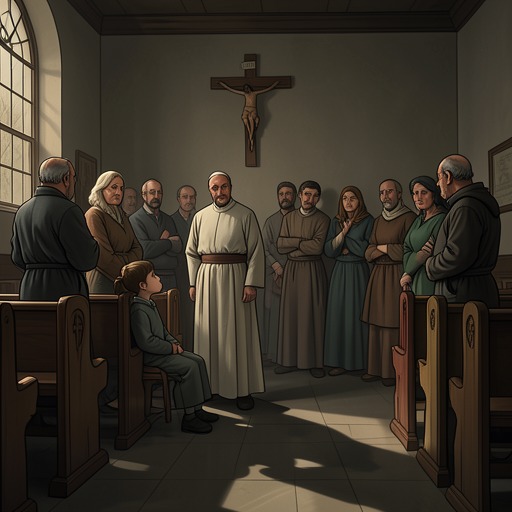
In one classroom, Davy has been made to apologize to Jonathan after hitting him. The boys are placed in opposite corners, and Bradley enters with Slattery. Davy looks to Cushla for help; Jonathan watches the strap protruding from Bradley’s pocket. Cushla tries to stop what is developing, but Bradley backs out. Slattery then crosses the room, and the children return to their seats at Cushla’s signal. He begins the Act of Contrition, but the children remain silent, apparently afraid of making a mistake.
Slattery turns that silence into an indictment of their religious knowledge. He asks for the opening of the Confiteor and for the Mysteries of the Rosary; no child responds. He recites the mysteries himself, presenting the familiar categories of Catholic devotion in a slow, mournful manner. His questions to Davy about his age sharpen the scene’s imbalance: when the seven-year-old answers, Slattery uses the answer as the opening for a story rather than as a child’s simple reply. Catechism here is not a shared lesson. It is a public test in which the priest sets the terms and the children’s uncertainty becomes evidence against them.
Sectarian Teaching
Slattery tells the class about a young girl who was sent on an errand, attacked by a group of men, and marked with the initials of the Ulster Volunteer Force. The account is presented as a story for children, but its force lies in the conclusion he draws from it. Davy asks whether the girl was seven, concentrating on the detail and continuing to work at the paint on his pencil. Slattery refuses the question’s relevance and instead tells the children that Protestants hate Catholics. He follows this claim by identifying Davy as one of the McGeowns.
The scene shows how Slattery makes a child’s family identity part of a lesson in communal danger. Rather than allowing the story to remain an account of violence against an individual, he turns it into a general claim about an entire religious community. Davy’s question briefly resists that framing by attending to the girl’s age; Slattery redirects attention from her particular circumstances to the sectarian conclusion he wants the class to absorb. His authority is therefore instructional and political at once, even though the setting is an ordinary classroom.
Public Piety and Private Encounters
After an attack leaves the father of a pupil in hospital, Bradley summons the children to the hall and warns them against gossip, proposing prayer. Slattery steps forward during the gathering and asks whether they have heard of Romper Room. A girl answers that it is a television programme where Miss Helen gets children to sing songs. The interruption shifts the assembly from its announced prayerful purpose to Slattery’s own prompt, though the brief scene does not explain what he intends to do with the answer. It reinforces his ability to redirect a school gathering without offering the children an account of why.
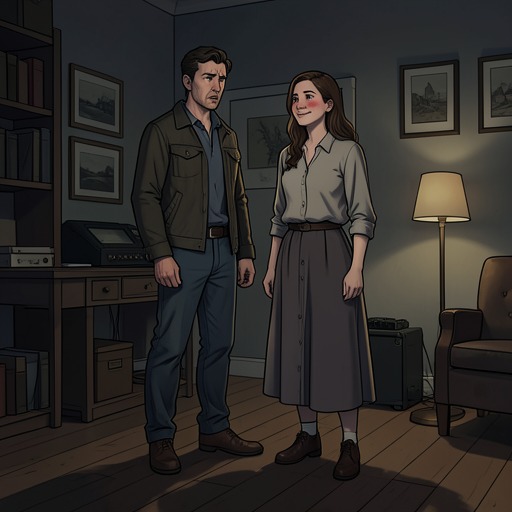
On another afternoon, Cushla finds Slattery leaning through the passenger window of her car, speaking to Davy. She approaches and addresses him as Father; he addresses her formally as Miss Lavery and says he was talking to their young friend. The exchange is brief, and the content of his conversation with Davy remains undisclosed. Its placement matters: Slattery’s authority has already been shown in front of the class, but here Cushla encounters it at close range, in a private space where she must ask what he is doing with her pupil.
Confession, Objects, and Uncertainty
Before the children’s First Confession, Cushla has told them they are too young to have serious sins and suggested ordinary childhood misdeeds they might mention. Slattery counters with a lesson on original sin, Adam and Eve, remorse, guilt, and sorrow. He tells the children to expect no leniency and explains that the length of their penance will make the extent of their sinfulness visible to others. Confession is thus presented not as a private conversation but as an exercise whose severity can be publicly measured through time spent kneeling.
Slattery gives each child a picture of Padre Pio and speaks of the saint’s bleeding wounds. As he hands one to Davy, he bends and says something in the boy’s ear. Cushla hurries across the church, but Slattery is already walking away, smoothing his pockets. Neither the words nor their effect on Davy are disclosed. The withheld content makes this encounter a point of unresolved tension: Cushla sees enough to intervene, but not enough to know what was said.
That scene contrasts with Cushla’s own use of devotional objects. After a private weekend with Michael Agnew, she buys Davy’s First Communion missal and rosary beads, as well as a St Joseph novena card associated with her grandmother’s prayers when someone was in trouble. She recognizes the incongruity of bringing home these objects after the weekend, yet her purchase is directed toward Davy’s needs. The contrast does not make religious practice simple: the same world of prayer and sacred images can provide familiar forms of care while Slattery uses doctrine and ritual to impose guilt and fear.
Narrative Significance
Father Slattery’s appearances connect the school’s religious routine to the pressures surrounding the McGeown family. He questions children, introduces a story of sectarian violence, addresses Davy apart from the class, and determines the severity by which their first confessions will be judged. The evidence does not reveal what he says privately to Davy, and that silence is significant: the priest’s power is clear, while the child’s experience of it remains inaccessible to Cushla and the reader.
Cushla’s responses provide a counterpoint to Slattery’s institutional confidence. She has challenged his classroom visits, remembers his conduct toward her father, and rushes toward Davy when she sees him whispering to the child. At the same time, she buys Davy religious objects as practical tokens of attention. Through these contrasts, the novel distinguishes personal care and inherited devotion from a clerical authority that presents fear, sin, and sectarian identity as lessons for the young.