Joanna Agnew
TrespassesJoanna Agnew, the wife of Michael Agnew and mother of Dermot Agnew, is introduced at the moment Cushla Lavery unexpectedly meets her. Later disclosures establish that Joanna has struggled with alcoholism and depression, including hospital treatment, while Michael’s funeral shows her overcome by grief. Seen chiefly through Cushla’s perspective, Joanna is at once a vividly observed stranger and a person whose suffering has largely remained outside Cushla’s view.
First Encounter
At a restaurant, Gina Lavery recognizes Michael Agnew and draws Cushla into an introduction to his wife. Cushla has not noticed Joanna until Michael rises and takes Gina’s hands; when Gina then places Cushla’s hand in Joanna’s, Michael winces. The small gesture makes the concealed relationship between the women suddenly present in the room, even as the greeting itself remains outwardly courteous.
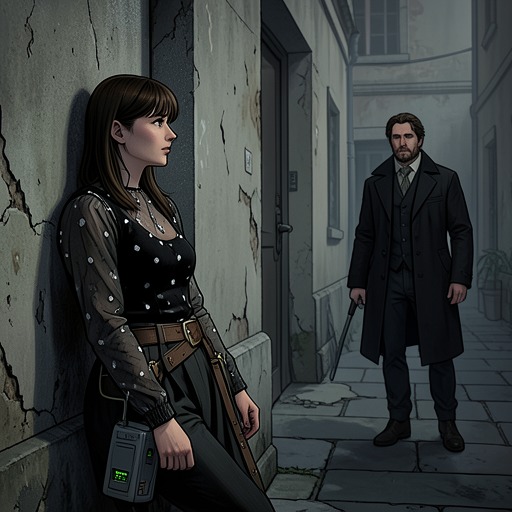
Joanna does not resemble the woman Cushla had imagined: she is neither tiny nor nervy nor plain. Cushla sees a heart-shaped face, straight auburn hair cut to the chin, and an expensive, well-cut camel-coloured dress. A bruise with a small hole at its centre marks the back of Joanna’s left hand, suggesting a cannula or injection. Her appearance combines controlled elegance with a physical trace of treatment, details that make her presence both striking and difficult for Cushla to read.
Joanna tells Cushla that she has not seen her since she was little and that Cushla resembles her father. Her grip is desperate, as if she needs the contact to steady herself. Cushla experiences the touch as excruciating because she feels both the strain in it and its sincerity. The encounter is not a simple exchange of courtesies: Joanna reaches toward Cushla with an intensity that the younger woman cannot comfortably absorb.
Illness and Marriage
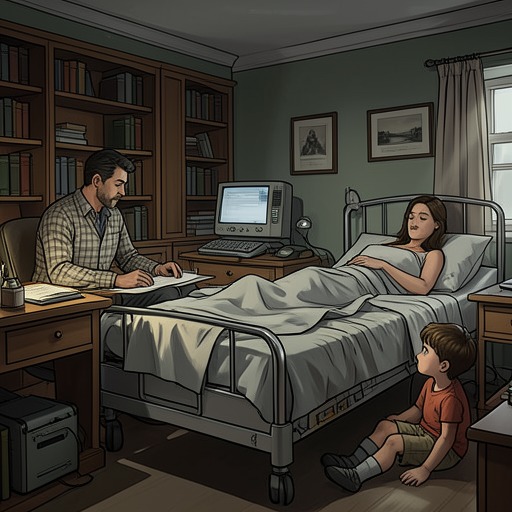
Michael later tells Cushla that Joanna is an alcoholic and is being treated for depression. He describes finding her curled on the floor and says she had been admitted to hospital more than a month earlier for another course of electric shocks. At times after treatment she is well enough to do things. The account presents illness not as a single episode but as a recurring condition, with periods of treatment and relative capacity.
Cushla asks whether Joanna’s hospitalization, together with Dermot’s being at school, was why Michael had been able to see her so often. Michael confirms that it was. His admission places the affair within the practical absences created by Joanna’s illness and their son’s schedule, without making those circumstances a full explanation of the marriage or of Joanna herself. The details that Cushla learns about Michael’s home life also complicate the distance between the wife she had pictured and the woman she has actually met.
Michael’s Funeral
At Michael’s funeral, the minister recalls his youth as a rugby player selected for Ireland Schoolboys, his academic record, his passion for the arts, his commitment to equality and justice, and his pride in Dermot. The eulogy also names his great love for Joanna. Cushla hears this from the congregation, aware that Eamonn Lavery has stepped in behind her; the public account of the marriage reaches her in the same ceremony in which she must confront Michael’s death.
When the coffin is carried down the aisle, Dermot is only a couple of feet away, looking too young in his new suit to bear his father’s body. Joanna is supported between two women, her legs buckling like a wounded deer, and clings to her son outside as the coffin is taken toward the hearse. The physical collapse sharply contrasts with the serenity Cushla saw at their first meeting. Joanna’s grief becomes impossible to mistake, while the son who had appeared in a rugby photograph is now beside his father’s coffin, at the centre of the family’s loss.
Narrative Significance
Joanna enters the story through Cushla’s limited knowledge: first as an imagined rival, then as a composed and beautiful woman whose hand bears evidence of medical treatment, and finally as a wife and mother overwhelmed by bereavement. These successive views resist reducing her either to the obstacle in Cushla’s affair or to the list of Michael’s disclosures about her illness. Her desperate greeting, the history of recurring treatment, and her collapse at the funeral remain distinct parts of a life that Cushla can only partially see.