Gerry Devlin
TrespassesGerry Devlin is a teacher, songwriter, and steadfast friend to Cushla Lavery. He enters the story as a recently appointed colleague whose enthusiasm for peace-making contrasts with the hostility around him. His importance grows through practical gestures rather than declarations: he challenges Slattery in front of the school, makes room for Cushla in his social and family life, and helps care for Davy McGeown when she is absent. The friendship survives Cushla’s personal and professional crises, and in the novel’s later glimpse of her life, Gerry remains her best friend.
Identity and Work
Gerry Devlin teaches the other P3 class at Cushla’s school. He has only been on the staff since September when the narrative introduces him, but he has already taken responsibility for training the school choir. He also writes poems for peace and sets them to music. His energy is conspicuous to Cushla, who feels that his commitment makes her look less enthusiastic by comparison. Their difference is not a simple opposition between conviction and indifference: Cushla recognizes the awkwardness of his efforts, yet comes to join them when his intervention offers a way to resist a more immediate harm.
Gerry’s songs are earnest and imperfect. At a school assembly, his peace lyrics have clumsy rhymes and familiar appeals to love and forgiveness; Cushla remembers them as difficult to listen to. But their artistic limitations do not cancel their function. When Slattery speaks about loyalist murder gangs to the assembled children, Gerry walks onto the stage with his guitar and begins to sing. The pupils’ voices join his, and Cushla finds herself singing too. His song turns a gathering that might have remained under the priest’s control into a collective response. Bradley and Slattery do not join in, leaving the two men apart from the rest of the assembly.
Colleague and Friend to Cushla
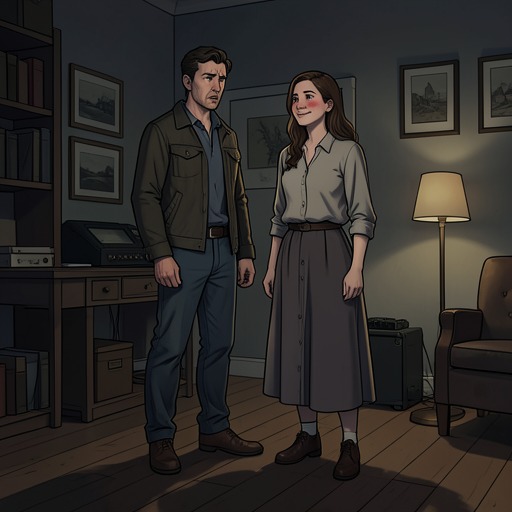
Gerry and Cushla’s exchanges mix teasing with an ease that develops into trust. He jokes about using his guitar to drown out Slattery; Cushla laughs and answers that even Slattery does not deserve that. When Gerry says he is going to a party, he eventually asks Cushla to come along. Later he arrives at her mother’s house wearing his leather coat, notices its older furnishings, and learns from Cushla that it is her mother’s home. These social encounters place him beyond the staffroom without making him an outsider to Cushla’s ordinary life.
Their friendship is visible in the way he seeks her out and in the way she identifies him to others. At the family bar, Gerry arrives looking around anxiously; when Eamonn makes a joke about a man entering a bar, Cushla explains that Gerry has come to see her. On another occasion, Gina answers the telephone and tells Cushla that Gerry is calling. The call prompts Cushla to send her mother out of the room before she speaks with him, a small indication that the friendship has its own private channel within the household.
Gina also welcomes Gerry into the family’s domestic space. She invites him to dinner, and he arrives with a box of chocolates for her. She gives him a beer and seats him in Cushla’s father’s chair, a gesture of welcome whose significance Gerry does not notice. Cushla has insisted on cooking: the meal includes roast chicken and potatoes, tinned peas prepared as her father liked them, gravy, and greens supplied by Mr Reid. Conversation ranges across school and family life. Gerry remarks on the length of Davy’s penance and on Cushla’s forceful manner at school; Gina adds stories about her daughter’s difficult behaviour at home. Cushla is unexpectedly grateful to be the subject of their attention, even when that attention takes the form of criticism.
Practical Help in a Period of Crisis
Gerry’s friendship becomes especially tangible when Cushla’s circumstances narrow. After she has missed a day at school, she worries about how Davy, who has a limp, will get there. Gerry explains that Bradley told him she would not be coming in, so he made a quick trip up the road to collect Davy. The visit is not presented as a grand rescue: it is a colleague noticing an immediate need and acting on it. For Cushla, who is preoccupied with Davy’s welfare, the assistance answers a specific worry at a moment when she cannot be present herself.
He also comes to see Cushla at home when she is increasingly isolated. She admits that she missed the last day with the children and asks how Davy managed the journey to school; Gerry’s account of fetching him gives her the information she needs. The scene joins professional and personal care. His concern originates in what has happened at school, but he brings it through the front door and into the kitchen, where Cushla is making tea. His presence offers companionship without erasing the pressures she faces.
Before Gerry leaves for France with friends, Cushla asks him to find out where Davy is. He cannot identify a straightforward way to locate the boy short of going from door to door in Short Strand. Cushla later drives east herself, reaches a point from which she can see where she had left the McGeown family, and turns back, frightened by the surroundings and the possibility that she is being followed. The narrative does not establish that Gerry secures Davy’s letter or determines his placement. Instead, his promised effort belongs to a larger pattern: even as the family’s displacement makes contact difficult, Cushla tries to keep a connection with Davy, and Gerry is someone she trusts enough to ask for help.
Friendship, Contrast, and Later Life
Cushla is not in love with Gerry. When Gina eventually admits that she saw Cushla getting into Michael Agnew’s car and explains that she had hoped the affair would end by itself, she distinguishes Gerry from Michael: Gerry is a decent man, but Cushla did not fall for him. This retrospective comment clarifies the boundary between affection and romantic attachment. Gerry’s closeness to Cushla is real, but it does not make him a substitute for Michael or turn his care into courtship. The contrast also gives his friendship a particular steadiness: he remains present without being the person Cushla chooses as a lover.
By the time Cushla is known as Mrs McTiernan, she has not seen anyone except Gina and Eamonn for a long while, and she avoids Eamonn when he visits with the children. Gerry has left, and she receives a postcard from him while he is travelling with friends. It bears an image of a red metal bridge over a river, with a cathedral beyond; Gerry writes that the bridge was designed by Gustave Eiffel and served as a trial for the tower. The postcard brings news of his route from France to Girona, a modest sign of a life continuing beyond the crisis that has closed in around Cushla.
In a later conversation, Cushla explains that Gerry is in a civil partnership with Mr Mulgrew and is still her best friend. The remark confirms that their bond endures across time, despite distance and the separation of their adult lives. Gerry’s narrative role is not to resolve Cushla’s troubles but to offer a counterweight to the forces that isolate her: at school he gives a public voice to peace, and in private he supplies attention, humor, and practical help. His imperfect songs and unshowy acts of care belong together. Both insist, in different registers, on the possibility of connection when the surrounding world encourages division and withdrawal.