Katsumi Matsunaga
AnotherKatsumi Matsunaga is a former student of Yomiyama North Middle School whose voice, preserved on a cassette tape, supplies the clearest surviving account of an earlier recurrence of the Yomiyama phenomenon. A member of the 1983 third-year Class 3, he is both a historical witness and a morally compromised predecessor: he killed the person he came to identify as the extra person, then left behind a warning that later students interpret as a practical solution to their own disasters.
Identity and Historical Position
Matsunaga belonged to the 1983 third-year Class 3 at Yomiyama North Middle School and was scheduled to graduate the following March. His importance in the 1998 story does not arise from a present-day appearance but from the recovery of his fifteen-year-old testimony. Teshigawara reports that new information has emerged through Tomoka, identifying Matsunaga as the source. The identification matters because he had been at the school during the same period as Reiko Mikami and had been in her third-year Class 3, placing him inside the earlier class directly connected to the phenomenon.
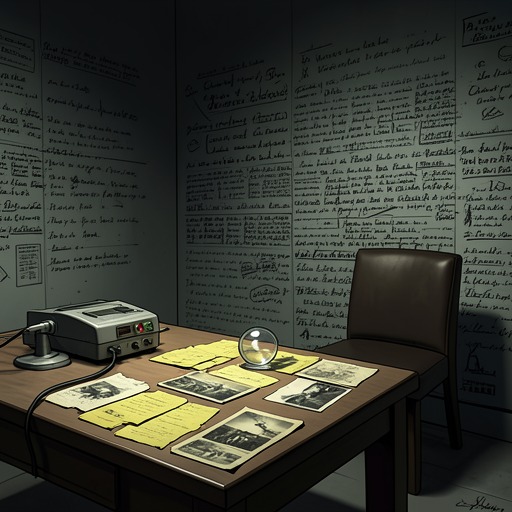
The recording begins with Matsunaga identifying himself and specifying his class and school year. He says that he is making the tape alone in his room after eleven o’clock on August 20, with roughly ten days of summer break remaining. This precise, private setting gives the testimony the character of an immediate confession rather than a later legend. The tape preserves a young student speaking from within the recurrence itself, before its implications have been safely organized by teachers or survivors.
The Cassette Testimony
Matsunaga’s account is presented to Koichi Sakakibara, Mei Misaki, and Yuya Mochizuki as a message from the past that directly addresses their crisis. The narration identifies what follows as both a confession of a crime and a warning and advice to students who are following in his footsteps fifteen years later. His testimony therefore performs two functions at once. It records what happened in 1983, while also attempting to instruct a future class trapped in the same structure of concealment, altered memory, and escalating disaster.
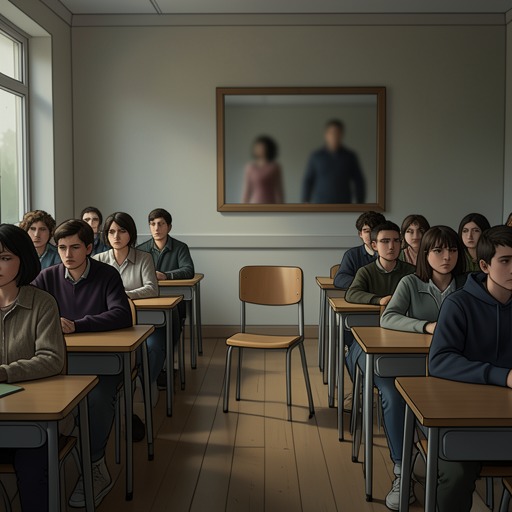
The central revelation comes when Matsunaga explains that, after the class descended the mountain and returned to the lodge to call for help, a disturbance occurred amid the confusion. He eventually learned that the trip had contained only nineteen students, not twenty. The discrepancy forced him to confront a fact that ordinary memory and the available social record had concealed: the person he had killed was the extra person hiding in the class. The tape’s A side cuts off immediately after this realization, leaving the confession suspended at the point where personal violence becomes evidence of a supernatural order.
Crime and the Extra Person
Matsunaga’s killing is the precedent later known as Matsunaga’s Killing of the Extra Person. Its significance lies not merely in the act itself but in the contradiction surrounding its victim. Matsunaga remembers killing someone, yet the surviving understanding of the trip contains only nineteen students, and no one recognizes the murdered individual as having existed. The class phenomenon has therefore absorbed the victim into its own falsification of records and memories, making the crime appear both undeniable to its perpetrator and impossible within the collective account.
That contradiction clarifies the mechanism described by Mei Misaki and confirmed without hesitation by Tatsuji Chibiki: when the extra person hides in the class, records and memories are tampered with so that otherwise impossible details seem normal and the victim’s identity remains unrecognized. Matsunaga’s testimony supplies an earlier human encounter with that mechanism. His recollection survives precisely where the wider class memory has been rendered unreliable, but survival of the memory does not make his conclusion morally safe; it leaves him carrying the knowledge that he killed a person whom the world had been made unable to acknowledge.
Warning to the 1998 Class
Matsunaga’s message does not present his action as an ordinary murder detached from consequence. He frames it as a confession, a warning, and advice for the later students. His repeated instruction is to return the casualty to Death and kill the extra person, which he claims is the only way to stop the disasters once they have begun. The language turns a past act into a proposed rule of intervention, and its force in 1998 comes from the possibility that the earlier class discovered a method the current students have not yet found.
The instruction also intensifies the danger of the class’s exceptional social order. Chibiki explains that people with no direct link to third-year Class 3 are comparatively safe, while those inside the class are exposed to its rules and distortions. The students’ attempt to increase the number of people treated as not there eventually fails, and after Mr. Kubodera’s death the class gradually resumes treating Mei as a real participant. Against that background, Matsunaga’s recording offers a more violent alternative to collective exclusion: identify the hidden casualty and physically eliminate that person. His testimony thus becomes both a source of knowledge and a possible instrument of further catastrophe.
Narrative Role and Ethical Tension
Matsunaga is absent from the main chronology, yet his voice changes the students’ understanding of what is happening. The recording converts an inherited rumor into a witnessed historical pattern, linking the 1983 class to the 1998 class and making the disasters recur not only as events but also as instructions. His story gives the present a precedent, but it does not give the students certainty about whom they may safely condemn.
The tension is sharpened by the class’s readiness to assign responsibility during the current crisis. Izumi Akazawa tells Mei and Koichi that they bear responsibility for the disasters, demands an apology from Mei after she stops being treated as not there, and turns fear into accusation. Matsunaga’s testimony exists within the same atmosphere of emergency, in which normal recognition and ordinary safeguards have been suspended. His confession can be read as testimony from someone who acted under that pressure, but the text preserves the cost rather than cleansing the act: the answer he leaves behind requires killing an ostensibly living classmate in order to restore the order of the year.
The later knowledge that Reiko Mikami was known to Mr. Kubodera and most of the class as Koichi’s aunt further demonstrates how the class’s rules depend on enforced separation, withheld recognition, and managed memory. Matsunaga’s recording belongs to this same system of concealment. It is valuable because it resists the phenomenon’s erasure, yet its proposed remedy reproduces the logic of the class by treating a person as an anomaly whose removal can restore collective safety. His narrative role is consequently double: he is the crucial witness to the past recurrence and the disturbing voice that makes violence appear like a duty.