Reiko Mikami
AnotherReiko Mikami is both a teacher and the concealed extra person of the 1998 third-year Class 3 disaster. Known at school as Ms. Mikami, she serves as the assistant teacher and art-club adviser, yet she is in fact the woman who died two years earlier and was returned to the living through the Yomiyama phenomenon. Her presence makes the class’s attempt to manage the disaster inseparable from the suppression of memory itself: those around her treat her as absent, while she continues to teach, suffer, and participate in the desperate effort to prevent further deaths.
Identity and Background
Reiko Mikami is an art teacher at Yomiyama North Middle School and the assistant teacher attached to third-year Class 3. She also has a personal connection to Koichi Sakakibara: fifteen years before the main events, she gave birth to him in Yomiyama, then became ill that summer after catching what developed from a cold into something worse. At school, however, Koichi is expected to address her as “Ms. Mikami,” preserving the separation between her professional identity and her familial identity as his aunt.
Her position is complicated by the fact that she had already been involved with the class in the previous year. When the earlier art teacher, who had been the main sponsor of the art club, transferred, Reiko continued as sponsor. In the year of the current disaster, she acts as assistant teacher and is repeatedly exposed to the class’s unnatural social arrangements, including the treatment of Mei Misaki as someone who is “not there.”
Teacher Under the Not-There Strategy
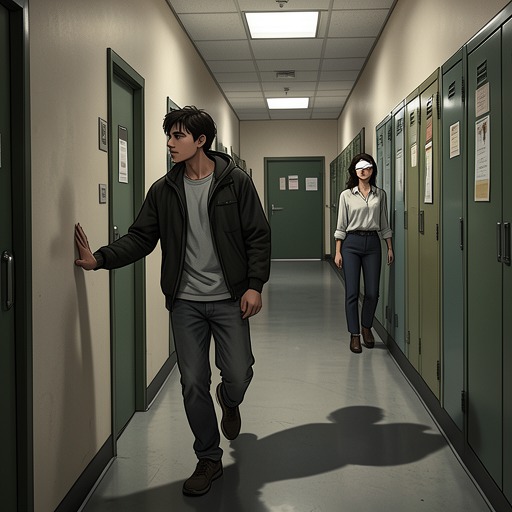
Reiko understands and enforces the class’s collective decision to exclude Mei Misaki. When Mei and Koichi explain that they are absent from art and extended homeroom because everyone will supposedly feel better if they are not present, Reiko accepts the decision rather than challenging the rule. The arrangement demands that she ignore them, and the resulting silence becomes a visible burden. At one encounter outside the art-club room, Reiko and the two students pass one another in the hall while all three pretend not to see the others; she stops, turns her eyes away uneasily, and may appear to tremble as though trying to speak.
This conduct is not simple indifference. Reiko sometimes appears deeply anguished, and her distress unsettles Koichi even though he feels unable to voice a complaint to her. Her role as an adult authority therefore becomes tragically divided: she is responsible for maintaining the class’s rule, yet her own visible suffering suggests that she recognizes its cruelty. The “Not There” Strategy gives the students an apparent means of control, but it also turns teachers into participants in a collective performance whose emotional cost they cannot openly acknowledge.
Connection to the Previous Disaster
Tatsuji Chibiki explains that the class’s strategy of making one student “not there” was devised roughly ten years earlier and had sometimes contained the disaster, though it had also failed partway through a school year. The revelation that the strategy failed two years earlier gains force when Mei notices that Reiko was the head teacher of third-year Class 3 during that period. Reiko therefore had direct experience of an earlier outbreak before returning as the current assistant teacher.
Her experience also helps explain the severity of her response to the present crisis. After Mr. Kubodera’s death, the class is moved from the sealed third-floor classroom in Building C to an empty room in Building B, while Reiko becomes substitute head teacher. The arrangement places her at the administrative center of a class already marked by violent death, but it also repeats the conditions under which she previously endured the phenomenon. Her institutional authority is thus inseparable from accumulated trauma and incomplete memory.
Suspicion, Blame, and the Extra Person
Once the class stops treating Mei as “not there,” Mei becomes someone everyone acknowledges as present, and the change is unsettling precisely because it reverses the social order that had seemed necessary. In the resulting uncertainty, Naoya Teshigawara suggests that Mei herself might be the extra person. Mei responds without visible alarm, saying that she does not think she is. The accusation shows how quickly the class converts an unexplained disaster into a question of individual identity.
Izumi Akazawa later directs that same logic at both Mei and Koichi, assigning them responsibility for the disasters that have occurred since May, including Mr. Kubodera’s death. She demands an apology from Mei, arguing that Mei resumed acting as though nothing had happened as soon as she ceased to be “not there.” The accusation treats social exclusion as if it were a moral debt and makes Reiko’s classroom a tribunal in which fear is converted into blame.
The suspicion eventually turns toward Reiko herself. Naoya, convinced that Tomohiko Kazami is the extra person, attacks him and later admits that he killed him. Meanwhile, Reiko is pursued as the actual extra person. Her concealed status gives the class’s earlier behavior a grim retrospective meaning: she was not merely an adult supervising the strategy but the person whose return had already entered the class’s reality without anyone being able to remember it.
Revelation and Ending
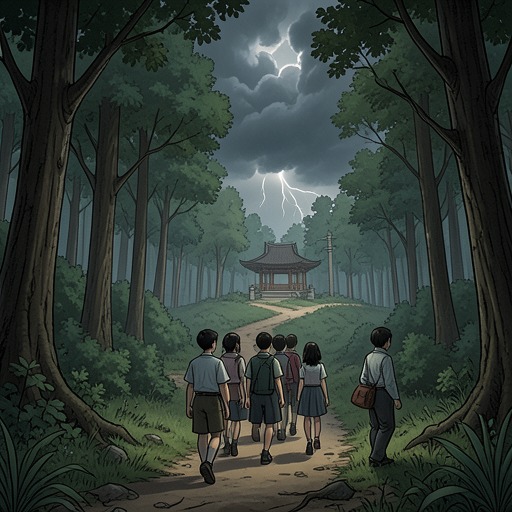
The decisive revelation is that Reiko is the extra person. Koichi’s memories and the class’s final explanations establish that she died two years earlier in the fall, yet returned as part of the phenomenon. She later became the substitute head teacher after Mr. Kubodera’s death, partially remembered her own experience fifteen years earlier, planned the camping trip as what must have seemed a desperate countermeasure, and attended it as a chaperone.
At the climax, Koichi confronts Reiko while holding a pickax taken from Mei. The weapon is described as medium-sized, with a haft roughly sixty or seventy centimeters long and a sharply pointed iron head capable of inflicting fatal wounds. Reiko protests that the act cannot be carried out, while Koichi recognizes the full weight of his decision and agrees to do it. He kills her, thereby returning the extra person to death and ending the immediate manifestation of her presence.
The consequence is not only physical death but the destruction of social memory. After Reiko’s death, no one remembers that an art teacher named Reiko Mikami had existed since April, that she had been assistant teacher of third-year Class 3, or that she had become substitute head teacher. No one remembers her role in planning the camping trip or her presence there as chaperone. Mei tells Koichi that everyone instead says Reiko died two years earlier in the fall. Reiko is therefore erased twice: first from ordinary recognition while alive as the extra person, and then from the surviving characters’ recollections once she has been killed.
Narrative Significance
Reiko’s character embodies the most disturbing contradiction of the Yomiyama phenomenon. She is physically present yet socially denied, institutionally responsible yet unable to disclose the truth, and remembered by Koichi and Mei only because they were deeply involved in her death. Her divided status also exposes the limits of the class’s rules. The “Not There” Strategy attempts to control catastrophe through a manufactured absence, but Reiko’s case shows that absence can become a condition imposed on the living, while the dead can return with all the authority and familiarity of ordinary life.
Her arc further links private history to public disaster. The woman who gave birth to Koichi fifteen years earlier becomes the teacher supervising the class in which he must ultimately kill her. The separation between “Ms. Mikami” at school and Reiko within the family postpones recognition until recognition itself becomes dangerous. By the ending, the class has regained a manageable version of reality only by losing the memory of the person who had occupied its center. Reiko’s erasure is therefore both the apparent solution to the disaster and its most telling proof: in Yomiyama, survival may depend on forgetting whom the world has already accepted as present.