Yuya Mochizuki
AnotherYuya Mochizuki is a student of Yomiyama North Middle School and a member of its art club whose importance grows from quiet observation to active evidence-gathering. Often called Mochizuki by his classmates, he is associated with the art room, with Tomohiko Kazami and Naoya Teshigawara, and with the material traces through which the Yomiyama phenomenon conceals and reveals the truth. His artistic eye first makes him recognizable; later, his recovery and playback of Katsumi Matsunaga’s cassette tape place him close to the most consequential testimony about the year’s extra person.
Identity and School Life
Mochizuki belongs to the school’s art community and spends time in the art club room, a former classroom on the first floor of Building Zero at the western end of the building. The room has been divided in two, leaving the club with only half of its original space; it contains worktables, member lockers, steel shelves of art supplies, and several easels. This concrete setting gives Mochizuki a defined place within the school’s social geography, even as the “not there” strategy alters who may openly occupy shared spaces.
His personality is rendered through the work he leaves behind rather than through a formal self-description. One easel holds his version of Edvard Munch’s The Scream. The background differs substantially from the original, while the central figure, with hands pressed over its ears, resembles Mochizuki himself. The image links his artistic practice with a recognizable posture of alarm and inward pressure, but the evidence does not require treating the painting as a literal confession. It does, however, establish him as a student capable of translating the surrounding unease into visual form.
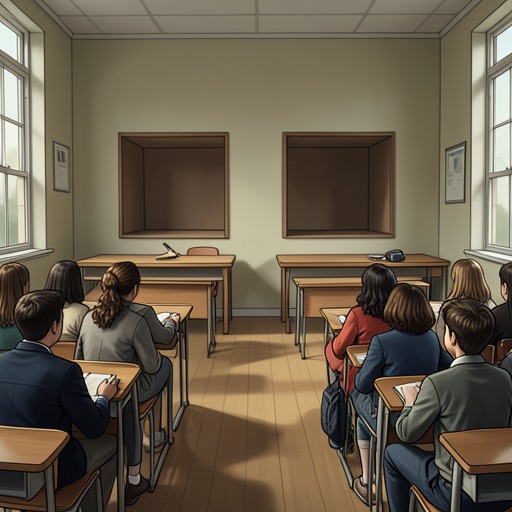
Mochizuki’s arrival in the art room is timed almost theatrically: after Mei Misaki and Koichi Sakakibara enter, Mei observes that he has not changed, and Yuya Mochizuki walks in at precisely that moment. His greeting identifies Mei and Koichi as senpai, placing him within the school’s ordinary hierarchy even while the phenomenon has made ordinary recognition unstable. The scene therefore introduces him through both continuity and interruption: he remains the familiar art-club junior, but the social rules governing presence and absence have begun to shift around him.
Position Within the “Not There” Strategy
The school’s “not there” strategy affects Mochizuki indirectly but significantly. Mei becomes unable to attend art-club activities after the phenomenon resumes in April; she can appear a few times that month, but once May begins she can no longer go because she has become “not there.” Mochizuki consequently belongs to the club environment that Mei has been excluded from, making the art room one of the institutional spaces from which the strategy separates them.
That separation is later complicated when the students stop treating Mei as absent. The change is subtle because Mei is not especially social, yet teachers are expected to begin calling her name and asking her questions again. Mochizuki is among those around her who now treat Mei as someone “there.” This reversal restores a basic social fact while making the result unsettling: what should have been ordinary recognition feels strange because the class has already reorganized itself around denial and exclusion.
The same contradiction appears when Koichi and Mei decide to avoid the classroom so that everyone else will feel better. The pair leave rather than join their classmates, and Mr. Chibiki approves the decision. Mochizuki is therefore part of a school environment in which presence is not merely physical. To be acknowledged, ignored, or deliberately kept away becomes a collective procedure intended to control the disasters, even though the procedure itself produces isolation and uncertainty.
Friendships and Everyday Connections
Mochizuki is connected to Naoya Teshigawara and Tomohiko Kazami through ordinary school friendship and familiar meeting places. Inoya, the coffee shop run by Tomoka Inose and her husband, is close to school and gives Mochizuki’s friends special treatment. Teshigawara visits partly because he is likely to see Mochizuki there, and Mochizuki quietly confirms the connection. The detail presents him as a social anchor: not an exceptionally public leader, but someone whose presence organizes the movements of friends around him.
His friendship with Teshigawara also carries a strain of suspicion. Teshigawara calls Mei strange for remaining outwardly calm while being caught up in the phenomenon and suggests that she might be the extra person that year. Mei answers that she does not think she is, and Teshigawara accepts the reply without resolution. Mochizuki is not the target of this accusation, but his presence within the exchange places him among the classmates forced to negotiate suspicion, loyalty, and the possibility that any familiar person may occupy the hidden role.
Mochizuki’s relations are also shaped by the rules Mr. Chibiki has reconstructed as an observer. The phenomenon corrupts class lists, school records, official documents, diaries, notes, photographs, videotapes, and computer data so that contradictions caused by the casualty’s presence disappear. Mr. Chibiki further concludes that the disasters reach class members and blood relatives within two degrees, including parents, grandparents, and siblings, while step-relations without blood ties remain outside that range. Mochizuki’s social world is thus governed by a system in which family and friendship are not merely emotional bonds but possible channels of danger.
The Cassette and the Search for Evidence
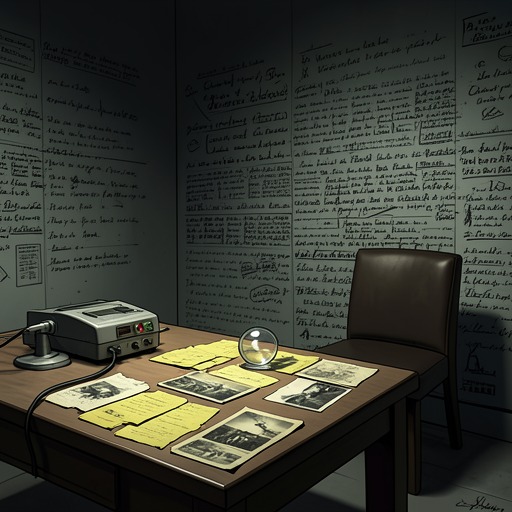
Mochizuki becomes especially important when the students recover Katsumi Matsunaga’s cassette tape. Teshigawara recognizes the writing on the package as Matsunaga’s, and the wrapped object is opened after considerable effort. Inside is a plain TDK sixty-minute audiocassette, still at the beginning of its reel. Its unremarkable appearance contrasts with its evidentiary force: in a world where records can be tampered with across many formats, a physical tape becomes a fragile but recoverable container of testimony.
The group carries the cassette out of the restricted area and returns to the art club room after five in the afternoon. Mochizuki participates in the attempt to read the object rather than leaving the discovery as an unexplained relic. When the A side reaches Matsunaga’s account, the recording ends abruptly at the moment he identifies the man he killed as the extra person hiding in the class. The three listeners gasp, and Mochizuki fast-forwards through the remaining portion before beginning the B side, which opens with the declaration that it is the confession of his crime.
This sequence gives Mochizuki a practical role in converting hidden history into audible evidence. The tape is not pristine, complete, or institutionally preserved: it is sealed, difficult to unpack, abruptly interrupted, and divided into two sides. Yet those material limitations do not make it useless. They make interpretation necessary, and Mochizuki’s handling of the cassette helps expose how damaged media can both conceal a truth and preserve enough of it to disturb the official version of events.
Photographs and Narrative Significance
Mochizuki later proposes taking a photograph as a remembrance of the group’s final summer of middle school. He removes a compact camera from a side pocket of his day pack and points it at the others. When Ms. Mikami offers to take the picture instead, he refuses the substitution because he wants her included in the image. His action is modest, but it directly opposes the logic of disappearance: the photograph is meant to retain the people present rather than silently accept anyone’s exclusion.
Afterward, Mochizuki gives Koichi two photographs, one taken by Mochizuki himself and another taken by Teshigawara. Both images carry dates in their lower-right corners, and both show five people. The repeated numerical fact matters because the phenomenon works by making contradictions appear to resolve themselves. The photographs instead preserve a visible count that demands explanation. Mochizuki’s camera therefore extends his earlier relation to the cassette: he is not simply a participant in events but a custodian of unstable records.
His narrative role rests on this conjunction of sensibility and action. The student associated with a distorted version of The Scream becomes the friend who helps retrieve a confession and the photographer who preserves a five-person arrangement across two images. The school’s supernatural corruption attacks memory and documentation alike, but Mochizuki’s artistic and archival gestures create small, concrete resistances to erasure. He does not solve the phenomenon alone; his importance lies in helping the story retain what the phenomenon tries to make impossible to remember.