Tatsuji Chibiki
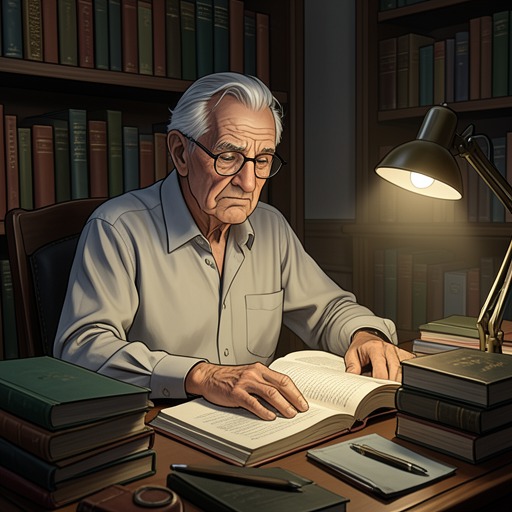
AnotherTatsuji Chibiki is both a survivor of an earlier catastrophe and the most persistent custodian of its evidence. Once a teacher at Yomiyama North Middle School, he later becomes its librarian, using the Secondary Library as a place from which to study the Yomiyama phenomenon, preserve records, and explain its recurring distortions to those willing to listen. His importance lies in the tension between knowledge and helplessness: he understands more than almost anyone else, yet his understanding cannot by itself prevent the disasters.
Identity and Background
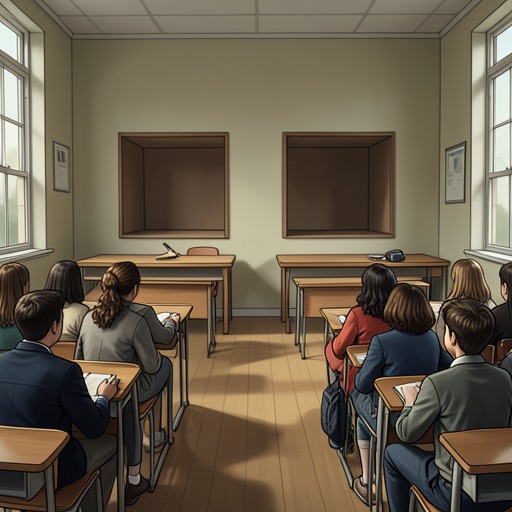
Chibiki is identified in a historical photograph as Mr. Tatsuji Chibiki, linking the apparently elderly librarian of the present to the teacher who directly experienced the Third-Year Class 3 disaster twenty-six years earlier. He tells Koichi Sakakibara and Mei Misaki that he dislikes discussing what happened because he may be the last person at the school who experienced it firsthand. His account places him inside the older tragedy rather than outside it as a detached scholar: he had been young, believed he was acting according to sound educational ideals, and now judges some of those ideals frivolous in retrospect.
His recollection of the earlier class centers on the death of a popular student named Misaki and the consequences that followed. In his interpretation, no one acted with malicious intent, yet the students’ and adults’ collective response became the trigger through which the school’s “doors to death” opened. The phrase gives Chibiki’s history a moral as well as supernatural dimension. The disaster did not begin with a single villain; it emerged from a structure of mistaken judgment, shared conviction, and an inability to recognize what had entered the class.
From Teacher to Observer
The year associated with the 1976 casualty was Chibiki’s last year as a teacher. After he left teaching, the principal insisted that talk of a curse or comparable phenomenon remain private, but allowed him to stay at the school as a librarian. Chibiki had occupied that position for eighteen years by the time he spoke with Koichi and Mei. The library therefore becomes more than a workplace: it is the institutional remnant of his former authority and the chosen vantage point from which he watches the phenomenon without officially controlling it.
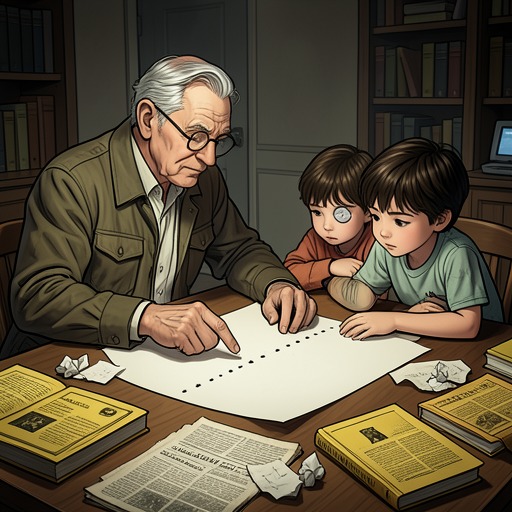
He explains that he decided to observe each year’s phenomenon as a third party. Students sometimes come to him, as Koichi and Mei do, and he receives them as an archivist, witness, and reluctant teacher. His role is paradoxical. The school suppresses public discussion, while Chibiki privately accumulates the knowledge that suppression would erase. He is not presented as an administrator capable of imposing a solution; he is the person who remains in the building, keeps watch, and waits for the next contradiction to become visible.
Archives and the Mechanics of Erasure
Chibiki’s principal material instrument is a black binder containing copies of the Third-Year Class 3 class lists for twenty-seven years, from 1972 through the current year. He offers it as a set of examples that makes the phenomenon legible. The binder transforms a vague rumor into a sequence of comparable documents, allowing changes across years to be inspected rather than merely remembered.
He uses Mami Asakura’s name to demonstrate the instability of the records. During the 1996 phenomenon, her name should have appeared on the class list because she was treated as a member of the class. Chibiki remembers that the name had also disappeared from the 1993 list, together with the mark identifying her death and the note recording it. When the casualty vanished after graduation, the records returned to their proper condition, but the alteration had not been limited to paper. Chibiki states that school records, official documents, diaries, notes, photographs, videotapes, and computer data can all be tampered with or corrupted so that contradictions are concealed.
The same process governs human memory. Chibiki recalls that, even as an observer, he never suspected Mami’s presence, although she had died at fourteen in October 1993. Her family, friends, teachers, and classmates had forgotten the death, while everyone accepted the false reality that she was fourteen and beginning her third year in 1996. Memories and surrounding details were altered to make the impossible arrangement appear consistent. Once the casualty disappeared, records and memories returned to their proper state, and those closest to her lost the memory that she had ever appeared as the casualty. Chibiki’s archive is therefore valuable precisely because ordinary evidence is not stable: the binder records the brief moments when an impossible history has been made to look normal, and when that history is later erased.
Relationships and Disclosure
Chibiki is the unnamed source behind much of Mei’s prior knowledge. When Koichi asks about the “someone” Mei had mentioned while explaining the phenomenon, she confirms that she meant Chibiki. His relationship with Mei is consequently not a first encounter but an uneven continuation of instruction: she has heard fragments, while he possesses the fuller account and decides to supply it when Koichi joins the conversation.
He also recognizes the practical necessity of the “not there” strategy. When Koichi and Mei explain that they will miss art and extended homeroom because everyone will feel better if they are absent, Chibiki approves their decision. His response shows that he understands exclusion as a protective measure within the class’s emergency logic, even though he does not treat it as an ordinary social arrangement. He can acknowledge the strategy without sharing the students’ total silence, because his own position as librarian places him outside the class’s chosen pattern of collective denial.
Intervention and Narrative Role
Chibiki’s authority is not confined to explanations and documents. During the violence at Sakitani Memorial Hall, Koichi sees a black shape attack the killer, knock the knife away, and throw the attacker to the ground. The figure is revealed to be Chibiki, who has already ended the struggle by the time Koichi identifies him. This intervention radically enlarges his function. The librarian who has spent years watching from the margins is also capable of entering the danger directly when observation is no longer enough.
Yet Chibiki’s intervention does not preserve the full truth for everyone. After the catastrophe, Koichi and Mei are among the only people who remember Reiko Mikami’s existence. The others, including Chibiki, no longer remember that an art teacher named Reiko Mikami had been the assistant head teacher of the class, had become the substitute head teacher after Mr. Kubodera’s death, had partially recalled an experience from fifteen years earlier, had planned the camping trip, and had served as a chaperone that night. Chibiki therefore ends the story in the same condition that defines his earlier work: he is indispensable as a witness, but the phenomenon can still remove the witness’s memory of what he witnessed. His lasting significance is the tragic persistence of record-keeping and vigilance in a world where both records and minds can be rewritten.