Yukari Sakuragi
AnotherYukari Sakuragi is a student of Yomiyama North Middle School Third-Year Class 3 whose death on the last day of the May midterm examinations becomes the first major disaster of the 1998 Class 3 disasters. Her death is not merely recorded as another casualty: it is witnessed by Koichi Sakakibara, linked to the simultaneous accident involving her mother Mieko Sakuragi, and later transformed by the class into an argument for blaming Mei Misaki and Koichi. Through Yukari, the novel shows how an attempt to control the Yomiyama phenomenon can turn fear into a self-fulfilling social force.
Identity and Circumstances
Yukari appears in the class-list records for 1998 alongside the other students of Third-Year Class 3. A red X is written beside her name, and the notes identify May 26 as an accident at school and record that her mother, Mieko, suffered a car accident on the same day. The paired entries make Yukari’s death inseparable from the family disaster surrounding it: the class does not experience an isolated student accident, but a sequence in which a child’s urgent response to news about her mother becomes part of the catastrophe.
The event occurs on the last day of the midterm examinations. Koichi later remembers the scene as a tragic accident that he had been unlucky enough to witness. The memory is so immediate and distressing that, when he and Mei Misaki face the next examination period, both remain in the room rather than handing in their answer sheets early and leaving as they had previously done. Yukari’s death therefore continues to shape behavior after her physical absence, turning an earlier school accident into a living pressure on the survivors.
The Accident at School
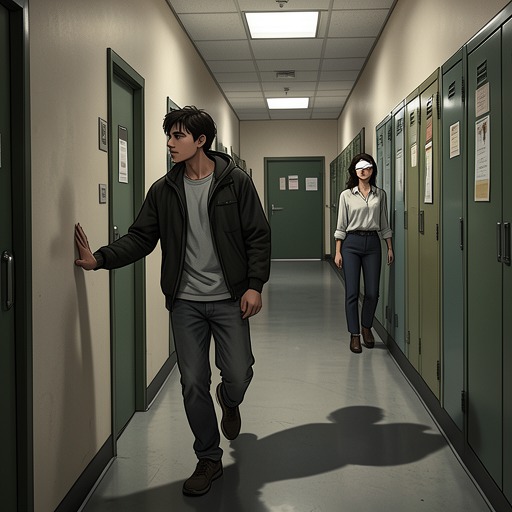
Yukari learned that her mother had been involved in an accident and hurried out of the classroom. She initially moved toward the East Stair, the route she normally used, but Koichi and Mei were standing in front of it. Seeing them together was especially alarming because Mei was supposed to be treated as “not there.” Yukari changed direction in a panic and ran toward the West Stair instead.
That change of route is the decisive movement in the account of her death. The class later interprets it through the logic of the talisman and the “not there” strategy: if Mei and Koichi were together despite the rule, perhaps the protective measure had failed, and perhaps that failure had caused Mieko’s accident. Yukari’s fear of the forbidden arrangement thus becomes part of the mechanism that redirects her into danger. Her death is presented as an accident, but the circumstances around it are saturated with the class’s attempt to impose supernatural causality on ordinary movement and emergency response.
Koichi’s recollection emphasizes the cruelty of the scene rather than giving Yukari an independent opportunity to explain herself. In recurring nightmare imagery, Yukari rises unsteadily, pulls an umbrella from her throat, and tells him that the death was his fault. The image repeats the accusation associated with other victims and converts his helpless witnessing into imagined responsibility. Yukari’s remembered form is therefore both a dead classmate and the embodiment of Koichi’s guilt over having occupied the wrong place at the wrong moment.
Blame and the Class’s Response
After Mr. Kubodera’s death, the class’s behavior toward Mei and Koichi changes. The attempt to increase the number of students treated as “not there” from one to two has failed to stop the disasters, so continuing to ignore both of them appears useless. The change is gradual and unofficial rather than the result of a clearly announced decision; students begin acting as though Mei really exists, including addressing her during conversations. This altered social atmosphere makes it possible for Yukari’s death to be discussed openly, but it does not produce a fair understanding of what happened.
Izumi Akazawa argues that Mei and Koichi bear responsibility for the disasters, including Mr. Kubodera’s death. She demands an apology from Mei and identifies the apology as being for Yukari’s death. Sugiura supplies the specific accusation: Yukari saw Mei and Koichi together even though Mei was supposed to be “not there,” became frightened that the talisman had failed, and ran away from them along the opposite route. The class thus recasts Yukari’s panic as evidence against the two students who happened to be present, shifting collective uncertainty into personal blame.
This accusation also reveals how Yukari’s memory is controlled by those who survived her. Her death becomes a public moral charge rather than a carefully examined accident. Akazawa’s demand for an apology implies that Mei and Koichi have violated the class’s protective order, while Sugiura’s eyewitness account supplies a narrative in which Yukari’s fear is proof of their culpability. The tragedy is consequently used to police conduct within the class, even though the same evidence shows that the exclusionary strategy helped create the conditions for panic.
Narrative Significance and Legacy
Yukari is the first death to make the 1998 Class 3 disasters undeniable for Koichi. Her accident gives concrete form to information previously conveyed as rules, records, and warnings: the class’s hidden casualty, its manipulated memories, and its attempts to neutralize the Yomiyama phenomenon all acquire a human cost. The class-list entry preserves the administrative outline of the event, while Koichi’s memories preserve its emotional violence; neither account can reduce it to a simple statistic.
Her death also establishes a recurring pattern in the novel. The class tries to manage an extraordinary danger by excluding particular people from ordinary recognition, but the exclusion produces confusion about what is real and who is responsible. Yukari’s attempt to avoid Mei and Koichi is not presented as irrational in isolation; it is the understandable response of a student living inside a system that has taught her to treat a classmate’s presence as a threat. The resulting accident exposes the difference between a rule that promises safety and a social order that distributes fear.
Yukari’s final narrative role is therefore paradoxical. She is remembered as a victim of the disasters, yet her death is repeatedly made to serve the interests of the living: as evidence that the strategy failed, as a reason to demand an apology, and as a source of guilt in Koichi’s nightmares. Her absence remains active in the class’s decisions and in the narrator’s memory. By tying her school accident to her mother’s simultaneous car accident and to the students’ fear of the “not there” strategy, the story presents Yukari as the point where private grief, institutional superstition, and collective scapegoating become one catastrophe.