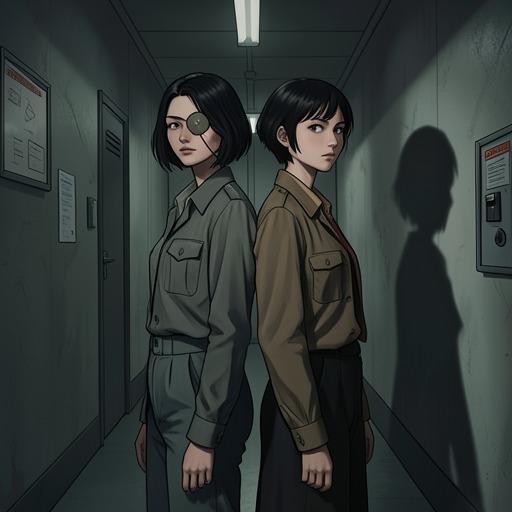
Mitsuyo Fujioka
AnotherMitsuyo Fujioka is the birth mother of Misaki Fujioka and the maternal aunt of Mei Misaki, whose identity was reshaped when one of Mitsuyo’s twin daughters was fostered by the Misaki family. Although she remains largely offstage, Mitsuyo’s family history becomes decisive: it explains why Mei and Misaki were raised apart, why they were nevertheless related as fraternal twins, and why Mitsuyo later became directly involved in saving Misaki’s life.
Family Identity and Marriage
Mitsuyo was the sister of Yukiyo Amane, Mei Misaki’s biological mother. The sisters were fraternal twins, born to the same unmarried mother, Grandma Amane, and were described as having grown up in the same environment and looking very much alike even though they were not identical. Mitsuyo married first, taking the surname Fujioka, while Yukiyo later married Kotaro Misaki. Their husbands occupied sharply different social positions: Mitsuyo’s husband was a young, serious office worker at a small food-related company, whereas Kotaro was a wealthy and capable businessman who traveled abroad throughout the year.
Mitsuyo’s importance in the family narrative lies not only in being Yukiyo’s twin but also in the unequal circumstances surrounding their households. The Fujioka family had financial concerns and doubted whether it could raise two children at once. At the same time, Yukiyo had fallen into profound despair, creating a situation in which the two families reached an arrangement that served both material need and emotional crisis.
Motherhood and Mei’s Fosterage
Mitsuyo was the first of the sisters to have children with her husband. The Fujiokas had twins, Misaki and another daughter, and one of those children was sent to the Misaki household as a foster daughter. That child was Mei, who changed her name from Mei Fujioka to Mei Misaki at about two years of age. Mei had no memory explaining why she, rather than Misaki, had been chosen for the transfer.
This arrangement makes Mitsuyo central to the concealed structure of Mei Misaki’s identity. Mei was raised as Yukiyo’s daughter, while Misaki remained Mitsuyo’s daughter, yet the two girls were the same age, were fraternal twins, and began life within the same biological family. The separation therefore created a contradiction between social identity and biological relation: Mei was publicly a Misaki, but she had originally been born a Fujioka and remained Misaki’s twin sister.
Misaki’s Illness and Kidney Donation
The family history becomes urgent when Misaki develops a serious kidney disease in the spring. Her condition was severe enough to require dialysis for the rest of her life unless she received a kidney transplant. Misaki was admitted to a major hospital in Tokyo for the operation, and Mitsuyo became the donor, giving her daughter one of her own kidneys.
Mei had wanted to donate her kidney instead. Because she and Misaki were fraternal twins of the same age and roughly the same size, Mei believed that she might have been the better biological match. The doctors rejected that possibility because transplanting an adult’s kidney into a child was considered difficult because of the difference in size. Mitsuyo’s donation consequently gave concrete medical expression to her role as Misaki’s birth mother, while Mei’s wish to donate revealed the continuing force of the twin relationship despite their separate upbringings.
Connection to Death and the Class Crisis
Mitsuyo’s family is also connected to the book’s recurring overlap between ordinary illness and the supernatural meaning of death. Mei explains that she has learned to recognize a particular color when death is present, first sensing it at a funeral and later perceiving the same color on the face of a dead man trapped in a crushed car. Against that background, Misaki’s kidney disease belongs to the realm of diagnosable bodily illness, while the deaths surrounding Yomiyama North Middle School belong to the unexplained disaster affecting Third-Year Class 3. Mitsuyo’s actions remain grounded in medical care even as Mei’s account places the family inside a wider pattern of death and threatened survival.
The later crisis at the school turns Mei’s presence into a target of collective suspicion. After she is again treated as someone who is “there,” Akazawa Izumi accuses Mei and Koichi Sakakibara of bearing responsibility for the disasters and demands an apology from Mei. Teshigawara Naoya likewise suggests that Mei herself might be the “extra person.” These accusations depend on the class’s unstable labeling of Mei, not on Mitsuyo’s conduct; nevertheless, the hidden fact that Mei is Mitsuyo’s biological daughter and Misaki’s twin gives the accusations an additional irony. The person treated as an outsider is bound to the Fujioka family by birth, while the family’s attempt to protect and sustain its children has produced the very identity confusion that others misread.
Mitsuyo therefore functions as an absent but consequential figure. Her marriage and household circumstances help produce Mei’s fosterage, her motherhood establishes Misaki’s biological identity, and her kidney donation becomes the clearest act of care attached to the family’s concealed history. Through her, the novel links kinship, medical vulnerability, fostered identity, and the moral distortions created when a community tries to explain disaster by assigning responsibility to a visible individual.