Mr. Kubodera
AnotherMr. Kubodera is the head teacher of Yomiyama North Middle School Third-Year Class 3, a figure whose ordinary educational authority is gradually revealed to be powerless against the Yomiyama phenomenon. He overlooks Koichi Sakakibara’s worsening attendance, avoids contacting Koichi’s grandparents, and helps sustain the class’s “Not There” Strategy; then, during a short homeroom, he brings a carving knife from home into the classroom and drives it into his own neck in front of his students. His death, followed by the death of his mother, becomes the “deaths of July” and demonstrates that the class’s attempt to exclude two people from ordinary social recognition has not stopped the disaster.
Position and Conduct
Mr. Kubodera is introduced through the practical consequences of the class’s abnormal rules. Although Koichi Sakakibara increasingly misses school, an issue that would normally alarm an educator, Mr. Kubodera never reprimands him. He cannot inform Koichi’s grandparents, who are acting as his guardians in Yomiyama, and parent-teacher conferences concerning high-school placement are arranged so that another teacher attends in the place of the student who is “not there.” Mr. Kubodera therefore does not simply neglect his duties: his conduct has been bent around the class’s imposed reality, in which normal records, communication, and supervision cannot operate normally.
The same institutional paralysis affects Koichi’s academic life. Because Koichi follows the lessons and expects to pass his examinations, the teachers can apparently alter or soften his attendance record without immediate consequences. Mr. Kubodera’s silence helps preserve the surface of ordinary schooling while concealing the exceptional status imposed on the class. His authority remains visible, but its normal functions have been suspended.
Knowledge of the Class’s Rules
The class’s arrangement depends on people without a direct connection to Third-Year Class 3 being comparatively safe. Tatsuji Chibiki explains that those with no direct link to the class can interact with its members without being affected, which clarifies why Mei Misaki has been able to visit the Secondary Library and obtain information from him. Mr. Kubodera, by contrast, is directly bound to the class through his role as head teacher. He belongs to the danger zone he is supposed to manage, and the school’s educational structure offers him no secure position outside it.
The danger is not limited to physical accidents. Mei Misaki’s account describes how, while the “extra person,” or “the casualty,” remains hidden within the class, records and memories are altered so that contradictions appear normal and no one recognizes the casualty’s true identity. Tatsuji Chibiki confirms that this tampering really occurs. Mr. Kubodera’s treatment of Koichi is part of the same distorted environment: the class’s social and administrative practices have been reorganized so that extraordinary behavior can pass as routine.
The Classroom Suicide
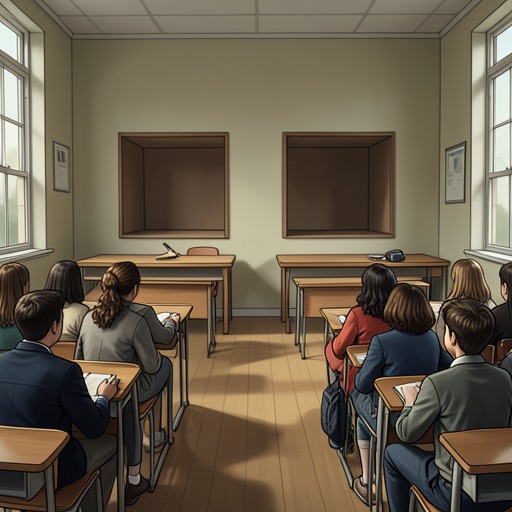
The decisive episode occurs on a bright morning when Mr. Kubodera enters the classroom during short homeroom. He is initially recognizable as the same ineffectual teacher, wearing the same plain white shirt and carrying himself with the same unimpressive posture. Yet Koichi senses that something is different. The scene converts that faint deviation from routine into an abrupt public catastrophe.
Mr. Kubodera’s speech first becomes difficult to understand and then breaks apart into sounds that no longer resemble healthy human speech. While the students watch in stupefaction, he slowly withdraws his right hand from the bag resting on his desk. He is holding a sharp-bladed object, alien to an ordinary middle-school classroom. The weapon is later identified as a carving knife that he had brought from home.
In front of the entire class, Mr. Kubodera turns the blade toward himself. As screams and confusion rise around him, he produces a violent, unearthly sound and thrusts the knife into his own neck. The event is not private despair carried out away from witnesses; it is a sudden rupture of the classroom’s educational order, transforming the teacher’s desk and the short homeroom into the site of a public death. By the time the police and ambulance crew arrive, he has already died, while the students remain physically unharmed.
Deaths of July and Failed Protection
Tatsuji Chibiki later explains that he had already been troubled by the situation and had gone to the third floor of Building C during short homeroom to see how the class was doing. He arrived after hearing the students’ screams and weeping. His later investigation also yields information from the police, including the fact that the knife came from Mr. Kubodera’s home. The aftermath thus combines direct witnessing, institutional response, and retrospective inquiry, but none of these avenues provides a clear cause for the suicide.
The immediate consequence is interpreted through the class’s attempt to place two people in the status of “not there.” Koichi and Mei Misaki had hoped that the new strategy, in which two people would be excluded from ordinary recognition, might prevent further deaths. Instead, Mr. Kubodera and his mother, a family member within the relevant range, become the “deaths of July.” The strategy has failed: the disaster has begun and continues despite the attempt to manipulate participation and recognition within the class.
Blame, Fear, and Narrative Role
Mr. Kubodera’s death becomes one of the facts used in the class’s escalating search for responsibility. Izumi Akazawa cites the terrible event that happened to him the previous month while accusing Mei Misaki and Koichi Sakakibara of bearing responsibility for the disasters that have occurred since May. She demands an apology from Mei, arguing that Mei resumed acting as though nothing had happened after she stopped being “not there.” Mr. Kubodera is therefore transformed after death from a teacher who failed to protect his students into evidence in a public accusation against the students themselves.
This reversal exposes the moral panic surrounding Third-Year Class 3. The class cannot explain why its protective measures fail, so responsibility is redirected toward visible individuals. In the same atmosphere, Naoya Teshigawara becomes convinced that Tomohiko Kazami is the extra person because Kazami no longer remembers shared childhood experiences, and Teshigawara admits that he killed him. The later violence at Sakitani Memorial Hall follows the same pattern of disaster, suspicion, and lethal action, although its deaths are ultimately attributed to Mieko Numata’s murders and arson rather than to the fire itself. Mr. Kubodera’s suicide stands at the beginning of this widening chain as the event that makes the strategy’s failure undeniable.
Mr. Kubodera’s significance lies in the collision between his official role and his helplessness. He is the adult charged with maintaining the class’s routines, yet he cannot enforce attendance normally, cannot communicate with Koichi’s guardians, and cannot remain outside the phenomenon’s reach. His death destroys the assumption that institutional supervision offers protection. The classroom remains a place of lessons, records, and authority only in appearance; beneath that surface, the disaster can seize the teacher himself and turn the mechanisms meant to contain it into instruments of concealment and blame.