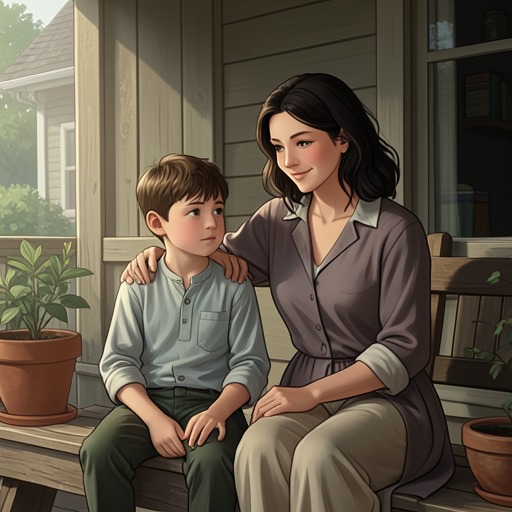
Ritsuko Sakakibara
AnotherRitsuko Sakakibara is a deceased member of the Sakakibara family whose life connects Koichi Sakakibara’s personal history to the earlier disasters surrounding Yomiyama North Middle School Third-Year Class 3. She was a student in the 1983 class, later gave birth to Koichi Sakakibara, and died in the summer of that same year. Her death, initially explained as the worsening of an illness after childbirth, is subsequently understood as one of the disasters associated with the class’s phenomenon.
Identity and Background
Ritsuko Sakakibara was a third-year middle-school student in 1983, when she belonged to Yomiyama North Middle School Third-Year Class 3. Her place in that class is confirmed through the school’s yearbook: in the group photograph, she appears fifth from the right in the second row, smiling tensely among her classmates. The photograph also includes Tatsuji Chibiki, then the class’s teacher, standing apart from the students in a pale blouson and smiling more cheerfully than the pupils.
Ritsuko was also the sister of Reiko Mikami. This family connection makes her death especially significant to Koichi Sakakibara, who is Reiko’s nephew. Although Koichi had long understood that his mother had died fifteen years earlier, the full relationship between her death and the 1983 class was initially hidden from him by the loss and distortion of memory surrounding the phenomenon.
Motherhood and Death
Ritsuko gave birth to Koichi Sakakibara at a hospital in Yomiyama. Afterward, she was not recovering well; a summer cold in July developed into something more serious, and she died. This was the ordinary family explanation Koichi had always received for her death, presenting it as a tragic medical complication following childbirth rather than as part of a supernatural pattern.
The chronology later becomes exacting: Ritsuko died in 1983, the year in which she was a third-year student at Yomiyama North Middle School and a member of Third-Year Class 3. Tatsuji Chibiki immediately recognizes the implication when the year is identified as Reiko Mikami’s class year. The coincidence is not treated as a mere possibility. Given Koichi’s position in the 1998 class and his growing knowledge of the phenomenon, he concludes that his mother’s death must have been one of the disasters produced by Third-Year Class 3.
Connection to the Class Phenomenon
Ritsuko’s history illustrates how the phenomenon reaches beyond the current classroom and into family memory. Tatsuji Chibiki explains that when the extra person, or casualty, is hidden within the class, records and memories can be tampered with so that contradictions appear normal and the casualty’s identity remains unrecognized. This mechanism helps explain why the account of Ritsuko’s death could remain stable within the family while its connection to the 1983 class was forgotten or concealed.
The class’s strategies also affect how Ritsuko’s family is treated in the present. Because Tatsuji Chibiki has no direct link to the current Third-Year Class 3, he is considered safe from the phenomenon’s effects and can interact normally with Koichi and Mei Misaki. By contrast, the class itself operates under rules that require members to suppress ordinary recognition. When the attempt to designate two students as not there fails, the class gradually stops ignoring Mei and Koichi after Mr. Kubodera’s death. These changes show the unstable, exceptional social order created by the phenomenon, an order that had also shaped the treatment of Ritsuko’s surviving relatives.
Family Memory and Disclosure
Ritsuko’s identity is recovered through material evidence as well as testimony. Koichi examines the yearbook to verify what he remembers, finds his mother in the 1973 photograph of Third-Year Class 3, and then confirms the teacher’s name as Tatsuji Chibiki. Mei Misaki reveals that the unnamed source from whom she had learned information about the phenomenon was Chibiki himself, turning the photograph into the point where Koichi’s family history and the school’s suppressed history meet.
A separate family photograph bears the handwritten date March 16, 1973, with a note identifying the people pictured as Koichi’s friends in Third-Year Class 3. The dated photograph reinforces the importance of class photographs and other preserved records as fragments through which the past can be reconstructed. Yet the evidence also remains vulnerable to the phenomenon’s interference: documents and memories may preserve details while obscuring the relationship among them.
Narrative Significance
Ritsuko never appears as an active participant in the present-day investigation, but her absence governs its emotional and historical stakes. Her death is the first disaster the story associates directly with Koichi’s own family, transforming the phenomenon from a school legend into an inheritance carried through his mother and aunt. The apparent medical explanation for her death is therefore reinterpreted as part of a larger cycle, showing how the phenomenon converts private grief into historical recurrence.
Her relationship with Reiko Mikami also exposes the cost of the class’s rules. In the present, Reiko must treat Koichi as a transfer student named Sakakibara at school while remaining his aunt at home; both maintain the separation demanded by the Fourth North Yomi fundamental. The fact that Reiko knew the truth from the beginning, as did most of the class, means that Ritsuko’s son was surrounded by people who understood his family connection while he himself lacked the necessary memory. Ritsuko’s legacy is thus not only a death but a structured silence: the loss of a mother, the concealment of a sister’s history, and the delayed recognition that the disaster affecting Koichi’s class had already entered his family once before.