Mei Misaki
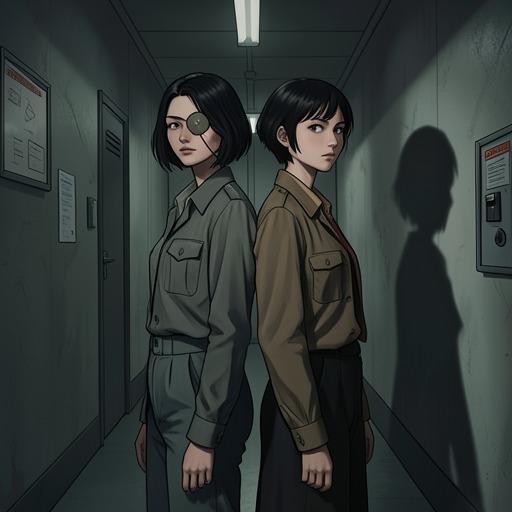
AnotherMei Misaki is the quiet, visually distinctive student whose presence becomes the testing ground for the class’s attempt to survive the Yomiyama phenomenon. Treated as if she does not exist, then abruptly restored to ordinary social reality, she remains connected to the phenomenon through her ability to perceive the color of death and through the suspicion that she might herself be the extra person. Her reserve is not passivity: it is a practiced way of moving through a world that repeatedly turns her into a label, an absence, or a threat.
Identity and Social Position
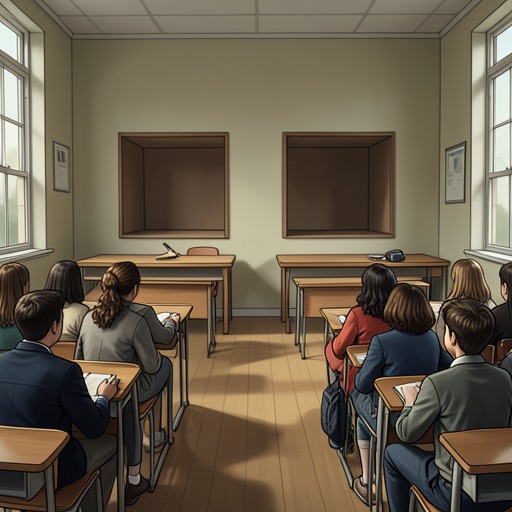
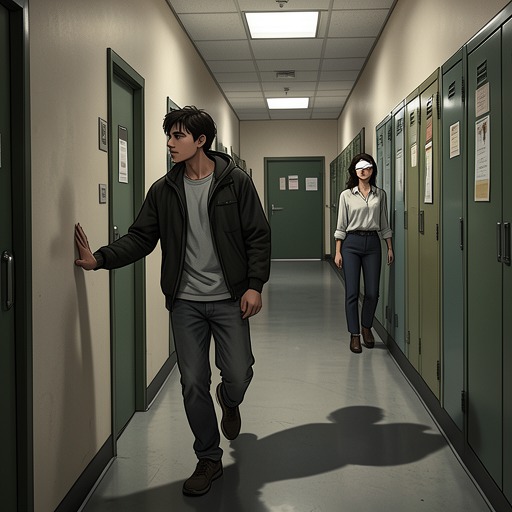
Mei’s defining condition is the “not there” strategy imposed on the third-year Class 3. Every student and teacher ignores her, while she and Koichi Sakakibara respond by treating everyone else as absent. The arrangement is deliberately reciprocal but profoundly unnatural. Mei cannot attend ordinary school life without risking the class’s fragile countermeasure; in April she appeared at the art club a few times, but once May began she could no longer go because she had become “not there.” Her exclusion is therefore not merely personal hostility. It is a collective ritual that denies her social existence in the hope of preventing further deaths.
The arrangement also alters how Mei and Koichi relate to the rest of the class. During lunch on June 18, heavy rain prevented them from eating on the roof, yet they were reluctant to remain in the classroom with everyone else. As soon as fourth period ended, they left together, and Mei suggested that they look into the art club room. Their shared absence becomes a kind of private companionship: the class erases them, but the two excluded students recognize one another.
Perception, Art, and the Uncanny Body
Mei’s connection with death is given a striking physical image through her artificial eye. Koichi remembers seeing beneath her eye patch a blue eye with an artificial spark, resembling the eyes set into dolls. The image makes her perception both an instrument and a source of unease. Her eye does not simply mark a bodily difference; it becomes the visible threshold through which the hidden condition of people and images can be detected.
That perception is confirmed when Mei examines a photograph and identifies the color of death on a student. She tells Koichi that she saw it, adding that this was the first time she had looked at something described as a paranormal photograph and sensed the color in that way. Her ability is therefore not presented as a generalized explanation of the supernatural. It arrives as a disturbing act of recognition, one that gives her access to information unavailable to those around her and places responsibility on her whenever death becomes perceptible.
Her painting of her mother extends this relation between sight and rupture. The unfinished oil portrait shows a woman dressed in black whose face is split from the top of the head through the forehead, eyebrows, nose, and mouth, opening in a V. One half carries a faint smile and the other sorrow. The image contains no blood or exposed anatomy, yet its grotesque division turns the face—the ordinary sign of identity and human presence—into a scene of separation. Mei’s art makes inward contradiction materially visible, as though affection, grief, memory, and death could occupy the same face without resolving into a single expression.
The Phenomenon and the Burden of Knowledge
Mei’s experience is inseparable from the phenomenon’s assault on records and memory. The phenomenon can corrupt class lists, official documents, diaries, notes, photographs, videotapes, and computer data, concealing the contradictions produced when the casualty is mixed in with the living. It also alters the memories of those involved. The example of Mami Asakura, who had actually died in October 1993 at the age of fourteen, demonstrates the scale of this falsification: family, friends, teachers, and even an observer had forgotten that she had ever been dead.
Against this collective unreliability, Mei’s perception has an unusual authority, but it does not make her omniscient. Her knowledge is partial, embodied, and often delayed. The blue artificial eye, the color of death, and the damaged photograph all suggest that truth reaches her through images and sensations before it can be organized into certainty. This makes her a counterforce to the phenomenon’s manufactured normality while leaving her exposed to the same uncertainty as everyone else.
The class’s response to her shows how quickly knowledge becomes stigma. After the violent death that forced the class into an empty room in another building, students stopped treating Mei as “not there.” The change was subtle because she was not naturally sociable, but it meant that teachers would once again call her name and ask her questions. Although this was the ordinary treatment she should have received from the beginning, Koichi finds it unsettling. Mei’s social restoration does not erase the violence of her prior exclusion; it reveals that inclusion and exclusion can both be imposed by the group without her consent.
Suspicion, Confrontation, and Moral Choice
Naoya Teshigawara voices the suspicion that Mei may be the extra person for the year. He points out that she is involved in the crisis while behaving as though it were someone else’s problem, then trails off before stating the accusation directly. Mei answers with a shadow of a smile and says that she does not think she is the extra person. Her response is restrained rather than defensive, preserving ambiguity without accepting the class’s demand that she define herself according to its fear.
The same pressure returns when Izumi Akazawa addresses Mei and Koichi sharply in front of the others. Mei remains calm while Akazawa turns her glare toward their table. The contrast is important: Akazawa’s accusation seeks to force Mei into a public position, whereas Mei’s composure denies the accuser the emotional reaction that would make the label seem conclusive. Her silence is not proof of innocence, but neither is it evidence of guilt. It is a refusal to let collective panic become a substitute for knowledge.
Mei’s decisive ethical position appears when she encounters the suspected extra person and refuses to act violently. Holding a pickax, she tells Koichi that they cannot do it because the target is the extra person. She can see the color of death on them, yet that perception does not translate automatically into permission to kill. The moment places her ability under moral constraint: she recognizes danger, but she rejects the idea that recognition alone authorizes murder. In a class organized around returning the casualty to death, Mei insists that the living must still answer for what they do.
Background and Narrative Significance
Mei’s history is connected to the hospital where she was born. Her mother gave birth to her there, and in that summer—July—her mother’s poor condition developed from a cold into something worse. The timing places Mei’s family history alongside the long memory of the phenomenon, while the account’s precise distance of fifteen years, or more exactly fourteen years and eleven months, emphasizes how the past remains close beneath apparently ordinary chronology.
Her relationship with authority also exposes the limits of the school’s social system. Detective Oba explains that he has a daughter in elementary school and worries that she might eventually enter North Yomi and be assigned to third-year Class 3. His concern shows that Mei’s predicament is not an isolated curiosity: the institutional failure surrounding the phenomenon threatens to reproduce itself in future classes and families. Mei stands at the point where that inherited danger becomes intimate, visible, and difficult to dismiss.
The old Building Zero supplies another image of the boundaries imposed around her world. Rope and cardboard marked “Do Not Enter” block both stairwell entrances, yet Mei, Koichi, and Teshigawara slip beneath the barrier and climb the normally unused stairs. Her participation in this trespass reflects her broader role. She is marked as forbidden and absent, but she also moves toward the places where the school’s concealed history might be found. Through her, the novel turns exclusion into a dangerous form of access: the person denied ordinary visibility becomes the one most capable of seeing what ordinary social order has hidden.