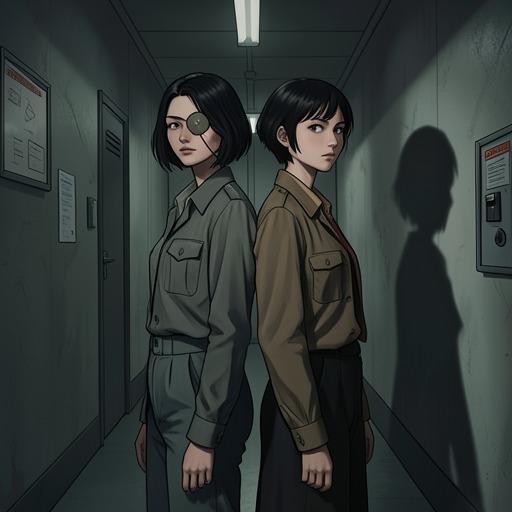
Misaki Fujioka
AnotherMisaki Fujioka is the fraternal twin sister of Mei Misaki and the first victim of the 1998 Class 3 disasters. Although she never becomes an active participant in the present-day investigation, her illness and death establish the year’s chronology, intensify Mei’s isolation, and turn an apparently private family tragedy into the opening sign of the Yomiyama phenomenon.
Family Identity and Twin Relationship
Misaki Fujioka was born into the family of Mitsuyo Fujioka, who was the first of two fraternal twin sisters to marry and have children. Mitsuyo married a young, serious office worker employed by a small food-related company, while her twin sister Yukiyo later married Kotaro Misaki, a wealthy businessman who traveled frequently. Mitsuyo’s children included Misaki and another girl: the two were themselves fraternal twins who nevertheless looked remarkably alike.
Misaki was raised by her biological parents, whereas Mei was sent to live with a foster family. The contrast gave their shared identity a painful asymmetry. Mei described the experience of sensing that her other half was nearby, while knowing that Misaki had grown up with her real mother and father and that Mei had lost an eye during childhood in foster care. Their twin bond therefore combined physical resemblance with radically different family histories and circumstances.
Illness and Death
Around the spring before the main catastrophe fully revealed itself, Misaki developed a serious kidney illness. Doctors told the family that she would require dialysis for the rest of her life unless she received a kidney transplant. She was admitted to a major hospital in Tokyo, where she received one kidney from her mother, Mitsuyo. Mei had wanted to donate a kidney herself, believing that being fraternal twins of the same size made her the more suitable donor, but the medical difficulty of transplanting an adult kidney into a child prevented that solution.
The transplant did not save Misaki. She died at the municipal hospital at the end of April, an event remembered by Koichi Sakakibara when he connected her name with his first encounter with Mei in the inpatient-ward elevator. Her death was consequently both a medical crisis within the Fujioka family and the first clearly identifiable death in the year’s supernatural pattern.
The First Victim of the Class 3 Disasters
Mei later recognized that the disasters affecting the third-year Class 3 had begun in April, as they had for earlier classes. Misaki Fujioka’s death in the hospital was therefore identified as the “death of April,” the first victim in the chain. This interpretation changed the meaning of the preceding months: the calamity had not begun with the later classroom incidents or with the school trip, but with an apparently ordinary family death that already fit the established cycle.
The timing also explains Mei’s changing position at school. She had appeared a few times in April, but once May began she could no longer attend because she had become “not there.” Koichi and Mei later explained their absence by saying that everyone would feel better if they were not present. Misaki’s death thus stands behind the social strategy that excluded Mei and Koichi, linking private grief to the class’s attempt to control the disaster through ritualized absence.
Mei’s Perception of Death
Misaki’s death is closely connected to Mei’s unusual perception of the “color of death.” Over the years, Mei had learned to associate a recurring visual sensation with the presence of death. She had sensed the same color when looking at a dead person’s face at a funeral and later at the face of a dead driver trapped in a crushed car after an accident. Misaki’s fatal illness and death provide the most intimate instance of that perception, because the sign appears within Mei’s own divided family and twin relationship rather than at an emotionally distant accident scene.
This perception makes Misaki more than a casualty in the plot. Her death is the point at which medical language, family care, and supernatural recognition overlap. The kidney disease is described through hospitals, dialysis, surgery, and transplantation, but its narrative consequence is not limited to medicine: the death becomes the mark that identifies the beginning of the class’s disasters. Misaki’s body is therefore treated simultaneously as a vulnerable human life and as evidence in a frightening pattern.
Aftermath and Narrative Significance
Misaki’s death continues to shape the surviving characters. Mei’s calmness and reserve conceal a relationship marked by loss, unequal upbringing, and the knowledge that her twin had been the other half of a divided self. Koichi’s discovery that the Misaki mentioned by Mei was Misaki Fujioka also retrospectively reinterprets his first meeting with Mei and the chronology of the year.
The event is repeatedly drawn into the class’s search for responsibility. Izumi Akazawa accuses Mei and Koichi of bearing responsibility for the disasters and demands an apology from Mei, arguing that Mei resumed acting as though nothing had happened once she stopped being “not there.” That accusation turns Misaki’s death into part of a scapegoating structure: the class seeks an individual explanation for a collective catastrophe, even though Misaki’s illness preceded the later conflicts and was not presented as an act caused by Mei or Koichi.
Misaki Fujioka’s decisive narrative function is thus paradoxical. She is absent from the present action, yet her death is the event that makes the entire year legible. As Mei’s twin, she embodies a lost counterpart; as a patient, she anchors the story in concrete bodily vulnerability; and as the “death of April,” she becomes the first unmistakable sign that the 1998 third-year Class 3 disasters have begun.