Misaki Yomiyama
AnotherMisaki Yomiyama is the deceased student whose death twenty-six years before the 1998 school year became the origin point of the calamity associated with Third-Year Class 3. Remembered as a boy popular with everyone, he became the absent presence around which the class’s history, altered records, and attempts to contain the disasters were organized.
Identity and Death
Misaki Yomiyama was a boy, and Misaki was his first name. His surname was Yomiyama, the same as the name of the town. This identification corrected a version of the story that had been obscured by rumor and incomplete recollection: the earlier Misaki was not the contemporary student being treated as absent, but a boy from Third-Year Class 3 twenty-six years earlier.
His death resulted from a house fire rather than the plane crash that had become attached to some retellings. One night in May, his house was completely destroyed, and his entire family died with him: both parents and a younger brother who was one year below him in age. The cause was never established. Authorities decided that the fire had not been a crime, although another version attributed it to a meteorite. The competing explanations show how the event accumulated folklore while its essential fact remained fixed: Misaki and his family were destroyed in a sudden fire.
The First Rupture
The death of the popular Misaki Yomiyama was followed by the class’s defining act of denial. No ill intention was assigned to the students or to the young educator who oversaw them; they had acted according to ideals they believed were right. Yet that response became the trigger through which the doors to death were said to open at the school. The following year brought the disasters, and the original classroom decision was retrospectively understood as the beginning of a continuing pattern rather than as an isolated response to grief.
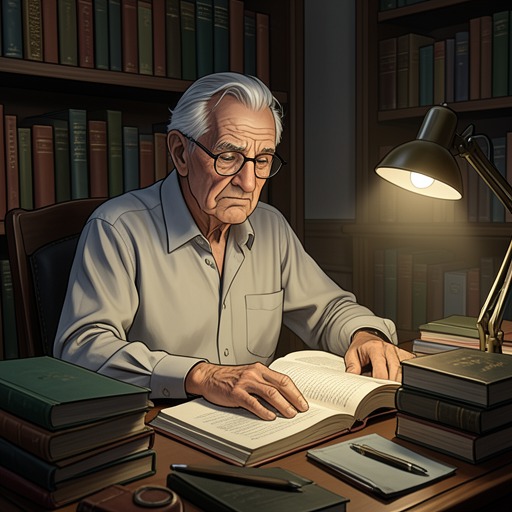
Tatsuji Chibiki regarded himself as responsible for the consequences. He believed that his own ideals as an educator had helped create the conditions for the calamity, and he also felt responsible for failing to stop the disasters that began afterward. He eventually left teaching and became the librarian, describing the change partly as an escape. He did not abandon the school altogether, however: he remained in the Secondary Library so that he could watch how events unfolded. His testimony makes Misaki’s death more than an old tragedy; it turns the event into the historical wound that continued to govern the school.
Memory, Records, and the Absent Presence
Misaki Yomiyama’s story survives through fragments, and its transmission is itself part of the mystery. Tatsuji Chibiki explained that the version involving a plane crash had spread even though the actual event was the house fire. The instability of the story’s details contrasts with the persistence of its central name, which reappears whenever the class’s history is investigated.
The class’s supernatural mechanism was described as affecting records and memories while the extra person, also called the casualty, remained hidden within the class. Details that should have been impossible could therefore appear coherent, while no one recognized the casualty’s true identity. This principle gives Misaki’s story a structural importance: the dead student is not merely recalled incorrectly, but becomes part of a system in which evidence itself can be made to support an absence.
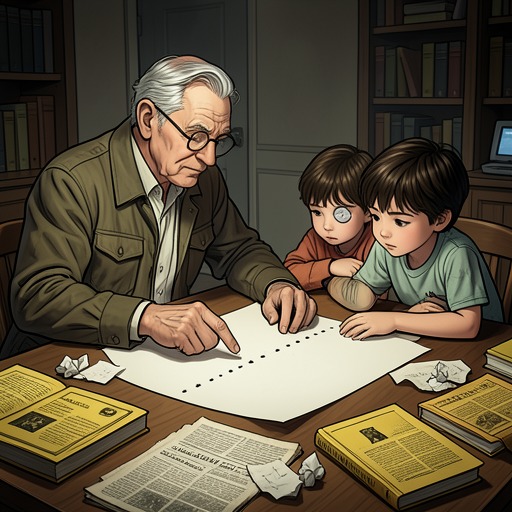
A photograph from the earlier class history became a direct point of investigation. In it, the students were gathered before a blackboard, with a younger Tatsuji Chibiki positioned in the center and fifteen-year-old Ritsuko Sakakibara standing diagonally behind him. Mei Misaki asked Koichi Sakakibara whether he could identify Misaki Yomiyama in the photograph. The question connected the old student’s identity to the visual record that the contemporary investigators were trying to read, making the photograph an apparently stable object within a history otherwise vulnerable to alteration.
Influence on the 1998 Class
The legacy of Misaki Yomiyama shaped the treatment of the contemporary Mei Misaki and Koichi Sakakibara. Tatsuji Chibiki said that people with no direct link to Third-Year Class 3 were comparatively safe, because ordinary interaction with the class should not affect them. That explanation accounted for why Mei could repeatedly visit the Secondary Library and obtain information from him. It also placed the librarian outside the class’s immediate danger while leaving him close enough to observe its operation.
When the class attempted to increase the number of students treated as not there from one to two, the tactic failed to produce any benefit. After Mr. Kubodera’s death, the students gradually stopped ignoring Mei and Koichi. Their changed behavior was not presented as the result of a formal decision; it emerged as an invisible transformation in the class’s conduct. Naoya Teshigawara, for example, began acting as though Mei really existed and addressed remarks to her during lunch. The reversal exposed the fragility of the social rules built to contain the calamity: the class could exclude a living student by collective agreement, but the death associated with the original Misaki continued to dictate the limits and failures of that agreement.
Responsibility and Narrative Significance
During the confrontation before the class trip, Izumi Akazawa attributed responsibility to Mei and Koichi for the unfortunate events that had occurred since May, including Mr. Kubodera’s death. She demanded an apology from Mei, arguing that Mei had behaved as though nothing had happened after ceasing to be treated as not there. The accusation transformed the class’s fear into a public assignment of blame, even though Misaki Yomiyama’s original death had itself begun with no stated criminal intention and no known cause.
Misaki’s legacy also helped produce later misidentification. Naoya Teshigawara became convinced that Tomohiko Kazami was the extra person because Kazami could no longer remember shared childhood experiences. Teshigawara said that he had questioned Kazami about their childhood hiding place by the river and a failed bicycle trip toward the ocean, only to hear that neither memory was familiar; he then confessed that he had killed Kazami. The episode demonstrates how the calamity’s logic turns damaged memory into apparent proof and suspicion into violence.
At the final crisis, Koichi was forced to take up the pickax taken from Mei and acknowledge that it might inflict deadly wounds. His decision was framed as necessary to end the disaster, linking the original death of Misaki Yomiyama to the later demand that the dead or extra person be returned to death. Misaki therefore remains decisive even without appearing as an active participant: his name marks the first loss, his death supplies the pattern by which later events are interpreted, and his continuing place in altered memory makes the past an active force in the present.