Yukiyo Amane
AnotherYukiyo Amane, known within the family as Kirika and identified as Mei Misaki’s mother, is the absent but formative presence behind Mei Misaki’s most intimate history. Her stillbirth, subsequent grief, and inability to have another child led her to regard Mei as a substitute for the daughter she had lost. That substitution does not erase her love: she and her husband cherished Mei and cared for her intensely after the loss of Mei’s left eye, even making her a special glass eye. Yet Yukiyo’s attachment is inseparable from the wound that produced it, leaving Mei to understand herself as both a beloved daughter and a replacement for someone who never lived.
Family Identity and Hidden History
Yukiyo is the biological sister of Mitsuyo, Misaki Fujioka’s mother. The sisters were born to the Amane family, were fraternal twins, and were the same age. Mitsuyo became pregnant first; Yukiyo became pregnant a year later, but complications resulted in her baby being stillborn. The loss had a permanent medical consequence: Yukiyo learned that she would not be able to have any more children. Her grief became so severe that Mei later described her as having been driven almost to madness.
The family concealed this history for years. Mei learned the truth while she was in the fifth year of elementary school, after her grandmother accidentally let something slip and then explained what had happened. Yukiyo had apparently intended to keep the matter hidden from Mei for her entire life, and the disclosure caused her to completely lose control. The delayed revelation therefore changes Mei’s understanding of her own name, place, and childhood: what had seemed to be an ordinary mother-daughter relationship was also organized around a death that preceded Mei’s birth.
Mei as Replacement and Daughter
After the stillbirth, Mei became, in Yukiyo’s emotional life, a substitute for the child she had been unable to raise. Mei understood herself as a replacement for Yukiyo’s stillborn daughter, and she believed that the same was true, to some extent, of her father. This does not make the parents’ care insincere. On the contrary, Mei felt that they cherished her more than most parents might cherish a child, precisely because she occupied such an emotionally charged place in the family.
The contradiction is essential to Yukiyo’s characterization. Mei is not merely rejected or instrumentalized; she is loved, protected, and treated as precious. But love remains entangled with substitution. Mei’s statement that a replacement is still a replacement captures the danger of Yukiyo’s attachment: at some point, Yukiyo began to see in Mei the child she should have had. Mei’s identity was thus asked to carry two incompatible meanings at once, as a living daughter in her own right and as the visible continuation of a dead child’s place.
Care, Disability, and the Glass Eye
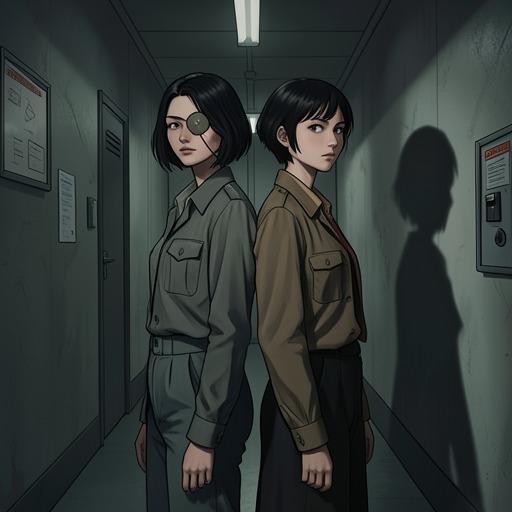
Yukiyo’s relationship with Mei is also expressed through practical care for Mei’s disability. Mei lost the sight in her left eye after surgery at about four years of age and could not perceive even a flicker of light through it. The condition had been present for as long as she could remember. In response, Yukiyo made a special artificial eye for her daughter, known as the doll’s eye.
The eye is both an object of care and a material sign of the family’s complicated emotional structure. It represents Yukiyo’s determination to give Mei something that would allow her to face the world with a visible, human appearance, yet it cannot restore sight or undo the original loss. Mei’s physical difference remains a lived condition rather than a problem solved by the prosthesis. The artificial eye instead makes the divide between appearance and perception tangible: it fills the empty socket, while Mei’s left eye remains unable to see ordinary light and later becomes associated with her ability to sense the color of death.
Loss, Illness, and Maternal Consequences
Yukiyo’s history is connected to a wider chain of family illness and bereavement. Mei’s account places the stillbirth before the later illness of Misaki Fujioka, Yukiyo’s niece and Mei’s fraternal cousin. When Misaki developed a serious kidney disease, she faced lifelong dialysis unless she received a transplant. Mitsuyo donated one of her kidneys, and Misaki was admitted to a major hospital in Tokyo for the operation. Mei wanted to donate her own kidney, reasoning that, as fraternal twins of the same age and size, she and Misaki might have been the best match, but doctors explained that transplanting an adult’s kidney into a child was difficult because of the difference in size.
This medical crisis further complicates Yukiyo’s place in the family. Mitsuyo could directly save her daughter through organ donation, while Yukiyo’s own motherhood had been shaped by a child she could not save and could never replace without contradiction. The contrast between the two sisters’ maternal experiences sharpens the emotional background to Mei’s sense of being a substitute. It also shows how the family’s bonds are repeatedly expressed through bodies, organs, illness, and acts of care rather than through uncomplicated family roles.
Narrative Significance
Yukiyo remains largely outside the present action, but the story’s revelations about her reorganize the meaning of Mei Misaki’s life. Her identity as Mei’s mother is initially obscured by the family’s concealments and by the contradiction between Mei’s claim that she has no sisters and the existence of Kirika’s lost child. Later, Mei identifies the dead girl as the child her mother bore thirteen years earlier, exposing the relationship between Yukiyo’s grief and Mei’s own position in the family.
Through Yukiyo, motherhood becomes a structure of memory as much as a biological relationship. Her grief produces concealment; concealment produces uncertainty; and that uncertainty leaves Mei to assemble her identity from partial disclosures. Yukiyo’s care is therefore neither reduced to cruelty nor purified into unconditional devotion. It is a form of love marked by mourning, in which the living child is cherished while also being made to stand beside the absent one. That unresolved doubleness is what makes Yukiyo decisive to the emotional and thematic architecture of Mei Misaki’s story.