New France
BarkskinsNew France is both the setting of René Sel and Charles Duquet’s arrival and the contested forest frontier that shapes the novel’s long history of trade, settlement, and extraction. Its apparent abundance invites schemes of permanent wealth, but its forests are never merely empty resources: they are Indigenous country, a changing ecological world, and the source of costs borne by people and landscapes far from the markets that profit from them.
Arrival and Settlement
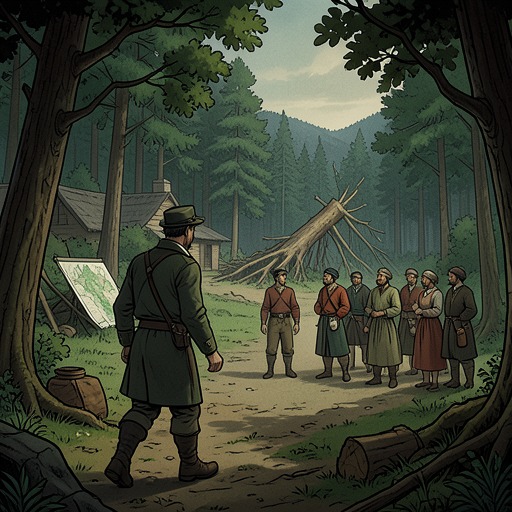
René Sel and Charles Duquet reach a remote riverbank settlement after passing Tadoussac, Kébec, and Trois-Rivières. Their first impressions are of rain, mud, biting mosquitoes, and the odor of willows; the next is a dark, vast forest that seems inimical to human settlement. The newcomers wait in the rain to make their marks in a ledger while local farmers watch from beneath a spruce shelter. René writes the letter R, the only letter he learned from a priest who died before teaching him the rest of his name. The scene makes the colony a place of both beginnings and limits: René’s first mark records his presence, but the surrounding wilderness and the precarious conditions of settlement immediately dwarf that act.
The cleared land is not simply converted into orderly farms. Trees are cut, stacked to dry, and burned; smoke becomes a constant feature of the air. Oxen churn the ground, while the loss of tree cover exposes the earth to harsh sunlight and causes mosses and ferns to wither. Against this material transformation, New France’s forest appears abundant enough to be treated as inexhaustible. The novel instead presents clearing as a process with visible ecological consequences, even as settlers and merchants regard the land chiefly through the possibilities it offers them.
Indigenous Homeland and Imperial Contest
The French presence in New France rests on a claim to territory that Indigenous characters contest directly. When Theotiste learns that the French king has given their lands to the British, she rejects the premise: the land, she insists, is not the French king’s to give. The exchange exposes the gap between imperial treaties and Indigenous understandings of possession. The novel sets the administrative language of transferred territory against the claim of people who already belong to and live on that land.
Père Crème similarly objects when a French official treats Indigenous people as instruments of military policy. He argues that the Mi’kmaq suffer as France takes their country and disrupts their families and lives through trade and forceful customs. His appeal gives voice to a conflict embedded in the colony’s strategic ambitions: France values the territory for its military position and access to the sea, while the people already living there seek to continue their own lives. His intervention does not alter the power imbalance, but it makes the human consequences of imperial expansion explicit.
Sosep describes how that expansion changes daily life as well as political ownership. Settlers’ livestock damage food sources, while their boats and nets take fish and introduced plants displace local ones. He recognizes that many newcomers may not intend harm, yet their growing numbers make the effects cumulative: the Mi’kmaq are few, and the newcomers are many. His warning that the people must keep their own world alive in their minds does not call for a simple return to an untouched past. It names the effort required to sustain Mi’kmaw ways while living in two worlds under the pressure of encroachment.
Forest Wealth and Commercial Ambition
The colony’s forests become central to Duquet’s search for lasting wealth. After seeing the fur trade fluctuate between surplus and scarcity, he rejects reliance on animals and other commodities that might disappear or lose their market. He turns instead to the forest, which he believes can supply ships, houses, and fuel indefinitely. His plan is to profit from furs for a few more years, then redirect his business toward timber. The confidence of that calculation depends on treating the forest as permanent, a belief the novel places under pressure through its accounts of clearing and ecological change.
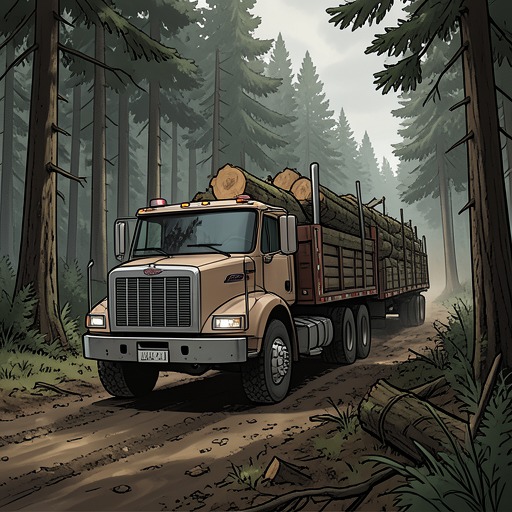
New France’s forest economy is shaped by distance and transport. Duquet sees the colony’s frozen river ports as a disadvantage beside the ice-free harbors of the English colonies, and he spends time in Boston cultivating relationships that may help him acquire old land claims and township grants. His commercial ambitions connect local land ownership to political influence, shipping routes, and distant markets. In the colony itself, he turns low-quality hardwood and limbs into firewood, sending twenty wagonloads each autumn toward Kébec and, when shipping permits, Paris. He also needs ships of his own, but the lack of a suitable shipyard in New France pushes him to consider yards elsewhere.
The timber business grows through cross-border arrangements. Duquet works with English and Scottish interests despite the danger and expense of doing business across political lines. New France’s hardwood forests are cut to supply a shipbuilding trade that reaches the Clyde in Scotland; one seventy-four-gun warship, the narrative notes, required fifty acres of oak. The scale of that example makes the commercial chain legible: forest becomes ship timber, and timber moves toward a distant yard where it is converted into vessels. The profit and the cutting happen in different places, as do the benefits and the ecological consequences.
The novel follows that commodity logic beyond the colony. In New Zealand, logging stations combine camps and trading posts, while warehouses, sawmills, and small shipyards draw European businesses to harbors with useful timber. Once a tract is stripped, operations move on, leaving waste and burned forest behind. The newcomers treat the forest as available for their use, a repetition of the extractive assumptions first attached to New France. Later, when Duke & Breitsprecher sends its best pine to Sydney and considers a supply contract, the firm’s search for timber shows how far the original frontier logic has traveled.
Memory, Inheritance, and Narrative Scale
New France remains important even after the narrative moves elsewhere because later generations inherit the consequences of its settlement and commercial decisions. In Boston, James Duke meets relatives who remark on his resemblance to Sedley, linking him physically to a family past. The episode contrasts that intimate inheritance with the expanding timber business: family identity travels through resemblance and succession, while forests travel as commodities through contracts, ships, and markets.
The novel also enlarges the meaning of settlement through the history of Mi’kmaw communities and their descendants. Much later, after the Halifax Explosion destroys the Mi’kmaw village at Tufts Cove, Lobert takes his family inland to Shubenacadie. There he works for a timber company for pay in logs and builds a three-room house. His family’s move is shaped by the continuing loss of secure land and by the need to earn a living within the industry that has transformed the forests. His son Egga is sent to residential school in the hope of gaining an education and better work, but the school instead subjects Mi’kmaw children and their culture and language to sustained destruction. The novel thus connects the colonial settlement represented by New France to later displacement and assimilation, without treating either as a closed historical episode.
New France’s significance lies in the tension between its promise and its cost. To merchants, the forest appears to be a vast, renewable foundation for wealth; to the Mi’kmaq, it is part of a lived homeland whose plants, animals, people, and practices belong in relation to one another. The narrative’s movement from a rainy riverbank settlement to distant timber markets reveals how a local landscape becomes the starting point for expansive commercial networks. Yet each extension of that network also deepens the conflict over who has the authority to claim the land, who benefits from its transformation, and who must endure what is left behind.