Michigan Territory
BarkskinsMichigan Territory is the setting of a decisive turn in the novel’s timber history: James Duke and Lennart Vogel find immense white-pine forests there, and Duke & Sons moves from debating the future of its New England operations to acquiring land on a transformative scale. The discovery promises generations of wealth, but its language of inexhaustible abundance belongs to the same extractive logic that elsewhere strips forests and leaves waste behind.
A New Forest Frontier
The prospect of Michigan Territory emerges as James and Lennart confront the limits of familiar timber country. James recognizes that buying land or stumpage in New England and New York State without knowing where replacement timber will come from could eventually undo the company. Nearby forests are not eternal, he admits: trees grow too slowly, competitors are increasing, and earlier opportunities have been lost when company leaders chose to wait. Lennart argues that the business must seek new forests before rivals do, and points to reports of numerous white pines in Michigan Territory.
The proposed journey is both a business expedition and a challenge to the company’s caution. James and Lennart are willing to go north and west to inspect the trees directly, rather than rely on accounts from people who may know the routes but not the forests. Lennart’s interest in still more distant timberlands shows that Michigan is part of a widening search, not an isolated destination. For James, however, its importance becomes concrete as soon as the party encounters the forest itself.
The White-Pine Discovery
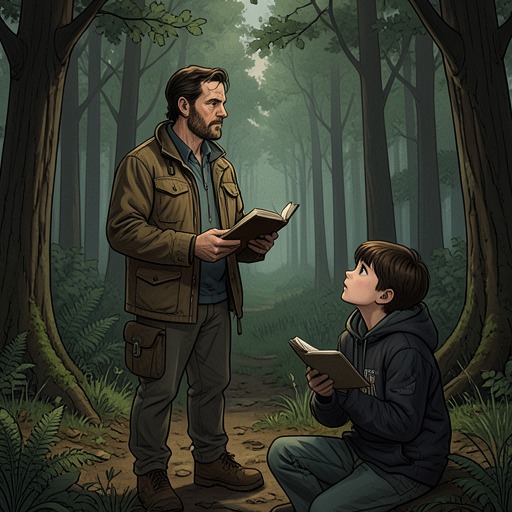
The route leads through the Shiawassee and toward the Saginaw Trail, where the explorers find a dense stand of huge white pines. The trees are described as four or five feet in diameter, with high, tiered branches and prized fine-grained wood; their position near waterways makes the timber appear especially accessible for transport. The scale of the stand transforms speculation into a commercial prospect. James walks, looks, measures, computes, and marks the forest, treating it as both landscape and inventory.
The party continues through mile after mile of large, straight pines and reaches a great bay on Lake Huron’s shore without seeing an end to them. Lennart immediately turns discovery into a sequence of business decisions: acquire as much forest as possible, establish a headquarters, report back to the company’s board, and continue surveying and grading the land. He anticipates that preparations will take at least a year, perhaps two, before cutting can begin. Albany might serve as a shipping point because of the canal terminus, while the land office and the company’s markets must be brought into the plan. James answers with the scale of the labor force he believes the forest can absorb, imagining a thousand men at work.
Land Acquisition and Company Strategy
The search quickly becomes ownership. James returns west and, in Detroit, works with a clerk at the government land office. Within three days Duke & Sons owns all the timberlands surveyed on the expedition: a hundred thousand acres. The company also buys three city lots and hires carpenters to begin an office building and three houses. James returns to Boston to await the land-patent certificates, while Armenius Breitsprecher remains in Michigan Territory to survey and mark additional sections and townships.
The purchase exposes a difference in business judgment. Lennart proposes buying townships without inspecting every acre, confident that the trees are there; Edward and Freegrace fear that such a gamble could leave the company with swamp, cliffs, sinkholes, grassland, or poor trees. The disagreement concerns more than risk. Michigan’s forests encourage the company to think at a new scale, in large blocks of land and long periods of preparation, while the prospect of credit and rapid acquisition tests how far its established methods can stretch.
Timber, Technology, and Networks
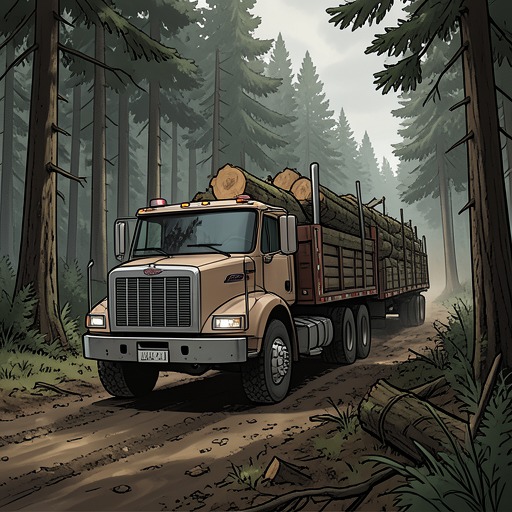
The value of Michigan’s pines depends not only on their size but on whether the company can move and process them. The novel repeatedly links timber profits to transportation costs. Lennart sees steamboats as a possible means of changing log movement; Edward imagines railways reaching dryland pineries where rivers cannot carry the harvest. The company’s existing reliance on rivers makes Michigan’s lakes and waterways a commercial advantage, but also reveals how infrastructure determines which forests can be exploited and at what cost.
Processing capacity creates another constraint. At a Michigan mill, James explains that the existing gang rig can produce only about three thousand board feet a day, while the shanty boys fell trees faster than the mill can handle them. Circular saws are on order, and he considers adding turbines, portable mills near cutting sites, and finishing operations for smoothing planks or making shaped components. Each proposed improvement could increase output or reduce the need to move unprocessed logs, but the mill remains a bottleneck between the forest and the market.
That chain extends beyond Michigan. Duke & Breitsprecher later sends its first shipload of best pine to Sydney, Australia, and entertains a decade-long supply contract. The prospective buyer also raises the possibility of partnering in New Zealand, where kauri timber might offer another source. Across these episodes, the forest becomes valuable through linked stages—land acquisition, survey, felling, river or other transport, milling, and overseas sale. Michigan’s discovery is thus a hinge in a larger commercial geography rather than a self-contained episode.
Extraction and the Meaning of Abundance
The novel sets the company’s confidence in abundant timber against the effects of extraction elsewhere. In northern New Zealand, separate logging camps and trading posts draw in warehouses, sawmills, shipyards, and European settlers. Operators move from one profitable stand to another, leaving smoldering stumps and deep accumulations of waste; repeated cutting and burning consume forest habitat as well as saleable wood. The claim that the forest exists for commercial use turns unfamiliar country into a resource without requiring its newcomers to understand it.
Michigan’s white pines initially appear to answer the problem of depleted forests: there is so much timber that the explorers imagine it could sustain work for centuries. Yet James has already acknowledged that nearby forests are finite, and the larger history makes clear that apparent abundance can invite the very speed and scale that destroy it. Later, Conrad Breitsprecher’s forestry study confronts the poor regeneration of logged sites and the need to plant seedlings among the stumps, prepare the ground, and persuade timber companies to think in decades and centuries. Read against that later concern, Michigan Territory’s discovery is both an extraordinary opportunity and an early expression of the novel’s recurring tension between forest as living system and forest as an apparently limitless commodity.