Akademia
BarkskinsAcadia is a contested homeland whose changing landscape exposes the distance between imperial claims of ownership and Mi’kmaw relationships to land. Across the novel, marshes become fields, woods become timber and farms, and political rulers transfer territory on paper; against those transformations, Mi’kmaw characters maintain that their country is theirs to inhabit, not a possession for France to give to Britain.
A homeland claimed by competing powers
In the colonial governor’s account, Acadia is strategically vital: English pressure comes from the north, the sea, and the Ohio valley, while the coast fishery is being ravaged by English and Boston vessels. France’s proposed answer is to retake the region and build Louisbourg as a gateway to its North American possessions. In this imperial framework, land matters as territory, fortification, and access to the sea. The governor also expects the Mi’kmaq to fight for France, treating their military service as an obligation even as their population has fallen to only a few hundred warriors.
Père Crème challenges the assumptions beneath that demand. He tells the governor that the Mi’kmaq suffer, love the country being taken from them, and care for children whose lives are being altered by colonial goods and forceful customs. Their view of the territory is not an argument for one European sovereign over another: it is a claim to a homeland where generations have lived. The governor answers with suspicion about the missionary’s loyalty to France, turning an appeal for the people of Acadia into a test of imperial allegiance.
The conflict becomes explicit when Sosep tells Theotiste that the French king has given their lands to the British. Theotiste rejects the premise: the king cannot give away land that is not his. Her response distinguishes a diplomatic transfer between empires from the Mi’kmaw understanding of continuing presence and belonging. Acadia’s political history, as the novel presents it, therefore cannot be reduced to a succession of European titles.
Settlement and the remade landscape
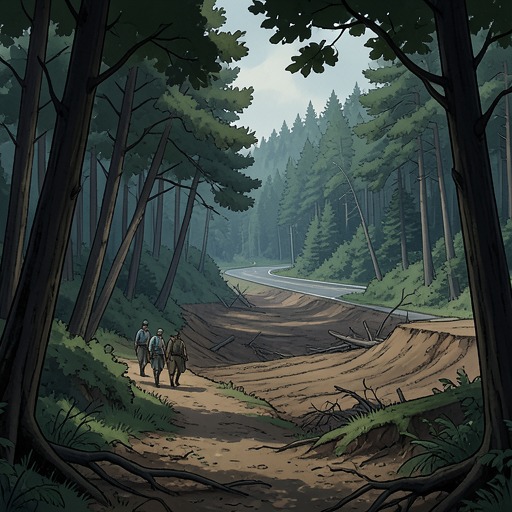
The settlers’ transformation of Acadia is visible in the physical rearrangement of its environments. French families live along the shore; fields of maize and turnips replace woodland, and salt marshes are drained to produce hay for livestock. Moose, caribou, and bears retreat, while beavers are greatly reduced by trapping. Their pelts have become a form of white-man money, displacing the older practice of placing a beaver skin on a grave. The landscape changes not only in appearance but in the relationships and customs that once made its resources part of Mi’kmaw life.
The settlement process accelerates through a colonial appetite for surplus. Settlers drain marshes, fell forests, and exchange clams, berries, fish, logs, hay, and moose hides for more cows, horses, chickens, and pigs. Their agricultural practices are organized around producing and accumulating more. Mi’kmaq people may tolerate or befriend their Acadian neighbors, but the growth of settlement steadily reduces the room in which older patterns of use and movement can continue.
The pressure is not confined to land clearing. Pigs forage in the woods and learn to dig clams, competing with Mi’kmaw women for food; one hog attacks and kills a toddler who has followed the clam diggers. Sosep describes settlers’ animals damaging food supplies, boats and nets taking fish, and introduced plants overcoming local ones. Few settlers may intend to harm their neighbors, he says, but their numbers make their collective impact feel like a great wave. His warning gives demographic imbalance a material form: encroachment arrives through everyday practices as well as official decisions.
Mi’kmaw continuity amid dispossession
Sosep’s response to this pressure is not simply a call to abandon new ways. He tells his listeners that survival requires holding Mi’kmaw ways in mind and living in two worlds. In the Mi’kmaw world he describes, plants, animals, birds, and people are persons who help one another. Keeping that vision renewed is necessary, he says, so it can stand against the outside force advancing on their lives. The teaching makes cultural continuity an active practice under changing conditions, rather than a retreat to an untouched past.
The narrative also shows how communities adapt without dissolving into a single identity. Mi’kmaq people marry some Acadians, teach them their language and beliefs, and take up aspects of their neighbors’ ways. Père Crème senses that a new kind of people, part Mi’kmaq and part Acadian, may be emerging. Yet this exchange takes place alongside resentment of settler incursions and the experience of an interior Mi’kmaw life at odds with an external world increasingly shaped by colonial power. Cultural contact is therefore neither simple assimilation nor an equal meeting.
That unequal setting persists as English settlement expands. The English king encourages former soldiers and sailors and colonial New Englanders to take free land in Nova Scotia, and thousands arrive. Acadian farmers themselves resent being urged by the priest to take up arms against the English, while Mi’kmaw people face land loss, illness, and violence. The novel places these different pressures in the same contested region without treating them as interchangeable: imperial rivalry, settler expansion, and Indigenous dispossession intersect but impose distinct burdens.
Territory, law, and the meaning of ownership
The novel repeatedly contrasts Indigenous claims with European systems that convert land into divisible, transferable property. In New France, settlers are assigned strips running from river to forest, a form of distribution defended as equitable because it joins fertile soil, high ground, and timber within each holding. That arrangement treats forest as a useful component of a parcel and clearing as a means of making land productive. It stands against a territorial understanding grounded in long use, collective life, and the relationships among people and other beings.
A later property dispute makes the legal conflict personal. Démon Meillard claims that René Sel’s notarized title and bequest to Renardette establish her ownership of the property. He dismisses the Mi’kmaw descendants who say they are René’s children as people whose parentage cannot be trusted, then insists the sale can be made binding by recording it in Captain Bouchard’s ledger. The family points to the record that René married Mari under white law and asks whether the ledger itself supports their claim. In this encounter, documentation can recognize a relationship while also being wielded to deny the descendants’ standing; the dispute reveals how colonial legality may selectively validate Indigenous people when doing so serves a settler transaction.
A related case concerning Maine mast pines shows the broader reach of these competing titles. A Crown license authorized cutting on land that had belonged to the Crown in 1691, but ownership had since passed to John Frost. William Leighton cut the trees for the license-holder, and Frost sued him for trespass; the court found for Frost. The case turns on the question of which dated claim governs the land. Read beside Acadia’s Indigenous claims, it reveals a legal order prepared to adjudicate rival settler and Crown titles while the Mi’kmaw assertion that the land was theirs confronts the deeper problem of recognition.
Acadia’s changing historical horizon
The Acadia of the novel is never merely scenery. It is the setting where imperial strategy, settlement, and ecological change meet, and where the meanings of country, property, and survival diverge. The same woods can appear to settlers as timber, fuel, farmland, and an instrument of prosperity, while for Mi’kmaw people they belong within a living world of food, memory, mobility, and reciprocal relations.
The long consequences of this transformation reach beyond the earlier colonial conflicts. Much later, the 1917 Halifax Explosion and its tsunami destroy the Mi’kmaw village at Tufts Cove. Lobert Sel, grieving the loss of his brother Jim and four of Jim’s children, moves his family inland to Shubenacadie. The later catastrophe does not erase the earlier history of dispossession; it extends the novel’s account of Mi’kmaw vulnerability into a new era, where relocation and institutional pressure continue to shape life in the region. Acadia’s significance lies in this accumulated history: a homeland repeatedly redescribed by governments and markets, yet never made conceptually or morally equivalent to the property they claim to transfer.